Showing posts with label Chestnut-collared Longspur. Show all posts

Monday, February 12, 2018

The Best Birding


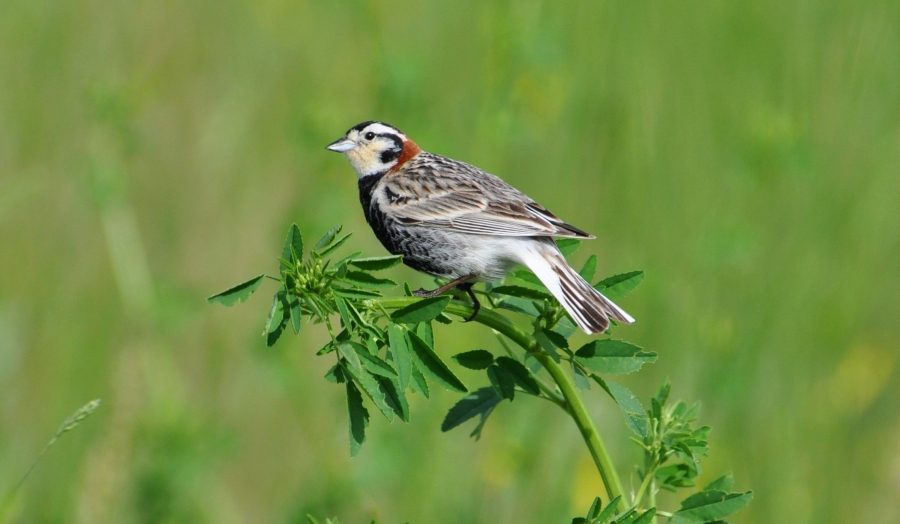
Prairie birds have left a lasting, indelible mark on my soul. It didn't make the list today, but I highly recommend birding the prairies and wetlands of eastern Montana and western North Dakota during the warm months. This friendly Chestnut-collared Longspur was at Medicine Lake National Wildlife Refuge, Montana.

Great birding. Don't you love it? Is that question even necessary? I would argue that with all the different ways birders get their kicks now, it is. Now I'm not talking about watching a Black-backed Oriole of dubious origins at a Pennsylvania bird feeder, or driving 7 hours to chase a Northern Parula because it is in a county you have not seen one in before, or the time you had to elbow your way through a crowd of crazed photographers to see your first Snowy Owl...I'm talking about actual great birding. Birding that sticks with you for a lifetime, and the birding that will surface in your mind while you lie on your deathbed, if only for an instant. While some perpetually chase the rarity dragon (or the bizarre County Bird Dragon) without reprieve, others have seen the light and set aside time and resources in search of great birding. Truly great birding often means travel to faraway places and getting drenched in bucketloads of lifers, but not always! Just because familiarity breeds contempt doesn't mean some of the most monumental birding you've ever experienced could not have happened in your own state, or (if you are really lucky) your own county.

Every now and then I get asked about the best places I've birded, and that question is blog fodder without doubt. I've finally given it enough consideration, and so this post is birthed into the Birdosphere. Below, in no particular order, are the places where I've had the best birding experiences. I won't claim they are actually the best places in the world to bird or anything, but these are the places where I've had my greatest successes. It's a bit heavy on California (what do you expect?) and a bit light on Ecuador (never been there), but I had a lot of fun putting this list together. Lots of memories of good times, some bad, but without exception, fantastic birding.

El Cielo Biosphere Preserve (and environs), Mexico - Just like Justyn ("JUH-STEEN") did before me, I had my first taste of tropical birding at El Cielo Biosphere Preserve and surrounding areas in the state of Tamaulipas. The quality of the birding there was unlike anything I'd ever encountered north of the border...Singing Quail, Blue-crowned (now Blue-capped) Motmots, Blue Mockingbirds, Crimson-collared and Hooded Grosbeaks, tanagers galore, Crescent-chested and Fan-tailed Warblers, rampaging mixed flocks the size of Rhode Island, etc. Oh yeah, and this is all less than a day's drive from Texas! That's right, you can wake up in the United States, drive for a while, and be looking at Bat Falcons and Squirrel Cuckoos before the sun begins to set...for you birders wholly focused on the ABA Area, the birds of the Lower Rio Grande Valley are just the tip of the avian iceburg, if you know what I'm saying. Anyways, at some point while we were there I think my face completely melted off my head and dripped into the leaf litter; fragments were carried off into the underbrush by enterprising Spot-breasted Wrens and Gray-breasted Wood-Wrens. Birding there really messed with my priorities in life, and things have never been the same.

The ongoing war with the cartels in Tamaulipas is a huge bummer on many levels...birders essentially no longer having access to the entire state (for safety reasons) is a minor one compared to people dying and families being torn apart, but since we are birders it still sucks. I believe there are currently three cartels in the state currently warring with one another, not to mention warring with the Mexican government. I have no photos from here because one of the cartels relieved me of my camera later in the trip (not near the preserve). I'd absolutely love to come back to this place someday though, if and when things ever settle down.


Red-footed Boobies cuddle at their nest in a Naupaka bush on Eastern Island at Midway Atoll. How can you describe such faces? I suggest that they are "dreamy".

Midway Atoll -  I've blogged extensively about Midway here, so I'll keep this short and sweet. Being among the seabirds at Midway is amazing, and that is not hyperbole. The other birds there ain't bad either (i.e. Laysan Ducks, piles of Pacific Golden-Plovers, Bristle-thighed Curlews). The birding here is quality over quantity for sure - you will never rack up a huge species list, but your experiences with the birds that are here will stay with you forever. Nothing I can say really does it justice. I do hope I can go back someday, but in case I don't at least I won't miss the horrible centipedes. I hate them.

Braulio Carillo National Park (Quebrada Gonzales), Costa Rica - On my lone trip to Costa Rica (seems like it's time for another) I was able to cover a large part of the country, lifering constantly and finding great birding more days than not. With that said, the birding at this particular site really stands out in my mind still. Some of the best mixed flocks I've seen in my life have been here - they were nothing short of spectacular. I'm not even going to tell you what we saw, it won't come close to capturing the size and diversity of the flocks here. I didn't even bother trying to take photos of birds here - that's right, the birding was too good to even bother with photography. If you are going to find yourself birding the Sarapiqui region at any point, DO NOT miss this site.

Also, we totally dipped on Snowcap and Black-crested Coquette at a reliable site just down the road from there, and I'm still pretty torn up about it. Redemption and vindication on this front are much desired.


Almost everyone who has seen Buller's Shearwater well has become enamored with them, and I am no different. Can't wait to see more of these squid-fiends this year. Photographed somewhere west of Half Moon Bay.

Pelagic Trips out of Half Moon Bay, California - I've done more of these than I can remember, and some of them were pretty poor, but there have been so many good ones! We have had some truly great days out there. The seabird diversity can be fantastic, and it is one of the best places in the country to see large numbers of storm-petrels, which includes four regularly-occurring species. I've seen five murrelet species on those trips, and had the honor to be out on the water the day of the Salvin's Albatross. Looking forward to getting back out there.


Blackburnian Warbler is a big deal to a lot of people. This is totally justified. Photographed at the community center on South Padre Island.

South Padre Island, Texas - I've harped on this a lot over the years, but I cannot emphasize enough how different migration is in the western U.S. than it is in the east. There is a reason that California birders are like "oh spring will be here soon, I guess that's cool, some year birds are coming, Lazuli Buntings are pretty" and eastern birders are like "FUCK YES SPRING YES YES YES YES PLUNGE THE WARBLER SYRINGE INTO MY CHEST". Hell, the last BB&B post (RETURN OF THE GERI) was all about birding the Texas coast. Anyways, this is a great migrant trap and I got really addicted to birding there during spring migration, but it's all done in a pretty strange setting.


Yellow-throated Warbler was one of many migrants that had a layover at Garden Key in Dry Tortugas National Park. I can see why everyone goes in spring, but I was pleasantly surprised at the diversity of species recorded on a multi-day October trip.

Dry Tortugas National Park, Florida - I was there in October for several days (we camped)...a great time was had by all, and though some days were better than others, the birding was generally very satisfying. No one really birds it in fall, so I didn't know what to expect, but I left with a full heart and a sizable island list. Talk about a scenic migrant trap, goddamn! What a fun place to bird. Some of the newly arrived migrants were really tame, such as the Black-throated Blue Warbler that landed on our picnic table and the Ovenbird that foraged beneath it. There weren't even any Sooty Terns or noddies around (we were too late in the season) and the drip wasn't even running (I overheard some poorly uninformed woman who worked there claim it would prevent birds from migrating south for the winter...astounding), and it was still pretty sick. Need to go back in spring.


A Black Skimmer pulls up after slicing through the waters of Sonny Bono National Wildlife Refuge (Wister Unit) at the Salton Sea.

The Salton Sea, California - The Salton Sea has a special place in the hearts of many. There is nowhere else like it, especially when you consider the human aspects, landscape, habitats, smells and birds as a whole. Birding the sea used to be, well, phenomenal. The sheer numbers of birds was staggering. It's still pretty good, but water levels have declined greatly over the last 20 years and a lot of formerly great spots are high and dry, and the salt and the pollution in what's left is even more concentrated; it's been some years since I birded it but those seemingly unending flocks of birds that used to be such a constant are getting harder and harder to come by. Sadly, Fulvous Whistling-Ducks have disappeared entirely and no Wood Storks have been seen since 2015. Yellow-footed Gulls continue to be dependable at least. The future of the sea is completely uncertain at this point, and it's anyone's guess what the birding will be like in a few decades...but it was glorious.


I try to reacquaint myself with Flame-colored Tanagers every couple of years; the mountains of Nayarit and Jalisco are a great place to do this. This one was parked above an army ant swarm at Sierra de San Juan in Nayarit.

Nayarit and Jalisco, Mexico - This one is really cheating. I can't just throw in two entire states can I? But I did. There are birding sites galore. There is a vast menu of mouth-watering species possible, including regional endemics. There is a lot of variety in elevation, and thus a lot of different habitats. The river trip with Chencho up Rio Lo Tovara is not to be missed! And unlike other parts of the country, there is a lot of high-quality, accessible habitat in these states, and you aren't forced in to birding from the side of a highway very much. I think these states often get overlooked by gringo birders in favor of Oaxaca, Chiapas or the Yucatan Peninsula, but they require your attention, I assure you.


I have no memory of taking this photo, but stoked I unearthed it...an Olive-sided Flycatcher with a tarantula hawk! If this was a female (who possess the famously potent stinger), this is a seriously badass prey item. Photographed at Galileo Hill.

Kern County California oases - Some of the rarities southern California gets really grip me off (Olive-backed Pipit quickly comes to mind), but I really miss birding the desert in late spring and fall, especially the Kern County sites. Galileo Hill might as well have been built by birders for the sole reason to make a giant migrant trap in the middle of the desert - that's not what it is meant for, but that is what it is. In the last few years, state megas like Buff-breasted Flycatcher (the state's first), Gray-cheeked Thrush and Red-faced Warbler have turned up here. California City is not really what it used to be, but Butterbredt Springs is still legendary. Lots of birds, lots of variety, lots of rarities and some distinct weirdness at these sites, and I wish they weren't so far away.


Did you know that Crested and Least Auklets form giant murmurations that rival any flock of sandpipers, blackbirds or starlings? I didn't either, until I got to the Aleutians. It's really something to behold...a magical experience even, particularly when you have the privilege of having these flocks zooming by a few feet overhead. This is an uncropped, unshrunken photo by the way, feel free to double click for a better look at the birds.

Buldir Island, Alaska. Working and living on Buldir was more like being a part of a wildlife spectacle than birding, though we certainly put in our time searching for Sibes and found a modest number of them. By Buldir standards, I was there on a relatively poor year for vague runts (in the next couple of years after I was there, Eurasian Bittern and Eurasian Oystercatcher were recorded!), but I can't complain very much. The seabirds though....wow. Both the numbers and diversity that nest there are on a whole other level, the likes of which I may not see again. You end up getting attached to birds like Whiskered Auklets and Red-legged Kittwakes, especially if you have to handle them, which is a trip in and of itself.

Honorable mentions of areas that didn't quite make this post go to southeast Arizona, large chunks of Costa Rica, the prairies of Montana and North Dakota, Point Reyes (CA), and the good old Oxnard Plain (CA), which is what I was reared on. And yes yes yes I know how great [insert country here] can be, but chances are I haven't been there yet, no need to convince me. Obviously, a great deal of birding needs to be done in places I've never been before, and just exploring the lands (and seas!) of this continent will take many more years to come.

But I have to ask...what would you put on your list? Anywhere that people wouldn't immediately think of? Light up those comments nerds.

Monday, September 12, 2016

Pawnee National Grasslands Part II


After we left the great but very bland-looking flock of longspurs, we finally came up on where the real Rhynchophanes action was. Hands shaking and drool forming at the corners of my mouth (not Billy's), we pulled up to several male McCown's Longspurs and all their black-bibbed glory. The females and juveniles were immensely pleasing, but these are the birds I was really hoping to see...I have no explanation for this, but I still remember the grainy image of one from an old Audubon field guide my parents had when I was a kid. This was a bird, for some reason, that I really needed to see...not just this species, this plumage. Why the mind holds on to things like this, I don't know, but as a badly-addicted bird junkie, I have always appreciated birds that melt the face and birds that have no such power, but can be equally as fascinating.


Male McCown's casually paraded around on the ground next to the car while others performed their flight displays in the distance. Everything was coming together...it was all finally happening, as they say down in Austin.


I'm trying to find the right word to describe a male McCown's...it's not a crippling bird by any means, nor should it be relegated to LBJ status (*shivers*...can we banish that phrase forever please?). It belongs in that warm, very comfortable realm between having a subtle beauty (this bird is not subtle though) and possessing what la gente consider true, undeniable beauty. I think I will dub this bird, now having seen them well, as impactful. When I next return to the prairie, longspurs will very much be on the brain.


Though it is tempting to linger in a MCLO daze, I can't avoid posting a Horned Lark photo, sorry. There are hella at PNG, which should surprise absolutely no one. I suppose a Horned Lark can leave an impression as well, and I won't deny them that, but the impression tends to fade after seeing thousands and thousands of them. Still a mellow bird though, and the lark is a known friend of the longspur and the Snow Bunting, which I have always been grateful for.


Longspurs are famous for their ability to frustrate observers, but this juvenile Chestnut-collared (year bird!) had yet to learn how to skulk and give fleeting, frustrating views. It did take me by surprise though...as I said before, very few birders are well-versed with juvenile longspurs and I was utterly unprepared to separate juvenile Chestnut-collared from juvenile McCown's. Luckily I had my wits about me enough to realize this longspur was not like the others I had been seeing.


This bird has a smallish bill and more of a face pattern than the McCown's (a very blank-faced bird, even as juveniles), and lacked any sort of scaliness in the upperparts. Much like a fine whiskey is best appreciated by the ardent and experienced drinker, juvenile longspurs are best enjoyed by the veteran (and thus, deranged) birder. Had I seen this creature as a beginning birder, I would have been struck down with fear and confusion...longspurs are not for the faint of heart.


I've got to post another male Lark Bunting, I have no choice in the matter. This is a bird for all.


After finishing up the usual tour route, it was time to fall back on listservs and eBird...we had not yet seen Mountain Plovers, and that was completely unacceptable. A spot seemingly in the middle of nowhere had many plover reports in the preceding weeks, so we barged our rental car down some questionable dirt roads and made it to the spot...a giant, sprawling prairie dog town, the biggest I had ever seen. This "town" had it all...Lark Buntings, longspurs, a Burrowing Owl, a Ferruginous Hawk loafing on the ground, and a great many frolicking prairie dogs.


Finding the Pastoral Plovers was easy, though this bird tried to make it difficult by crouching behind the spoils of some prairie dog burrows.


As with McCown's Longspurs, Prairie Plovers are shortgrass prairie specialists, and have a very similar breeding range. Many of them spend their summers in the company of prairie dogs, but the majority of the population drifts over to California during the winter months. Since Agrarian Plover is considered a California "specialty", it was especially novel to connect with them far away, at such a great refuge for grassland wildlife.


After leaving the magnificent prairie dog town behind, we headed west to bird a stretch of County Road 45, which is northwest of the standard auto loop and best accessed from Highway 85...after all, as The Great Ornithologist Felonious Jive says, "Middle of afternoon is best for see the most good bird".  This is another birdy section of PNG, and we finally managed track down some adult male Chestnut-collared Longspurs, which is arguably the most astonishing-looking prairie bird of them all. Great success...very nice!

On the last day of the Colorado trip we checked out some of the natural areas in Fort Collins, and bagged a couple year birds (Baird's Sandpipers and Franklin's Gulls) on the way out. All in all, I hella enjoyed seeing/birding that part of the country for the first time and look forward to visiting again for some of the lekking superstars the state is known for. Not a bad way to kill a week in July.

Thursday, February 5, 2015

Confessions of Filth: Birding After the Death of the Perpetual Weekend


Meet Troglodytes pacificus meligerus, the form of Pacific Wren found from Buldir Island to Attu Island, in the western Aleutians.  Some birds can't be chased...you just have to go where they live.  Buldir Island, AK.

There are castes of birders.  It is known.  I know this, you know this...the Global Birder Ranking System (GBRS) knows this.  There are the birding legends and pioneers, there is birding scum (chronic stringers, of course), and there is everything in between.  While some take decades to build their reputations, be it good or bad, others can see their GBRS rank skyrocket in a single moment. San Luis Obispo birder Bill Bouton recently experienced this when he photographed a Black Scoter in Crescent City, CA.  Looking at his photos a week later, he realized that something was wrong...and so he put the word out.  He had found, and documented, a Common Scoter...a rarity to end all rarities. He had told people where to find the Common Scoter.  And the next day, birders ventured forth and refound and the Common Scoter.

Bill Bouton became a birding hero.

I've never met the guy, but I know this.  Deep in the bottom of my heart.  And so does everyone else. He may even be a bad person, but he will always be a hero.

Which is neither here, nor is it there.  We are not here today to worship our heroes, or demonize the villains.  We are here to talk about one of the commonest activities that fall under the umbrella of birding...we are talking about chasing.


Black Tern.  I have been blessed to see many thousands of Black Terns, and I hope I will see many more.  I highly recommend seeing hundreds at once instead of a wayward migrant. Photographed somewhere in North Dakota.

Why does this come up?  Well you may remember, not long ago, I experienced something called the Perpetual Weekend.  Year after year I would get to bask in the warm glow of the Perpetual Weekend, and bird to my heart's delight.  I was birding at will.  I could go abuse myself with gulls, or go after some rarity.  I had ample time to do both.  Often I would chase, often I would not.  You remember that Common Cuckoo that showed up?  You want to know what I was doing that day when I heard the news?  I was sitting at home, drinking coffee, hitting "refresh" on my browser over and over again waiting for news of a rare bird.  When the initial report of a "probable" Common Cuckoo showed up, I just sat there waiting for the inevitable confirmation or denial of the bird.  When I got the green light 20 minutes later, I was already packed and ready to go.  I saw the bird very well, had prolonged and sustained views, and managed to beat the hordes of birders that showed up later that day.  It was glorious.

But no more.

Now I work 5 days a week.  No more sitting around on weekdays, casually pondering if I should go out and flog the shrubbery myself or wait for some Vague Runt to be dropped into my lap via the internet.  I no longer have the luxury of birding at will, because I feel the need to maximize my available birding time.  Like most wage slaves, now I can only bird 1-2 days a week. And what do I find myself doing more and more often?  Chasing other people's goddamn birds.  If one wants to see the most unusual birds for the smallest amount of effort, this is what many birders end up doing.  It's completely understandable.  But I've been doing it so fucking much lately that I just feel...dirty. Filthy, even. For reasons I cannot explain, I'm experiencing a sort of anxious guilt. And let me tell you, not every chase has a Common Cuckoo kind of ending.  The singular worst birding experience of my life (that did not feature horrific car accidents or getting robbed at gunpoint) was the monumental misery that was the treacherous Ivory Gull Chase of Y2K10.  I was left in a catatonic state of depression for months afterwards, and Dipper Dan almost died of a broken heart. Things have never been the same since then, and I dread having to relive it over and over again with a constantly changing cast of rare and awesome birds.

And I haven't even told you about BRAMBRING yet.  I could...but it will wait another day.


Osprey.  This bird flew over us as we were forlornly staring at the sea lion carcass that the Ivory Gull had just been feeding on.  I felt like the sea lion.  I felt like that headless fish. Sometimes, I still do.  Pismo Beach, CA.

Of course, if you don't dip on the birds you are chasing, everything is aces.  It's great.  That's how birders can stand to do big years (not counting modest county-level big years), which consist of mostly just chasing birds other people find.  They end up seeing most of the shit they chase.  It works, I suppose.  That said, just thinking about spending an entire year doing that or compulsively chasing all over the state just to inflate some county lists leaves a bad taste in my mouth.  There are birders who do nothing but chase other people's birds...all of the time. And by all of the time I don't mean just regularly, I mean pretty much every time they go "birding".  They almost never find interesting birds on their own...they don't care to try.  They don't care to bird without rarities on the brain.  I can't imagine that. Travelling is fun, yes, but never birding for the sake of birding?  It's kind of gross.


I've chased my share of Chestnut-collared Longspurs here in California.  But seeing all of those birds doesn't come close to watching crippling males bust out song-laden, facemelting flight displays on the prairie in summer. Photographed at Medicine Lake National Wildlife Refuge, MT.

So why do I chase at all?  Why does the #7 birder in the United States stoop to chasing birds other people find?  For the same reasons that #1-6 and #8-10 chase birds...we fucking love birds.  We are hopeless bird junkies.  We love looking at birds we've never seen before. We love looking at birds we've only seen a couple times before.  We love looking at birds we only get to see every few years, or once or twice a year. In fact, we love looking at birds.  That's why I've never understood birders who are revolted by the very idea of chasing.  Don't you like looking at birds?  Especially ones you don't get to see very often?  It's bizarre.  Sure I like to pad my California list and a few counties, but I am fully aware that no one gives a fuck how high my lists are except me...and if anyone did care, even a little bit, they certainly wouldn't tell me.  So it's not like I'm competing with anyone.  It's not like I'm doing a big year.

It's time to put this rambling screed to rest, I think.  As I've said, though I love Vague Runts, I feel a bit dirty these days...though it might be the BRAMBRING talking.  In time, I will find a balance.  I've never birded the bay area in spring before, and soon I will be hurling myself at common migrants left and right. I'm looking forward to it.

Right.  I like birds.  Pretty big news I suppose.

Wednesday, January 4, 2012

The Truth Is Out There


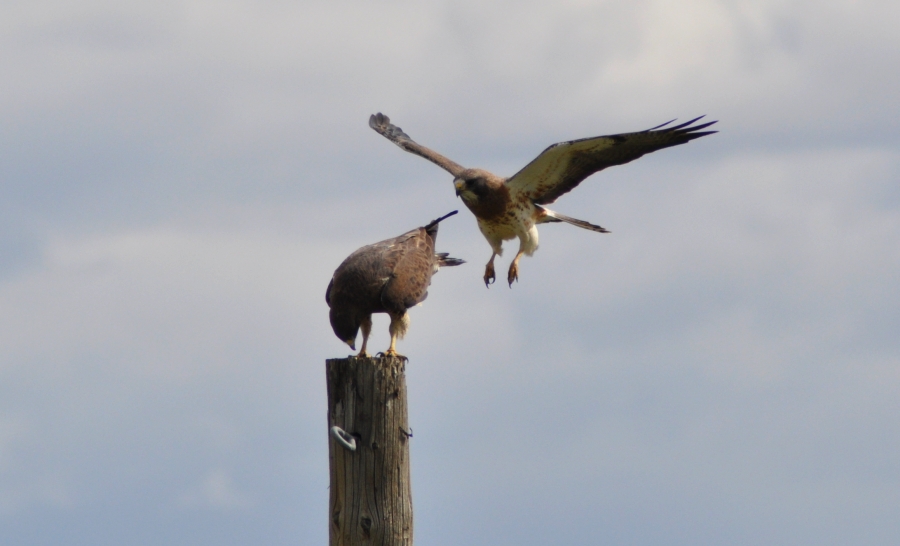
Swainson's Hawks ready to make sweet sweet love. They sexed for quite a prolonged period of time after this photo was taken, I was impressed. Near Camas National Wildlife Refuge, ID.

Everyone keeps asking me..."Seagull, where will you end up this year?". The truth is, I have absolutely no idea, but for the short term, I will go north. I seek the Snowy Owl, after all. Yesterday I began my migration that will culminate in dismal/dreary Port Angeles, WA, on the Olympic Peninsula....a place that some refer to as "where people go to die". I hope that's not true, or else I should seriously reconsider my motivations for going in the first place.

Being a Professional Crastinator, here are some more of my fav birds from last summer. Thank you, come again.

Gray Flycatcher, the baron of the sage. Mono Lake, CA.

Yellow-headed Blackbirds are obviously the best blackbirds. Camas National Wildlife Refuge, ID.


Franklin's Gull...an excellent gull. Redmond Lakes, ND.


Upland Sandpipers were a common sight for me over the summer. I guess that explains my face melting off several times a week. Redmond Lakes, ND.


Baird's Sparrow. If anyone gets a job at Lostwood National Wildlife Refuge this year, I can tell you where the magic Baird's spot is. Otherwise...just go to the Sharp-tailed Grouse blind, and don't misidentify the Grasshopper and Savannah Sparrows there. Redmond Lakes, ND.


Common Nighthawk. Peent! Peent! Peent! Redmond Lakes, ND.


Chestnut-collared Longspur. This was the friendliest longspur I met all year, on the entrance road to Medicine Lake National Wildlife Refuge, MT. Yet another prairie bird with an awesome song and tear-jerking flight display.


Black Tern. Des Lacs National Wildlife Refuge, ND, is awash in Franklin's Gulls, Black Terns and other shorebirds in the late summer. The terns act more like swallows than seabirds there, and are easy to get good photos of.


Before last year, I have never been someplace where Vesper Sparrows plague the landscape. Now that I lived in North Dakota, that has changed. Redmond Lakes, ND.


Sunday, October 16, 2011

A Tower To All The Nicer Things You Could Have Been


Mr. Common Nighthawk. Sorry I'm close to your nest, but the Piping Plovers invited me over.

Lately a lot of people have been asking me about North Dakota lately. They give me weird looks when I tell them where I've spent the summer. It's completely understandable. The best company to keep was birds, and they helped keep my sanity. In fact, they were such good company, I went birding all the time...I can only stand being forced to watch Two And A Half Men for so long, you know what I'm saying? For your sake, I hope you don't.

Whiskey is a good coping mechanism, but you can only take that so far...


Chesnut-collared Longspur in the middle of its crippling flight display. Medicine Lake National Wildlife Refuge, MT.


Bobolink. He look real good.


Vesper Sparrow. Woo!


Black Tern, the feisty fashionista of the tern clan.


Hand Dragon.


A Swainson's Hawk receives hatred from a Red-winged Blackbird.


A spangly Solitary Sandpiper.


A heavily worn Franklin's Gull. It's hard for gulls to look good at the end of the summer.


Sunset over Lostwood National Wildlife Refuge. Goddamn.

Tuesday, July 5, 2011

Medicine Lake, Montana


Chestnut-collared Longspur. It looks like it was created by a demented anime artist. They know how to light up a prairie.

In June I got the hell out of North Dakota for a day and hung out at Medicine Lake National Wildlife Refuge, in eastern Montana. It was a very birdy place with a lot of good access to prairie, lake and slough habitat and I was blinded more than once by some of the avian goodness there. If you get the chance, go! Here's a few of the birds there.

Grasshopper Sparrow, another grassland obligate. Grasshopper and Baird's Sparrows easily outnumber Savannah Sparrows in parts of the refuge. 

American White Pelicans have a big nesting colony at the lake, although I wonder if its not doing well this year due to high water levels.

Said pelican colony.


Brewer's Blackbird in butterfly disguise.

Medicine Lake has Lark Buntings! Yet another awesome prairie bird with a crazy flight display.


This Eastern Kingbird goes by "The MULE". He even trademarked it. What a badass.

Double-crested Cormorants nest on the lake as well. This adult was lacking any breeding plumes, but was still pretty sharp-looking.

A modest male Wilson's Phalarope upsets traditional gender-roles.

Franklin's and Ring-billed Gulls.

Birders don't pay a lot of attention to Western Meadowlarks, but between their golden voices and sweet outfits I think they're winners. They're also North Dakota's state bird, which is totes appropes.