I was somewhere far from most other places. Modoc County, California, is the northeasternmost county in the state. It is home to just 9,000 people; for comparison, my current home county of Santa Clara has almost 2 million residents. California birders love birding Modoc, despite how far it is from where most people live in the state. Modoc offers Trumpeter Swan, Black-backed Woodpecker, Bobolink...Cordilleran Flycatcher...and Smith's Flycatcher.
Ah yes, the enigmatic Smith's Flycatcher (SMFL). Genetically, they are somewhere in between Hammond's/Dusky and Least Flycatchers...possibly the worst place for any bird to be. Amazingly, despite its close relations to these other birds, they appear more akin to an Eastern Phoebe with wingbars and longer primaries.
North of Mexico, of all Empidonax, only Buff-breasted Flycatcher has a more restricted range. Smith's breeds only in Modoc County, southeastern Oregon, and a couple of isolated mountain ranges in northwestern Nevada. No one knows where they winter, so if you want to see one, it is necessary to meet them on their breeding grounds. This mysterious species is highly sought after by birders.
That's what I was doing in Modoc County. The trip wasn't exactly going as planned...shorebirds not where they were supposed to be...lodging plans falling through...but eventually I did find the phoebeish little flycatcher in its shady coniferous haunts. What a satisfying bird! All was well.
***
And all was well at Moonglow Dairy, at least at first. Moonglow Dairy is a dairy farm in Moss Landing, California, on the south side of Elkhorn Slough. Moonglow is known to birders as being one of the few coastal strongholds for Tricolored Blackbirds in the state, and as a legendary vagrant trap. There are few things one can do that are more reasonable than birding Moonglow in fall, and that's what I found myself doing with a few other nerds.
I was concerned, however, about the bears. Bears had been in the area lately, and they had been aggressive. The others in my party did not seem very concerned about them, but within minutes of arriving BEARS came crashing through the brush and confronted us out in the open. It was a mother and her two half-grown cubs. However, she stayed back while the two cubs came forward and attacked myself and other birder.
Luckily, I somehow got a hold of a METAL FOLDING CHAIR, which I held out between and myself and the bear, like an old-school lion tamer. The bear pawed at it and expressed great displeasure at the chair being deployed, and quickly lost enthusiasm. After another minute of halfhearted assault the bear gave up and turned back, and the other followed suit. The whole bear family ambled off together, and we were left to bird in peace.
***
Of course, the events I just related to you did not actually happen. These were dreams that I had on successive nights, which led right into the weekend. The places are real, but the content, not so much. These dreams were not random though, I assure you, they undoubtedly meant something...but the only way to unlock this hidden meaning was to act on them. So what could I do? I had to bird Moonglow Dairy, I had no choice. Modoc may be far away, but Moonglow is less than an hour south of me. Luckily, birding Moonglow on a September weekend is like coffee and cigarettes...my course of action may have been predetermined, but I had no qualms about it.

Despite the warm weather and clear skies, Moonglow was very, very birdy. Lots of cooperative Tricolored Blackbirds greeted me on the way in.

Horned Larks and this fresh Western Meadowlark were along the road as well, searching for encroaching bears.

A couple Pacific-slope Flycatchers foraged in the Eucalyptus at the parking area. It soon became apparent that there were a lot of migrants around. A Black-headed Grosbeak gave a brief view, and a yellow female oriole appeared near the treetops - luckily, it began calling repeatedly, so no doubt about it being a Hooded. I considered myself fortunate - she never came down very low, so it easily could have resulted in a cringe-worthy Hooded/Orchard situation.

This Willow Flycatcher accompanied some low-foraging Yellow Warblers.

Yellow Warblers...at first I thought there were a lot of Yellow Warblers around, then it became increasingly clear that there were more Yellow Warblers present than anywhere I'd birded before. Ever. They were utilizing all the vegetated habitat around, low and high. It had the vague feeling of a fallout.


An unearthly bellow shattered the peaceful silence, and I dared not approach any closer. Was this the rarely observed bear alarm call that I have read so much about?

No sounds were uttered from this creature, bellowed or otherwise. I determined that it was not a bear.

Elkhorn Slough, which backs up against Moonglow, is well known for its abundance of trusting sea otters. Sea otters, of course, are one of the best organisms on the face of the earth. If you find yourself in the area from out of country or out of state, make sure you make an otter detour. You won't regret it.


At first, I was confused. This sure was a strange PSFL...it doesn't seem to be very yellow...the eye ring is quite round...the bill seems a tad short....why does it have crazy white stripes on the tertials? Ohhhhh...it's a Least Flycatcher. Least Flycatcher!
Though a far cry from a Bird Police species, Least Flycatchers are quite rare in California, and like all their bretheren, are misidentified on the regular. I stuck around for a while to look at it as much as I could. In typical fashion, at one point I had refound it at the exact moment when the Moonglow owner pulled up to chat with me...there was nothing I could do but turn my back to the bird. Persistence did pay off through, and I got quality looks before I left. As an aside, you gotta love when private landowners let birders roam freely on their vagrant-riddled property, even if you have to talk to them at inopportune times.
Aside from not being a yellow bird (the vast majority of empids we get on the coast are yellowish Pacific-slopes), one of the most striking features about this bird was how much the bright white tertial edgings stood out compared to the Pacific-slopes and Willow that were also present. This was apparent even in poor light. I never managed a good photo that showed this, but I did managed a crap photo that shows this (last photo above). Everything else looked typical for a fall Least from what I gather, though a touch of darkness at the tip of the lower mandible would have been the frosting on the flycatcher cake.
I had done it. I had come as close as possible to finding Smith's Flycatcher...this was my first self-found Least west of Texas, and I owed it all to a couple of bizarre nerddreams. In a certain sense, I had fulfilled my cosmic destiny, carried out the orders given to me on the astral plane. It turns out that most people have never fulfilled their destiny, so I'm not sure how much you can relate...but I assure you, it is accompanied by a special kind of glory. Things will never be the same. But what does it all mean? I may have to return to Modoc to find out.
Ah yes, the enigmatic Smith's Flycatcher (SMFL). Genetically, they are somewhere in between Hammond's/Dusky and Least Flycatchers...possibly the worst place for any bird to be. Amazingly, despite its close relations to these other birds, they appear more akin to an Eastern Phoebe with wingbars and longer primaries.
North of Mexico, of all Empidonax, only Buff-breasted Flycatcher has a more restricted range. Smith's breeds only in Modoc County, southeastern Oregon, and a couple of isolated mountain ranges in northwestern Nevada. No one knows where they winter, so if you want to see one, it is necessary to meet them on their breeding grounds. This mysterious species is highly sought after by birders.
That's what I was doing in Modoc County. The trip wasn't exactly going as planned...shorebirds not where they were supposed to be...lodging plans falling through...but eventually I did find the phoebeish little flycatcher in its shady coniferous haunts. What a satisfying bird! All was well.
***
And all was well at Moonglow Dairy, at least at first. Moonglow Dairy is a dairy farm in Moss Landing, California, on the south side of Elkhorn Slough. Moonglow is known to birders as being one of the few coastal strongholds for Tricolored Blackbirds in the state, and as a legendary vagrant trap. There are few things one can do that are more reasonable than birding Moonglow in fall, and that's what I found myself doing with a few other nerds.
I was concerned, however, about the bears. Bears had been in the area lately, and they had been aggressive. The others in my party did not seem very concerned about them, but within minutes of arriving BEARS came crashing through the brush and confronted us out in the open. It was a mother and her two half-grown cubs. However, she stayed back while the two cubs came forward and attacked myself and other birder.
Luckily, I somehow got a hold of a METAL FOLDING CHAIR, which I held out between and myself and the bear, like an old-school lion tamer. The bear pawed at it and expressed great displeasure at the chair being deployed, and quickly lost enthusiasm. After another minute of halfhearted assault the bear gave up and turned back, and the other followed suit. The whole bear family ambled off together, and we were left to bird in peace.
***
Of course, the events I just related to you did not actually happen. These were dreams that I had on successive nights, which led right into the weekend. The places are real, but the content, not so much. These dreams were not random though, I assure you, they undoubtedly meant something...but the only way to unlock this hidden meaning was to act on them. So what could I do? I had to bird Moonglow Dairy, I had no choice. Modoc may be far away, but Moonglow is less than an hour south of me. Luckily, birding Moonglow on a September weekend is like coffee and cigarettes...my course of action may have been predetermined, but I had no qualms about it.
Despite the warm weather and clear skies, Moonglow was very, very birdy. Lots of cooperative Tricolored Blackbirds greeted me on the way in.
Horned Larks and this fresh Western Meadowlark were along the road as well, searching for encroaching bears.
A couple Pacific-slope Flycatchers foraged in the Eucalyptus at the parking area. It soon became apparent that there were a lot of migrants around. A Black-headed Grosbeak gave a brief view, and a yellow female oriole appeared near the treetops - luckily, it began calling repeatedly, so no doubt about it being a Hooded. I considered myself fortunate - she never came down very low, so it easily could have resulted in a cringe-worthy Hooded/Orchard situation.
This Willow Flycatcher accompanied some low-foraging Yellow Warblers.
Yellow Warblers...at first I thought there were a lot of Yellow Warblers around, then it became increasingly clear that there were more Yellow Warblers present than anywhere I'd birded before. Ever. They were utilizing all the vegetated habitat around, low and high. It had the vague feeling of a fallout.
A MacGillivray's Warbler was lurking at the edge of the pond with a throng of Yellows. This species is very hard to find on the coast (it was a year bird for me); the dedicated fall birder may see more of several "eastern" species than of western birds like Cassin's Vireos and MacGillivray's Warblers.
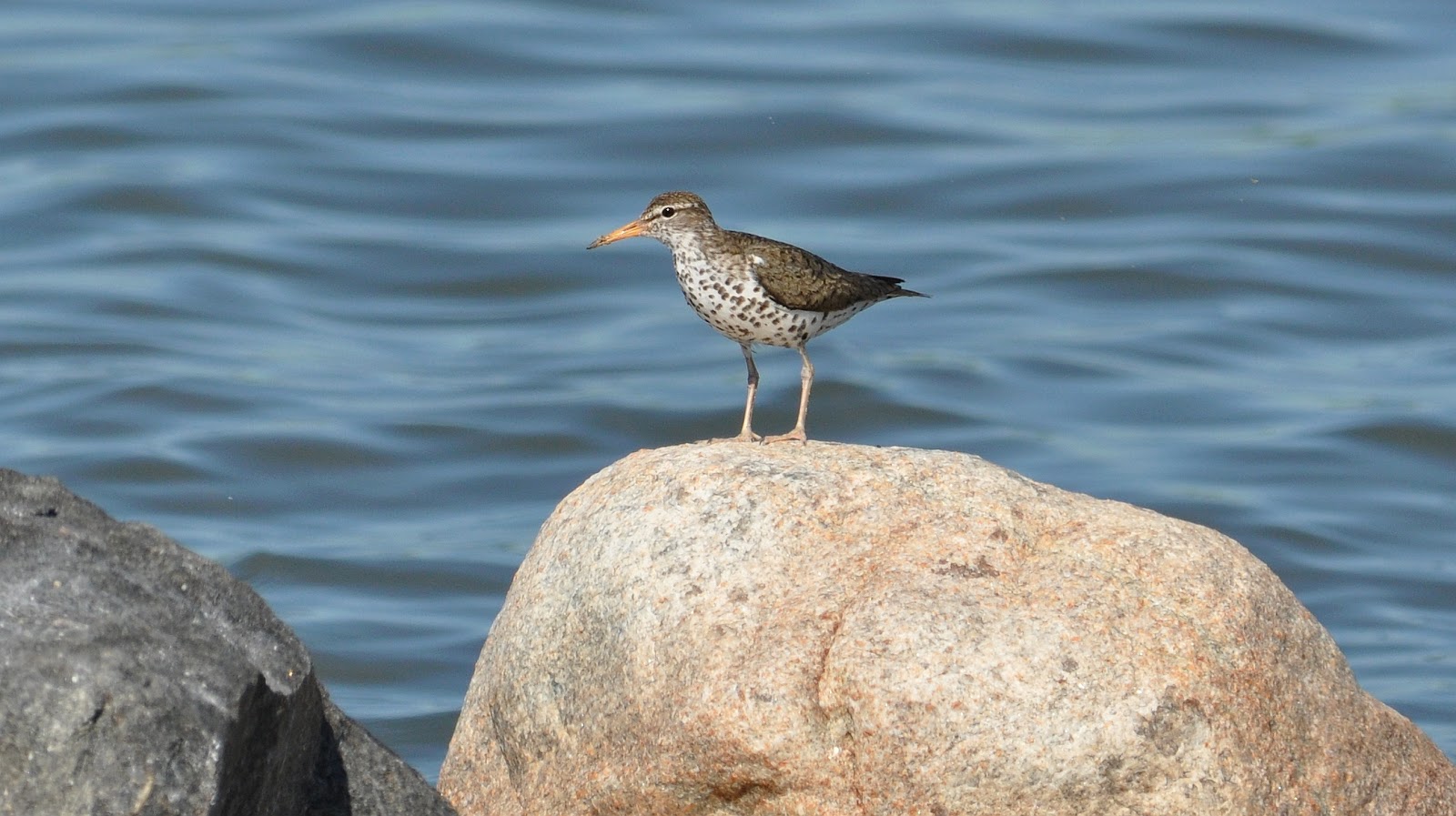
It had been a long while since I had good looks at a Pectoral Sandpiper. This bird was very obliging.
An unearthly bellow shattered the peaceful silence, and I dared not approach any closer. Was this the rarely observed bear alarm call that I have read so much about?
No sounds were uttered from this creature, bellowed or otherwise. I determined that it was not a bear.
Elkhorn Slough, which backs up against Moonglow, is well known for its abundance of trusting sea otters. Sea otters, of course, are one of the best organisms on the face of the earth. If you find yourself in the area from out of country or out of state, make sure you make an otter detour. You won't regret it.
I went back to bird the Eucalpytus grove again - things had really quieted down, and the teeming herds of my grunts present earlier in the morning seemed to have dispersed. I was following a couple Pacific-slope Flycatchers around when another bird appeared.
At first, I was confused. This sure was a strange PSFL...it doesn't seem to be very yellow...the eye ring is quite round...the bill seems a tad short....why does it have crazy white stripes on the tertials? Ohhhhh...it's a Least Flycatcher. Least Flycatcher!
Though a far cry from a Bird Police species, Least Flycatchers are quite rare in California, and like all their bretheren, are misidentified on the regular. I stuck around for a while to look at it as much as I could. In typical fashion, at one point I had refound it at the exact moment when the Moonglow owner pulled up to chat with me...there was nothing I could do but turn my back to the bird. Persistence did pay off through, and I got quality looks before I left. As an aside, you gotta love when private landowners let birders roam freely on their vagrant-riddled property, even if you have to talk to them at inopportune times.
Aside from not being a yellow bird (the vast majority of empids we get on the coast are yellowish Pacific-slopes), one of the most striking features about this bird was how much the bright white tertial edgings stood out compared to the Pacific-slopes and Willow that were also present. This was apparent even in poor light. I never managed a good photo that showed this, but I did managed a crap photo that shows this (last photo above). Everything else looked typical for a fall Least from what I gather, though a touch of darkness at the tip of the lower mandible would have been the frosting on the flycatcher cake.
I had done it. I had come as close as possible to finding Smith's Flycatcher...this was my first self-found Least west of Texas, and I owed it all to a couple of bizarre nerddreams. In a certain sense, I had fulfilled my cosmic destiny, carried out the orders given to me on the astral plane. It turns out that most people have never fulfilled their destiny, so I'm not sure how much you can relate...but I assure you, it is accompanied by a special kind of glory. Things will never be the same. But what does it all mean? I may have to return to Modoc to find out.