Showing posts with label pink-footed shearwater. Show all posts

Wednesday, May 18, 2016

The One Bird Theory


Prothonotary Warblers are great...I was more than happy to see this one in Goleta, in Santa Barbara County, last fall on the way to visit friends/family/birds in Ventura. In 2015, eBird has records for Prothonotary Warblers from 10 different locations in California. Could this just be the same bird wandering around? Of course not, but birding is rife with empty questions like this.

According to The Great Ornithologist Felonious Jive, there are more birders now than ever. I am inclined to agree with him. Birders are birding harder than ever before. Birds, in much of the country, are really getting birded.  Perhaps as a result of increasing coverage over the years, I am constantly hearing the same thing...the one bird theory.

The one bird theory is simple, though a bit cumbersome to explain. If a Ruff is seen in Oregon one day, and another Ruff is seen in Washington a few days later, birders will wonder if it is the same bird. If a Common Crane is seen in New Mexico, and a Common Crane is seen in Texas a few days later, birders will wonder if it is the same bird. If an Emperor Goose is seen in Humboldt County one day and an Emperor Goose is seen in Sonoma County the next day, birders will wonder if it is the same bird. So rather than assuming or deducing two different individuals are involved, a birder will wonder (and that is the key word here) if the same individual has been found in both places.

Now some of you might think they know where I am going, that I think the one bird theory has nothing to it. That is not true. The one bird theory turns out to be correct quite often. What does bother me is how often I hear or read the phrase, "I wonder if the [Species Blablabla] seen at [Location A] is the same bird that was found at [Location B]." It is usually just left at that, without any discussion. Well friends, you don't have to just put your wonderment out there for the world to behold, you can actually have an informed opinion...you could even decide yourself!

But how can one do this? Why think when one can wonder? Examining the one bird theory is not so difficult, it just comes down to considering a few factors and asking a few questions.


Elegant Terns are obvious birds...you know when they are around. It is important to know when birds are around, and when they are not.

Were they seen at the same time?

Overeager birders who quickly spout their one bird theory hypothesis often don't even check to see if the different individual sightings involved were actually happening simultaneously. A bird can only be in one place at a time, not two. Do your research people, don't make others do it just to answer your own question.


Migratory habits of many North American species are well understood. Black Terns go south in winter, north in spring. Not too complicated.

What direction is it going?

This question is especially important to consider during migration. Let's revisit our Ruff example from above. Let's say the sighting happens in October. In October, shorebirds migrate south. If a Ruff is seen in Oregon, it is incredibly unlikely it will turn around during the height of fall migration and show up in Washington. The Ruff will not suddenly figure out it is in Coos Bay and then try to hightail it back to Siberia in order to find the correct continent before it continued its southward migration. So, keep migration and dispersal patterns in mind when pondering the one bird theory.


Cassin's Finches, like several other high elevation species, periodically "invade" unusual places every few years in search of food, which can take them to unusual habitats and places where one would not expect them. When such patterns are evident, one need not spend much time contemplating the one bird theory.

Is there a pattern?

For various reasons (often unexplained), a region will occasionally experience an irruption of a vagrant species, such as with Black-bellied Whistling-Ducks, seabirds and northern finches. So when a lot of Common Ground-Doves sightings are popping up in the Midwest, which happened last year, there is obviously no reason to think it is just the same bird miraculously choosing to stop in heavily-birded vagrant traps and being found repeatedly.


An out of range Western Gull would be a worthy candidate of the one bird theory. They are not highly prone to vagrancy, and would stand out in a lot of places. A bird wandering around the east or the interior west could definitely be found in more than one place.

How rare is it?

There are rare birds, and then there are rare birds. If two Golden-cheeked Warblers were seen in two different places in California in one year, one should rightly consider if the same individual is involved...it is just incredibly unlikely one would get here in the first place (and we do have a record!), let alone two around the same time. However, if two Chestnut-sided Warblers show up in different places in California in the same season, the idea of them being the same individual would be a ridiculous notion unless both birds were melanistic or banded or something like that (we will get to that soon). Chestnut-sided Warblers are not at all unexpected in California, and the state gets many records every year, up and down the state. It's quite rare for the one bird theory to be in effect when a "expected" species is involved.


In the eastern United States, there is no shortage of habitat a wayward Western Tanager could use spring through fall. How many Western Tanagers are eastern birders missing? Probably hella.

Think about birder coverage.

In most, not all, parts of the country, birders are not covering all available habitat very well. Most is inaccessible, due to lack of birders, roads, trails, or because land is private or government property that the public can't get to. When this is the case, think about all the area where birds are being missed...what are the chances that the subject of your one bird theory will somehow be found in more than one place, and somehow not vanish into the abyss that is all this other unbirded habitat? Think about the odds...they usually are not very good.


Ah, the Common Nighthawk. An easy bird to see in some places, but how many of the Common Nighthawks out there are people really seeing? Nightjars are hard...they can be hard to identify, but just finding them is typically the problem. Finding them roosting is blind luck, and birders can't see them foraging in the dark. The unfortunate truth is that the vast majority of nightjars go completely undetected in their normal range, let alone as vagrants! 

Think about detectability.

Some birds are easier to see than others. An Ivory Gull is easy to see. A Common Poorwill is not. A Ferruginous Hawk is easy to see. A Gray-cheeked Thrush is not. A Long-billed Curlew is easy to see. A Wilson's Snipe is not. A Black Skimmer is easy to identify. A Common Sandpiper is not. A Laysan Albatross is easy to pick out. A Tristram's Storm-Petrel is not. When birds are hard to find due to their habits or simply hard to identify, you can bet that a lot of these birds are going undetected, even when they are right in front of us! Then there is the fact that most birds in our area go undetected because they are in places where we don't bird, or because they fly right over us during migration...when birds migrate, they don't stop in every single county on their way to their destination. Think about this: a Yellow Rail seen in one place is practically guaranteed to never be seen in another. So to put it all together, one must ask how many of a certain species we are missing in a certain area. This has everything to do with likelihood of the one bird theory holding up for a vagrant. Keep these things in mind when the one bird theory is wracking your brain...the more you think about the detectability of a species, the more the one bird theory has a tendency to lose water.


This Pink-footed Shearwater is a good example of what a bird can offer that would help identify it on an individual level. This bird has a lot of molt going on in the flight feathers, definitely something to key in on, and the underwing pattern is a great thing to examine as well.

What does it look like?

I saved the one of the most obvious things to consider for last. These days, many rarities are photographed well. So before you put your public wonderment out there, see if you can compare photos of the bird(s) in question. You can compare age, plumage, sex, molt, wear, patterning, bands, etc. This is what typically provides a definitive answer when questioning if the same bird is involved.

And there you have it...it boils down to knowing status and distribution, what the birds look like, and some focused questions about the odds of the same bird being found twice versus the odds of a different individual being involved. The one bird theory will always be out there, and for good reason, but now you are equipped to test it. You are ready. Wield the hammer of this knowledge in listservs, forums and Facebook groups, and you too can make birders better.

Wednesday, July 29, 2015

Boat Season Has Arrived


When August arrives, birders across the continent have one thing on their obsessive brains: shorebirds.  This Global Birder Ranking System #7 U.S. birder?  Two things...shorebirds, and seabirds.  Oh, and another thing, pointing and screaming bird names as loud as possible with a captive audience.

Of course, there are always seabirds Out There, but the end of July heralds the beginning of pelagic season.  Away from Monterey Bay and Half Moon Bay, there is no where else on the west coast where boats depart on the regular to troll for tubenoses, for alcids, for boobies, for jaegers...you get the picture.  I am lucky enough to be able to get on a lot of these trips (mostly out of Half Moon), and spend time with this impressive and difficult group of birds...the birds of The Deep. In anticipation of my first west coast seabirding trip of the year (and yet another shot at Hawaiian Petrel, a bird I need), I thought I would cobble together some photos from past July and August trips. As always, if you are thinking about doing your first west coast pelagic trip, or your first ever pelagic trip, what are you waiting for? Get on a boat!

But these anxious feelings are nothing different from any other year.  What is different about this year is El Nino...not a speculated one, not a possible one, but a real one.  The nonbirder associates El Nino (sorry for the lack of tilde) with rain, the west coast seabirder associates it with rare birds. Weird seabirds have already put in appearances in California this year...a Red-footed Booby, a Nazca Booby, a Kelp Gull, a Bridled Tern...and none of those birds were even seen out to sea!  So who knows what will be out there?  Frigatebirds have already been showing up in SoCal, another encouraging sign.  Fingers crossed for Cook's Petrels, an El Nino special, but I will be happy with a Hawaiian (no fucked up ocean currents required), which is very much a bird of August.


Late summer is a good time for albatross, and Black-footed Albatross are almost always out there this time of year.  Unlike many other seabirds we see, if you see a Black-footed Albatross, you are going to get great looks.  It's also a good time for Laysan Albatross (top photo) as well, but a word of warning: 75% of Laysan Albatross called out on boat trips end up being Western Gulls.  Don't become part of that gruesome statistic...caution is warranted.  


Shearwater diversity does not tend to be very high at the beginning of pelagic season, but Sooty and Pink-footed are never missed, assuming the boat gets out of the harbor.  An early Buller's or Flesh-footed is never out of the question, and of course there are a great many other possibilities.


Small numbers of Northern Fulmars are often found on these summer trips, and the birds usually look something like this. They are ragged. They are haggard...and lets face it, they are godawful. Hideous. It's amazing they can even fly, they are molting so hard. Fulmars later in fall are very respectable in appearance and flight capabilities, not so much our summer lingerers. Luckily, if you've never seen a fulmar before, they are not at all afraid of the boat, so you can wonder at their horrible glory from close range.


August is a great month for jaegers, especially Long-tailed, who often will still be retaining their brilliant extendo-tail. The bulk of southbound Long-taileds seem to pass through from August to mid-September, so now is a good time to get them. The always-popular Skua Slam is always within reach this time of year as well.


Black (above) and Ashy Storm-Petrels are the expected storm-petrels early in the season, though Wilson's are not unusual. With El Nino brewing, this could be a good year to find Least Storm-Petrel this far north, though probably not this early. That said, the birding legend they call Papa Echo Lima recently saw some from shore down La Jolla way, which portends great things for those who want to see them up here.


Fact: 75% of Fork-tailed Storm-Petrels claimed on trips are actually phalaropes...but if you are one who warrants caution, then that 75% is not for you. These are Red Phalaropes, the less common, chubbier, more desirable phalarope.


Speaking of chubby, Cassin's Auklets are expected on trips throughout the summer and fall, though their numbers vary.  Unlike albatross and fulmars, Cassin's Auklets hate boats, so getting good looks at them can be stressful.


I know this isn't a compelling photo, but I think it sums up what looking at murrelets can be like over the deep.  Scripps's Murrelets (above) are the expected species, though last summer Craveri's were seen on a number of boats in July and early August. I'm hoping they come back for an encore this year.


Oh yeah, crippling rarities can show up any time...it just takes a shitload of luck, and maximizing your time on the water. This Salvin's Albatross was the star Vague Runt (albeit one not so runty) of the pelagic season last year, and things have never been the same.

All photos were taken offshore from Bodega Bay and Half Moon Bay.

Sunday, August 31, 2014

Half Moon Bay, 8/17 and 8/23


Sooty Shearwater. Angular.

Some coverage today from the August 17 and August 23 pelagic trips with Shearwater Journeys out of Half Moon Bay, CA. My next boat will be on September 7, with This Machine Nate, Laurence of Arizona, and Flycatcher Jen. I have never been on a boat with so many bird bloggers...the tremendous weight of our combined nerd-strength could sink us before we get out of the harbor. Hopefully they will get some lifers...I believe this will be Laurence's first pelagic, so I expect he will be flipping out and spewing puns for the duration. As for me, September 7 is still within the Hawaiian Petrel window, so that is my target bird...don't worry, I'll be looking for White-chinned and Great-winged too, but I am a humble birder. Warm water conditions persist in much of the eastern Pacific, and there are a lot of Sulids in the area right now, so you never know what we might find.

As I compose this post, I am impressively ill. I mean, no one is going to be doing any ice bucket bullshit for me, but existence is rather unpleasant at the moment. So for today I will cut the loquacious crap, and each photo is going to get exactly one word to accompany the species.


Rhinoceros Auklets. Gloomy.

Tufted Puffin. Inspecting.


South Polar Skua. Skippy.


Broad.


Black-footed Albatross. Hello.


Majestic.


Brakes.


Common Tern. Wedged.


Articesque.


California Gull. Cinnamon.


Edgings.


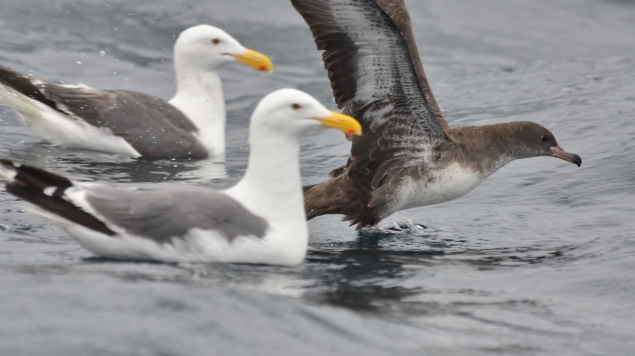
Pink-footed Shearwater, with Western Gulls. Disparate.


Harried.


Pomarine Jaeger. Pomatorhine.


Dauntless.


Pacific Loon. Fresh.


Steller's and California Sea Lions. Blondes.


Steller's Sea Lion. Sneers.

Wednesday, August 13, 2014

Pelagic Season Begins: July 26, Half Moon Bay


July 26 was my first pelagic trip of the year, leading for Shearwater Journeys again out of Half Moon Bay. Little did I know, it would be a date that would live on in infamy...the birding would reach a crescendo, although I did not expect it.

I was stoked to start doing some boat trips this year, as since I've returned from Texas I've hardly gone birding. I was also interested in what we might find offshore so early in the "fall", since I've never done a July pelagic before. It was (and is) Hawaiian Petrel season, and a boat the previous week had several Craveri's Murrelet, a bird I yearned for and usually does not get much north of San Diego. After seeing some guillemots in the harbor we plunged into the inshore fog bank, and headed out to sea. Eventually the fog broke and we started getting into some birds...a couple Scripps's Murrelets, a flyby Craveri's (which I missed...ouch), and then a Laysan Albatross appeared ahead of the boat.


I wouldn't call Laysan Albatross "rare" offshore here, but they are certainly rareish...they are not recorded as frequently as, say, Flesh-footed Shearwater, but they are never totally unexpected. Since I spent three and a half months with them on Midway Atoll, they hold a special place in my heart, so it's always good to check in with them.


Soon we were in deeper water, where Black-footed Albatross are plentiful. I never get tired of these birds (they get posted to BB&B almost more than anything else) and although they have only about 3 colors, they can make for some creative photography. They are well known for their big bodies, bill bills and big wingspan, but how about those big fuckoff feet?


Like many waterfowl, albatross will use their humungo feet for brakes and steering when making a quick landing.

I dig the long wake this gooney is leaving behind.


Of course, later in the day we got to see this bird, this rarity of rarities, which you probably know about already. If not, get the full story right here. I'm recovering, slowly. I'm still fighting myopathy and I've just been able to start eating solid food again.


The AOU did just recognize Salvin's Albatross as a full species, less than two weeks after our sighting. Thanks guys. Still marveling that we got to see this bird, and so well at that.

In less majestic and more disgusting news, we had a fair number of Northern Fulmars offshore that day, almost all of which looked like shit. Look at this bird. It's awful.

Several of these dark-morph birds were so worn and bleached that they had white mantles. Look at those horrible primaries! The decrepit tail! It's amazing these birds can even get airborne.


As expected for late July, most of the shearwaters we ran into were Pink-footed (above) and Sooty. We did get one Buller's (the best of all shearwaters), which was on the early side. Most shearwaters now are in heavy wing molt and have big chunks missing from their primaries and secondaries. At least they don't look like hideous fulmars.


This is the same bird. They'll be looking better in a month or so.


There were dozens of Common Murre dads leading their fuzzy, flightless chicks around. Maybe the murres had a good breeding season on the Farallones?


Another murre family scoots out of the way of the boat. I will admit that on this day, I committed a misidentification at sea. I mistook a Orca dorsal fin for a Humpback Whale pectoral fin. Embarrassing, I know. This may sound like an odd thing to do for some of you, but a humpback pec fin is similar in size and shape (but not color...) to a male Orca dorsal fin, and humpbacks frequently lie on their sides or on their backs and will wave a fin in the air, for reasons that only other humpback whales could possibly understand. I feel no shame...mostly because it wasn't a bird. Steller's Sea Lion was also a nice bonus mammal.

Oh, I did see a pair of Craveri's that day, so everything is fine. I'll be on Sunday's pelagic out of Half Moon Bay, so maybe I'll see some of you then. The marine forecast looks very good for alcids and finding rafts of storm-petrels this weekend...it's also worth mentioning that there recently have been 4 species of Sulids in San Mateo and San Francisco waters!!! Not baffling, but welcomed.