Showing posts with label Blackburnian Warbler. Show all posts

Friday, January 4, 2019

2019: The Year of The 5MR


In 2018, White-throated Sparrow was a county bird, a Five Mile Radius bird, and eventually a yard bird! This was the #1 bird I was hoping to see at Rancho de Bastardos that I kind of expected to show up eventually, and this looker spent a few days here right before Christmas. Sadly, it abandoned us before 2019. Another fun fact: every White-throated Sparrow I've seen in my home county has been in my radius! I would grade my radius as being middling for sparrows, maybe even above average. Fingers crossed for a Harris's this year, though it would not have to show up in my yard to make me happy. 

By this point, every regular BB&B reader has heard about the Five Mile Radius (5MR) and has one of three opinions on it.

Opinion A: 5MR is a fantastic idea and I'm already doing one!

Opinion B: 5MR does sound interesting but not interesting enough for me to start one...yet.

Opinion C: 5MR is stupid. It is stupid because listing is stupid/I am too invested in rabid county listing all over the state/I am busy because I am always doing a big year and need to spend hella time driving or flying/not everyone is doing it so therefore I will not do it/I suck.

If you are of Opinions A or B, or even the highly unlikely Opinion D ("What is 5MR?"), then this post is for you. If you are of Opinion C, well, god help you.


My 5MR is very good for sapsuckers; I saw Red-breasted (above, fairly common here), Red-naped and Yellow-bellied all in 2018. 2019 started with Red-naped (a different one) and Yellow-bellied...nope, no Red-breasted yet! If a Williamson's ever shows up it will probably be in a little park or cemetery no one birds, and 5MR is all about birding places like that. Photographed at Almaden Lake County Park.

I am not going to punish regular readers with describing what 5MR is all over again, but in case you are wondering what all the fuss is about, you can read this BB&B post and check out Flycatcher Jen's new handy little 5MR FAQ page.

BB&B is world-renowned for being a leading trendsetter, influencer, and tastemaker for birding in the 21st century, but Flycatcher Jen, PNW's blogging darling, gets full credit for launching this concept...we are just here to preach the radial gospel. I am a 5MR missionary, if you will, and in the end many of you will be converted, or in other words, saved. The birding paradigm is beginning to shift. So what is new with 5MR birding?


Last fall was excellent for Willow Flycatchers in Santa Clara County; this one was in my yard for a few days in September. There are a number of decent places in my 5MR to check for migrant Empids, but kingbirds are much tougher.

The 2019 5MR challenge is what is new. Jen has invited birders everywhere to come join in; she is tracking everyone's 5MR for 2019, and is at almost 150 (!!!) participants in many states and multiple countries! It's really all about birding your 5MR (or 8.05KR if you are metrically inclined) a lot this year, and we will be tracking many more metrics than just the usual who-will-get-the-most-species stat. She is even doing monthly challenges! You can read all about it right here, and if that grabs ya check out some more of the nerdy, jaw-clenching metrics right here. She also set up a Facebook group devoted to 5MR, which is (somewhat unexpectedly) really flourishing - go here to check it out and join up. No need to sign up for the 2019 challenge to be in the group!

Birders of all levels and all stripes have embraced the 5MR, and you should too! Bird Police, civilian bird wizards, "young birders", geri birders, intermediate birders, and probably some stringy ones...we are all here! Come revel in the places less birded and the luxury of never having to drive more than 20 minutes from your home! Become the master of your local eBird hotspots, or if there aren't many, you can bring them into existence yourself! Of course, there is no need to sign up for the 2019 challenge to enjoy the fruits of 5MR, but I think it will be fun.


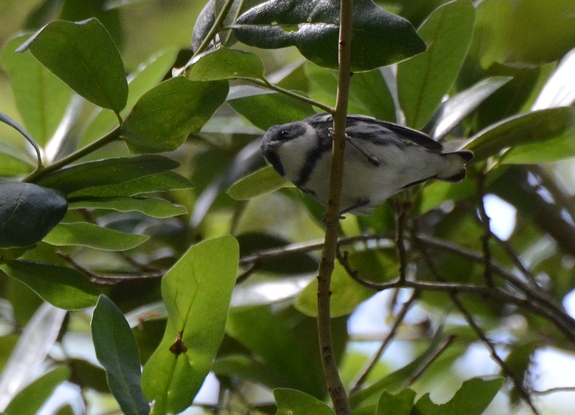
Easily one of the best birds in my 5MR last year was this Blackburnian Warbler, which I dipped on twice before connecting. I'm still figuring out how readily findable fall vague runts are in my 5MR, but clearly searching for them is not a fruitless endeavor. Incredibly, in December I got to see another one only 0.3 mile outside my radius. Photographed at Vasona Lake County Park.


Those of us living in urban areas tend to be very heavily biased towards months with wintering birds and lots of migrants passing through, but obviously no matter where you are, you can't forget about the birds that breed in your 5MR! Much of my radius is urban/suburban hell, but a lot of it is protected open space as well, mostly in the form of oak woodland, modest riparian corridors, and some chaparral. Good summer birds in my 5MR include Black-chinned Hummingbird, Vaux's Swift, Common Poorwill, Rufous-crowned Sparrow and Band-tailed Pigeons. I'm sure the pigeons are here year round but I don't see them around where I live for most of fall and winter. Look at this ridiculous thing mantling my tiny feeder! Need to track down Western Screech-Owl in my radius this year, among other residents/breeders.


I've said this a number of times now but there are a huge number of gulls in my radius in the winter months. I really, really want to find something rare in my 5MR (probably Glaucous, Lesser Black-backed or Slaty-backed) and in fact I'm sure they are around, it's just a matter of being in the right place at the right time. This Iceland was casually soaring over my yard last month.


If gulls and waterbirds are strengths, and perhaps even upland birds, the Achilles Heel of my 5MR is shorebirds. Why do they have to be so hard? Every species of shorebird I have recorded in my 5MR has been from my yard. That would be one species of plover (Killdeer, claro) and 4 sandpipers, of which Wilson's Snipe is the only interesting one, though it is the only expected one besides Spotted. It's pretty bad but I will take my snipes. Solitary is possible but I can't even fathom seeing something like a flock of peeps.


Not only do I have all three mergansers in my radius, I've seen them all from my yard! Red-breasted was a fluke though and I'm not sure if I will get another one in the radius this year. The ponds at Los Gatos Creek County Park are very reliable for Hooded Mergansers (where these cripplers were hanging out), which is probably the most heavily birded hotspot (for good reason) within my 5MR.

In 2018, I fared somewhat better than I thought I would in my 5MR. Birding at the very edge of my 5MR at Santa Teresa County Park in spring gave me some great birds like Calliope Hummingbird, Horned Lark, Grasshopper Sparrow and Rock Wren. The radius is real tricky there, with some sections of trail inside and some outside, but I finally got a good handle on it. Fall migration bestowed upon me a nice array of new 5MR birds like Cinnamon and Blue-winged Teal, Greater Scaup, Palm Warbler and Brewer's Sparrow. A Summer Tanager showed up right before Christmas, and the nearby Phainopepla is wintering at the same site again. I finished the year with 159 species in my 5MR without being really committed to inflating that total, which I'm pretty happy about - a few other 5MRs in Santa Clara County finished slightly below that number, though I have no doubt someone living closer to the salt ponds could do better than me, probably substantially so.


My 5MR has most of the expected Northern California wading species, though White-faced Ibis is not something that will be easy to find. Perhaps a Yellow-crowned Night Heron will turn up behind my house with all the Black-crowneds at some point? Yellow-crowned is long overdue in this part of the state and they have been increasing in Southern California. Until then, I will be content with the expected locals, like Great Blue Herons, when they choose to be confiding. Photographed at Los Gatos Creek County Park.

Of course, just because you don't want to sign up for the 2019 challenge doesn't mean you shouldn't do a 5MR at all! Absolutely none of my 5MR birding last year, or the year before, was done with me thinking about getting freaking year birds for my 5MR list...how embarrassing is that? It's pretty embarrassing...but oh wait I am ALL IN on the 2019 challenge so this year will be different!

Well, maybe not all in...I am about to leave for Belize. So long White-crowned Sparrows, hello Tody Motmots! See you on the other side Bushtit, pleasant good morning to you American Pygmy Kingfisher! Godspeed Hutton's Vireo, oh so good to finally meet you Yucatan Vireo!

Right, but otherwise I am heavily invested. Looking forward to checking out some new spots (a couple cemeteries immediately come to mind), tracking down a few self-found rarities, and really pinning down species that I have yet to see in my 5MR that I could reasonably expect to find here...Eared Grebe, Allen's Hummingbird, Red-breasted Nuthatch, and Tricolored Blackbird all come to mind quickly, though that does not mean they will come easily. I am hoping to see some more 5MRs pop up in Santa Clara County in 2019 as well!

Challenge or no challenge, hope you all have a very radial 2019!


My last Santa Clara County bird of 2018 was also my last new 5MR bird. American Bittern was the closest thing I had to a nemesis bird in Santa Clara. Ugh I love bitterns so much, happy that they are possible in my radius. Photographed at Los Gatos Creek County Park.

Thursday, November 29, 2018

The Best Birding of The Year: April in Sabine Woods


I'm not sure if anyone has noticed, but I am pretty awful at finishing trip reports in a timely manner. However, I love trip reports (though they seem to be dying) and I love fantastic birding, so I would be crazy to not make one last installment from this year's trip to Texas. Our second trip to Sabine Woods not only warranted a blog post, it was the best birding I experienced the entire year. So hop on in to the BB&B time machine one last time, as we make the quick leap back to April of 2018...

The day started out innocently enough. After Great Success earlier in the week at Sabine Woods, Dipper Dan and I headed back, hoping for a repeat. The southerly winds that prevailed over much of the previous day had switched to winds out of the north, so conditions were right for a good morning, if not a facemelting one.

At dawn we started the birding the trees at Texas Point National Wildlife Refuge, which is right on the way to Sabine Woods. It's not an impressive looking patch (some pieces of private property in the area appeared better suited as migrant traps), but since this is the UTC it should be checked! It was really slow at first, but after a while we began to see sweet sweet migrants coming in off the coast. Not many were stopping, but it was encouraging. The Northern Parula above was very accommodating, and ended up being the only one we would see that day.


After exhausting the relatively small Texas Point patch, we returned to Sabine Woods. Birding was on the slow side at first...acceptable, but not anything crazy. The forest floor was not crawling with Ovenbirds and thrushes, like it was when we visited earlier in the week though. This Canada Warbler that Dipper Dan found was an early highlight.


After talking to BB&B reader Steve from Kansas City for a while and learning about how terrible fans of the Kansas City Royals are...and looking at the Cerulean Warbler he pointed out to us...I found this Blue Jay getting high on sunbeams in the forest floor. Things were getting interesting.

Incrementally, the birding got better and better as the morning progressed. What began as dull birding became mediocre birding, which turned into decent birding which turned into good birding. A few hours after we arrived, the number of birds in the patch had seemed to double, then triple. By about 2PM there were simply birds all over the place. Woods totally empty of Ovenbirds earlier now were filled with them. The birding had gone from good to great; migrants just seemed to be piling in to the patch.

Eventually, we came to that rare and special realization that it was happening, much like it was at High Island the first day of the trip. This was the birding I had come here for, the birding I had hoped to experience but dared not expect. There were simply too many birds, too many birds to look at, mainly thrushes, vireos and warblers. Migrants galore. At one point, Dan and I split up for a while, and he encountered this Swainson's Warbler (left). It was only a few feet from him, falling asleep inside a bush, so the only photo he could get of it was with his phone. Obviously, the bird had just dropped in from who-knows-where and needed a nice nap before turning up the skulk meter to normal Swainson's Warbler parameters.

Well, when it's happening, it's happening. This is the sort of thing that happens when it's happening.


I missed Dan's sleepy Swainson's by a few minutes but managed to find my own in a different part of the patch. It was slightly more cooperative than I expected, which I was happy about. The brown wonder was a lifer only a few days before.

We birded vigorously through the afternoon. It was great. Not a fallout...lots of very approachable but otherwise normal-acting birds...but I had difficulty thinking that the birding could be much better than it was.


Eventually, we were fully saturated by migrants and the day was drawing to an end. We made our way back to the entrance, where a confiding Worm-eating Warbler greeted me...


...and promptly flopped down to the pavement. I love seeing warblers flopping around on the ground...it is a sign of excellent birding. Sure, some warblers are inherent ground floppers, and some may flop at any height...but it can be a sign. Worm-eating Warblers aren't exactly ground-phobic though, so I merely appreciated the bird's gesture and went on my way.

But I didn't get far. The day's final act was about to unfold, and the few tattered remains of what was once my face were about to melt off completely.

Right next to the entrance, some birders were looking at some Blackburnian Warblers...certainly not an unusual event but I felt these Blackburnians needed some special attention.


It turns out these Blackburnians were especially tired. They were in full just-crossed-the-Gulf mode and treated us with the same amount of caution they would give to an oak tree...in other words, we might as well have been invisible. I've met some confiding Blackburnians before, but these really took it to another level. When one of them started passing out on an open branch about 15 feet away, I knew that not only was it happening, it was happening really hard.

In short order they flopped to the ground and did their best Brewer's Blackbird-in-a-parking-lot impressions. I've been lucky enough to be really close to Blackburnians before, but this was a different level of close.


Incredible.


Here is an uncropped photo - the dark blob on the right is my shadow.


I looked up into the trees and saw a Bay-breasted Warbler, then two. They had been fairly common the past few days, but it was strange to see them perched just a few inches from one another; I got the clear impression that they had just fallen out of the sky together, their long Gulf crossing just completed. The Worm-eating Warbler on the ground had foreshadowed what was unfolding before my very eyes...


Warblers were now flopping around on the ground in front of us. This adult Tennessee Warbler, a known ground hater, flopped about without apologies.


Another Tennessee jumped into the ground frenzy. The growing terrestrial congregation of fearless warblers wasn't completely surrounding us, but were very focused or concentrating on an area in front of us about the size of a small lawn.


A Hooded Warbler, known to groundabout, was especially floppy.


The pair of Bay-breasted Warblers descended from the trees to join the growing flock of warblers in the grass for soul-satisfying looks.


Considering all the warblers on the ground, gravity must have been especially strong. This Blue-winged Warbler felt the pull but mostly managed to stay a few feet above it.


Gravity's pull was so forceful here that it was holding on to a leaf with one foot for dear life. Clearly, this was some sort of Bermuda Triangle for warblers.


This crippling Chestnut-sided Warbler materialized a few feet above the ground-fray.


The Bay-breasted Warblers in particular had little interest in going back up into the trees.


We should probably make sure a combo gets in here...Blackburnian/Bay-breasted ground combo is a sweet one. There were other warblers here in groundtown as well, but this post has to end eventually!

I'm still not sure how to describe this event. This was not normal. Kansas City Steve, who had logged a great many years of springtime birding at Sabine Woods, admitted he had never seen anything like it. It was like what I expect a full-blown fallout to be like, except happening on a weirdly small scale. I have always maintained that there is no such thing as a small fallout, but it appears time to reexamine that position. Keep in mind, of course, that there were huge numbers of birds in the patch that were not acting like this, but I'm thinking a small wave of extremely exhausted migrants had arrived at the edge of the patch just as we were leaving, giving us....well...a micro fallout? It makes me wince to read that but I can't think of a better label for the event. No matter what it was, it was unlike anything I've experienced before, things will never be the same, and I really hope a springtime return to the Gulf Coast happens sooner than later. We ended up getting new high counts in eBird for Acadian Flycatcher, Swainson's Thrush and Ovenbird at this heavily birded site.

I did have one more day to bird in Texas with Dipper Dan and Officer Shaw at High Island, which was ok but nothing like what happened at Sabine Woods the previous day. We then went to Shaw's, where we drank incredibly good beer, I had an incredibly bad allergy attack (how embarrassing), and a freaking Chuck-will's-widow flew over his suburban yard in broad daylight!

This will conclude BB&B's coverage of 2018's fantastic foray to Texas. Thanks to This Machine Nate for coming all the way out to the coast, shortly before being banished to the depths of an uncharted corner of Ohio. Thanks to Dipper Dan for being my ride or die and coming out from SoCal. Thanks to Officer Shaw for meeting up with us (twice!) and letting us crash in the Land of Sugar. You all battled Geri, you all won, and you are all birding heroes.

Tuesday, May 22, 2018

Smith Oaks, Hooks Woods, Eubanks Woods Sanctuaries


Smith Oaks was extremely productive for us on multiple days and hella fun to bird, generally better than Boy Scout overall. Smith was consistently somewhere between "moderately birdy" and "guhhhhhh birds everywhere" throughout the week...eBird checklists were best characterized as "corpulent". Here are a few of the hundreds of migrants we met there, starting with this Chestnut-sided Warbler.


As expected, the always becoming CSWA was a fairly common migrant throughout the week at all the migrant traps we visited.


A female Blackburnian Warbler with a trophy-sized worm of inches.


This is the same male Blackburnian that was hanging out next to the egret rookery in the last post. I'm still suffering from heart palpitations from seeing so many of these crippling heart-stoppers that week, which were one of the most common warbler species. So many glowing Blackburnians everywhere were difficult to cope with, physically, emotionally and spiritually.


Another crippling gasper, Golden-winged Warbler was certainly not a common migrant, but we did connect with more than I thought we would. We didn't come across any particularly confiding birds unfortunately, but who is complaining? Not me. A couple of them were singing, which is the first time I've ever heard them.


Though not a lifer, Cerulean Warbler was one of the main target birds of the trip for Yours Truly, #7. We had great success, and pleasantly saw a modest number of them.


Also like Golden-wingeds, they were hard as fuck to photograph/see well. Fitting, I suppose, for such a sought-after gem of a bird.


Female Cerulean, showing off her distinct long undertail coverts and almost stub-like tail.


Hella Wood Thrushes that week; we saw hundreds of them. This is not something I expected or have experienced before. Stoked.


When one encounters This Machine Nate on a trail, only one thing can be said for sure: you are in for a treat.


Nate's treat was met by a mix of intrigue and revulsion.


We also spent a lot of time at Hooks Woods. It's a lot smaller than Boy Scout and Smith, but it's the closest patch of trees to the coast, the habitat is good, and the concentrations of Geri there seem to vary between "low" and "bearable". This was the first Blue-headed Vireo of the trip; we would go on to see a handful spread out over the week.

I should mention that birding the road in front of the sanctuary can also be productive; this is where This Machine lifered Black-billed Cuckoo.


Here it is, your friend and mine, SWAINSON'S WARBLER, THE BROWN WONDER. This one was Dipper Dan's lifer. This was a good spring for these skulkers on the UTC apparently.


A surprise to one, Eastern Wood-Pewees adorned the migrant traps in large numbers. Lord knows how many of them were misidentified by Geri and friends.


Veeries were uncommon but dependable throughout our trip. Hooks Woods, and the lawn directly across the street from the entrance, was spilling over with Catharus the entire week. Thrushes were just littering the ground. We even saw some poor completely black thrush that had clearly just taken a bath in an oil pan someone had left out.

What a fucking bummer.


Where there are mulberries, there are Rose-breasted Grosbeaks. Mulberry trees are magic.


On our last day of birding the coast (April 27), Officer Shaw picked out this Olive-sided Flycatcher up in the canopy at Smith Oaks. Though not a late migrant on the west coast, it is in the eastern half of the country. It would be the only classic "late" migrant we would end up seeing; we did not connect with Alder, Willow or Yellow-bellied Flycatchers, or Mourning Warbler. We somehow dipped on Least Flycatcher as well, which seemed bizarre to me. I don't know if they are just not abundant on the UTC, or if they simply weren't moving through the area that week for whatever reason. We had several days with tons of Acadians...migration is weird.

Wrapping up High Island...Dipper Dan and I birded the High Island Historical Park (walking back to Guirdy Road) during the one very brief "slow" period we encountered....it was predictably slow, but I could see it being good when there are migrants around. We checked out Eubanks Sanctuary (mostly because we kept driving by it) on a birdy day and found it to be rewarding, although the habitat is overgrown and pretty much the same throughout the patch. Here is our eBird checklist; of note were Cerulean, Golden-winged and Canada Warblers (a new bird for the trip at the time). There is a pond in the back of the sanctuary that attracts a lot of birds, it is worth loitering around there for a bit. And amazingly, there were no other birders there! So if there are birds around and you want to take shelter from Geri, it is worth taking a look. We never did make it to the Crawford or Gast sanctuaries.

That wraps up our High Island coverage; in summary, it was as advertised. Absolutely ace birding, hordes of Geri, rampant misidentifications, and worthy of revisiting repeatedly.

Anahuac is up next!

Tuesday, May 15, 2018

The Smith Oaks Rookery: Spectacle of Life, Specter of Death


Moving on to the other side of High Island...the other big sanctuary here is Smith Oaks. As a migrant trap, it is better than Boy Scout Woods for many species, but this post is about the awesome, enormous rookery on the east side of the sanctuary. Before visiting the rookery, I lacked a decent photo of a Roseate Spoonbill (how embarrassing)...I no longer have that problem.


The Smith Oaks rookery is sprawling, loud and stinky; a spectacle. I was really impressed with it. The spoonbill show is something else...just look at these things. Why are they the way that they are? We are fortunate to have the world's best spoonbill species here, all of the others are vanilla in comparison.

I think we were too early to see spoonbill chicks, which is too bad. Surely they must look absurd.


It could be sharper, but this crop pleases me to no end for some reason. Makes me think of dinosaurs.


Roseate Spoonbill-Common Gallinule combo. The UTC is a region rich in combos.


Spoonbills are the main attraction, but Great Egrets seemed to be the most abundant species and they are difficult to ignore.


I don't think I've had the chance to sit and watch Great Egret nests close up before....it all felt very National Geographic. Speaking of which...


There are hella alligators at the rookery. This fairly large one slipped into the water and started hunting as we watched.


After some time it reemerged, taking a very direct path towards something...


...which turned out to be a Great Egret chick that had fallen from its nest.


I believe this was the chick's final moment before it went to that great big nest in the sky.


The last crunch.


The gator dispatched the egret chick very quickly and was back in the water in short order. Damn! Was not expecting to watch something like that unfold, let alone capture it all on the crusher. For the egret chick, you might be thinking "life is pain", but if not the for merciful reptile it would have died the slow and brutal death of exposure and starvation. Next time you run across an alligator, thank it for its service.


A couple days later we saw probably the same gator come striding out of the colony with another egret chick, though this time we did not bear witness to the chick's demise. I bet the local alligators hardly eat for much of the year compared to when the rookery is active.


Neotropic Cormorants also breed in large numbers here. In trip bird news, we managed to see all of one Double-crested Cormorant for the whole trip, an immature at this rookery.


These Almost-Geri demanded that Dan stop taking spoonbill photos and take their picture instead. In time, they will expect even more from us Non-Geri. That is the way of things...the way of The Geri.


Though the rookery is incredibly distracting (rightly so), don't forget to keep looking for migrants next to the viewing platforms (tired migrants aren't necessarily put off by throngs of loud Geri and photogs) and along the main rookery path. This glowing Blackburnian Warbler was right next to the observation deck pictured above.

More migrants in the next post!