Showing posts with label baird's sandpiper. Show all posts

Monday, December 11, 2017

Rarities Return, Featuring: Parakeet Auklet, Little and Red-necked Stints!


Every now and then a birding community will be struck by a rarity so bizarre and unlikely that we are left running around slamming into walls, foaming at the mouth, bleeding from headwonds, uttering incoherently about needing to be somewhere, at any cost. A Parakeet Auklet in July (July!) in San Francisco did exactly that, smashing the 2017 summer doldrums into oblivion and sending birders scurrying to SF. The story of how this vague runt was found was truly unlikely; a birder found it in the water off Sutro Baths in the summer of 2016, but it was never seen again...a year later, the same birder relocated the bird while kayaking less than a half mile further up the coast. This time, the bird was seen sitting on seastacks and cliffs, which as far as I know is the first time a healthy individual has been seen on solid ground in the state. There is a good chance the bird was doing the same thing the previous year, but no one saw it!

I appreciate a good Parakeet Auklet, and this being a good Parakeet Auklet (and a state bird) I dragged the family up to the city kicking and screaming for a chance at this bird...but despite staking it out for hours, it never showed. It was a tough dip to swallow, and most everyone who actually dips will tell you that all dip is tough to swallow to begin with...I'm talking about chewing tobacco of course, but hey it applies to birds as well.

While doing the drive of shame back to San Jose, I analyzed my chances of getting the bird the next morning if I made another chase attempt and decided against it...which I immediately regretted the next day when the bird was relocated quickly. My heart was filled with hate. By mid afternoon I was twitching uncontrollably from the constant updates of resightings, said "fuck it" and rocketed back north. This time I found the bird in about 30 seconds, circling behind Mile Rock. It eventually landed on a distant rock just a stone's throw from the shoreline, which I pointed out to several birders who were clearly there for the same reason as me.


Incredibly, one of the birders I updated totally ignored what I had just said, and instead told me that he believed the bird was currently sitting on a seastack right below us. Keep in mind I had a spotting scope and he did not, so I must have seemed absolutely incompetent to him. Friends, do I give off an air of complete ineffectiveness? For those of you who haven't met me, next time you encounter a birder in the field that you believe has utterly no idea what they are doing, just go ahead and assume it is Seagull Steve.

I had to look at this man's auklet, of course. It turned out to be not a guillemot, or an oystercatcher, or a black bird of any sort...it was a shadow. A shadow.

I booked it to where the actual bird had been sitting and eventually ended up below it, as it had flwon from its rock and was roosting high up on a cliff. Talk about something I never expected to see outside of Alaska. July in San Francisco? Get out of here. State bird! Though California has accrued quite a few records now, this is a very unreliable bird to see anywhere in the state....as Flycatcher Jen would tell you, good times.


July isn't all state birds and Parakeet Auklets though. Least Sandpiper is much more typical birding fare around these parts, and much more confiding as well. Photographed at Don Edwards NWR.


My god...could it be? SHARP-TAILED GROUSE???

No, it can't be, but this Least Sandpiper is striking a pose remarkably similar to what displaying Sharp-tailed Grouse are known for. This bird was having a territorial dispute with another Least.


Remember the barren dowitcherless times? It sure is nice to have dowitchers again, especially pink and orange ones. I think these are all Long-billed.


On another July day, I was out birding and saw a report of an alternate plumage Little Stint that was within easy driving distance. It wasn't a lifer/state/county bird, but seeing as I had gotten to look at all of one (1) before, I picked up the scope and hustled back to the car. The instincts that made me the Global Birder Ranking System's #7 US birder made me stop and scan a blackbird flock just long enough to find my county Yellow-headed Blackbird on the way back, and I was still able to make it back to the car quickly. Things were going splendidly. Unfortunately, at that point my instincts ceased to serve me well...in my haste to get on the road, I broke off TWO door handles to my car. What the fuck?! Who does that? This wasn't even for a life bird. That's what those two gray things are in my palm, freakin door handles.

And to top it off, later that day I was playing bass and I ripped off the plug to the amp from the power cord. Nerd strength was just pumping through my veins that day.


But hey, I saw the Little Stint! Talk about a completely rubbish photo (digiscoped). The light wasn't great and the bird wasn't very close, but I did get really nice, prolonged views. Lifer plumage! Year bird! It was nice to continue my long running streak of taking terrible stint photos.


A few days later I went back to see if the stint was still around (it was not), but I did find a very interesting peep that had me confused for a bit. Not that you can tell, but the bird's back was very bright and boldly marked, with lots of orange and red tones. With the short, straight, tapered bill, it was an intriguing combination, but at the end of the day it was just a Semipalmated Sandpiper.

Just a Semipalmated Sandpiper? That's a bit of an understatement...despite a great deal of looking at peeps all around the bay for many years now, until this bird I have never been able to find one in any bay area county. Anyone who has birded much around here would find that baffling, and they would be right. This was a hard-won bird, thus you are forced to look at a photo (digiscoped) so awful that it is, in fact, art. It was also the most colorful individual I have ever seen, but again you cannot make that out whatsoever. Because art.


Sorry about the run of appalling photos. Here is an alternate Western Sandpiper pondering life in its reflection. This looks to be a male, judging by the relatively short and straight bill.


This adult has already acquired a lot of basic plumage, but retains some old summer chevrons on the breast. More of a femaley bill on this bird.


Oh why hello RED-NECKED STINT. It sure is nice to see Red-necked and Little Stint in the same week! That's California birding for you. This one was at Elsie Roemer Bird Sanctuary in Alameda. As I mentioned back in 2015, this place had been due for a great bird! As with my other Red-necked Stint experiences in California, nice prolonged looks at a spiffy alternate bird that was either distant or in crap light. Not sure how that keeps happening, but when one is looking at a stint one cannot complain. But now I really, really need to get a good photo of some kind of stint eventually...

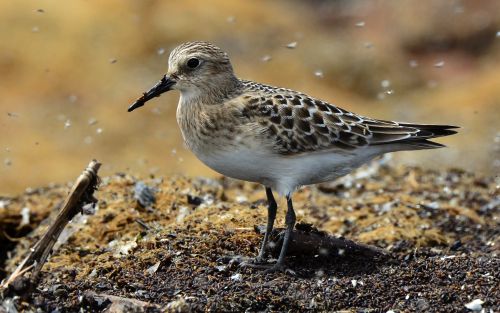
Although they don't inspire the panic of a stint, Baird's Sandpiper is a refreshing fall migrant that only has a short window here. They are refreshing birds in and of themselves, but their presence is always a tasty precursor of things to come...if you are looking at a Baird's Sandpiper in California, chances are you are only a few weeks away from experiencing that holiest of months, SEPTEMBER.

I know, I know, you can roll your eyes, we are far removed from September, but I'm getting there! I won't say that blogging is hard (it isn't, despite everyone who starts one and then gives up), but I will tell you that blogging with a baby is hard. As Corey Finger rightly pointed out to me last year, it's not that you won't have time to bird anymore once you have a baby, it's that you won't have time to blog. This is true.


Refreshing birds are often found in disgusting places. That's not a gross mudflat the birds are on, it is a much filthier floating mat of algae. Juvenile Least Sandpiper on the left for comparison.


Has any bird mastered the filthy floating mat dance like the Baird's Sandpiper? Unlikely.


Ok, I'll throw in a token resident bird, and one that BB&B doesn't cover much. This juvenile California Gull was also holding down the algae mat along with the peeps. I know birders in most states don't get to see this short-lived plumage very often, and we are balls-deep in gull season right now, so enjoy! The Baird'seses and the gull were at Coyote Hills Regional Park in Fremont, CA.

Friday, October 14, 2016

The Coast Is Alive With The Sound of Vague Runts


September went by very, very quickly...I have much catching up to do. September is generally considered the best month of the year to be birding in California...seabirds, shorebirds, and passerines are barging through the state in huge numbers (by West Coast standards) and the potential for finding a rarity is as high as it can get. Not that October is any slouch...it can be just as good, if not better...the main problem this month is that you have to battle the Yellow-rumped Warblers. This week rarity fever has been particularly acute...after Sunday passed, day after day has been absolutely perfect for putting down Vague Runts on the coast, and I've been stuck in the office like a chump...the Perpetual Weekend looms large, in memory. Birders at Point Reyes and Bodega Bay have been getting rewarded every day with the overcast skies and south winds...the patches are just clogged with rare right now. No Yellow-green Vireos for me this week (three have been found in the greater bay area in the last few days, two photographed...fuck), but fall is not over yet.


This fall was a good one for Baird's Sandpipers, it seemed like they were getting reported a lot more than in most years. Seeing them in California always feels like a mild victory, though they aren't quite unusual enough to be a true rarity. Frank's Dump, Hayward, CA.


Lesser Yellowlegs bring the mellow compared to their louder, larger relatives. We get good numbers of them at Coyote Hills (where this bird was), but they are pretty local throughout the bay area.


In early September I moved from Oakland to Albany, to move in with Billy so we can raise the shit out of this baby that is on its way. Albany (on the north side of Berkeley) is a tiny city that is little-known outside of having Golden Gate Fields and the Albany Bulb, so tiny that most people who don't live here don't even have an opinion about it...and we in the bay have a lot of opinions. Anyways, my last morning in Oakland I thought I should bird my patch one last time before I had to start a new one. Middle Harbor Shoreline Park has never rewarded me with anything really juicy (an extremely late fall migrant Common Tern was my best bird to date), but I always though the place had a lot of potential for waterbirds. As expected for early fall, a horde of loud Elegant Terns were loafing on the mudflats. A throng of birders, presumably an Audubon group, was also there; when they moved past me without mentioning any birds of interest I presumed that it would be another typical visit. I was wrong.


Within minutes of the group finishing their trip and leaving, I found a no-doubt BAR-TAILED GODWIT not far away on a mudflat. I couldn't believe it...finally a rarity here...and not only a self-found vague runt, the best bird I'd found in a few years!


Unlike the godwit I had seen at Bolinas just a few weeks before, this bird was quite close. I walked out to the end of a breakwater and hoped the sleeping would come in closer as the tide came up, which worked out brilliantly. I was quite chuffed.


I was out there for a while, and eventually the birds accepted I wasn't a threat and went about their business. Great looks at this quality rarity, this quality SIBE. Now, I'm not a big proponent of the One Bird Theory, but with the help of Peter Pyle I was able to compare photos of this bird, the Bolinas bird, and the Don Edwards bird, all of which had been seen within weeks of each other in three different counties. Personally, I feel there is a strong probability that this bird and the Bolinas bird were one in the same, while the Don Edwards bird was another individual.


Luckily, the bird stuck around a few more days and was relished by a great many birders; I'm only aware of one or two other records for Alameda County, and people were stoked. I guess I can't call it quits on this patch after all.


Now that we got this rarity out of the way, we can go back to robin-stroking. We take them for granted here, but there is nothing not to like about Chestnut-backed Chickadees. They are one of a handful of our native passerines that have adapted well to urbanization, and their flocks often lure in various migrants that will join up. Lake Merced, San Francisco, CA.


When I talk about robin-stroking, I'm serious. Young American Robins are rather interesting early in the fall. Don't deny it. East Wash, San Francisco, CA.


Chickadees and robins are well and good (what would we do without them?), but those are not birds you want to devote a lot of energy to in September. Gray Flycatcher, on the other hand, is one of those birds. Westerns and Willows are the only expected Empids on the coast any time of year; anything else from that genus is a very solid bird. Golden Gate Park, San Francisco, CA.


I love getting county birds in San Francisco, even though I haven't lived there for a few years now. I also love seeing birds out of range, even though Gray Flycatchers breed about 4 hours east of here in Mono County. A life of seeking rarities will do that to you. Hopefully this individual continued south along the coast, and wasn't so turned around that it thought the best migratory route it should take was southwest over the Pacific. That's not how I would have done it.


Wild Turkeys drink bourbon, not sure what it was doing here. Coyote Hills Regional Park, Fremont, CA.

Wednesday, November 18, 2015

The Most Overrated Bird

There are a lot of birds in the United States. There are even a lot of birds in Canada. One can see hundreds of species in a single year, without leaving your home state. Remarkable! Those that get out regularly can find a brilliant diversity of birds without leaving their little corner of the world. There are a lot of birds to see.

As the years go by and a birder sees more and more birds, certain things happen. A birder will start to feel a certain way about certain birds. For example, I'm quite fond of Baird's Sandpipers.


Baird's Sandpipers are one of the dullest North American birds. They have a severely limited color palette to work with. In migration, the only time I ever see them, they essentially behave the same as all the other peeps, though they tend to forage on slightly drier mud rather than out in the water. Is that fascinating? I think not. They are a bit bigger than other peeps and have long wings. Their calls are distinct, but not terribly interesting. They are pleasantly patterned but it's nothing a sandpiper can brag about. I suspect they are much more interesting to watch up on their breeding grounds on the tundra...but I've never been there and never seen them north of North Dakota.

And yet...I'm quite fond of Baird's Sandpipers. Perhaps it is just a function of their abundance, or lack of it. They are not a rare bird here, but they are respectfully uncommon. It's difficult to put a finger on.

Perhaps a commoner bird would be a better example of what I'm talking about...I like rare birds, so maybe I'm biased. How about...Mew Gulls.


Mew Gulls are dirt common here. One can see hundreds in a morning without putting in any effort at all. When someone tells me they haven't seen a Mew Gull before, I look at them funny, even if there are a multitude of excellent explanations for why they have not seen one. A life of birding without Mew Gulls is a strange notion to me. They are here in the bay area, in large numbers, for almost half the year. They are a familiar sight. Unlike other gull species, one does not see a flock of Mew Gulls and immediately think, "Oooh, there could be something good in there", which is my reaction whenever I see a bunch of Glaucous-winged/Herring/Western/Thayer's, etc. Yet, like them I do. They are small, they are unobtrusive, they occasionally make cute noises, and they don't hybridize with all their cousins. They aren't terribly unique, looking like a cross between a kittiwake and a Ring-billed Gull, but that doesn't bother me. Looking at them pleases me.

But with other common birds, I feel a bit differently. I need not list them all...I approve of them, surely, but after seeing so many...it can get old. The years go by, you see thousands of them..."familiarity breeds contempt", as the saying goes. You understand this. I doubt you are thrilled to see a Double-crested Cormorant these days, there is nothing wrong with that.

However, there is one bird that people consistently really, really get worked up about in California; I don't know why...they are not rare, they are not limited to a specific habitat. They are regular here in large numbers. See?


Look at that. They seem to be everywhere! A truly abundant bird. This bird, for about half the year, is reported to listservs more than any other single species, including a lot of significantly rare species. The amount of listserv traffic the Marin Dusky Warbler generated last month was a drop in the bucket compared to the praise this species inspires. Amazing for something so common right? So what could this species be? Surely it must be something beautiful, something charismatic, something that strikes a chord deep in the heart of every birdwatcher. Could it be a bird of prey? A facemelty oriole? A striking species of waterfowl? A hell of a warbler?

No.

It's a Pine Siskin.


Why? Why is this bird so revered? Look at it! It makes a Savannah Sparrow look crippling in comparison. Minus a dash of yellow, it rocks the color scheme of a female House Finch, one of the most aesthetically-loathed birds out there. I get that people are excited about birds that show up in their yards, but why is such attention not lavished on California Towhees? Anna's Hummingbirds? Allen's Hummingbirds? Chestnut-backed Chickadees? These birds are just as worthy of praise, if not substantially more so. I have seen thousands of Anna's Hummingbirds and can still be fascinated by one...with siskins...I'm sorry, I just don't get the universal appeal. It's not as if they are a highly irruptive species here. Give me Bushtits for my team, you keep your siskins.

And so there we have it...the most overrated bird in California, in my opinion, is the Pine Siskin. It is not a bird that I have hate for, but I seem to have an empty heart for this species compared to so many other birders. Why this species dominates listservs in counties from Oregon to Mexico is not something I can fully explain.

What do you think is the most overrated bird in your state? Is it also Pine Siskin? I suspect it could be. Just don't tell me "Snowy Owl" or some other awesome bird that rightly deserves the pedestal it occupies. Let's get to the heart of this thing.

Monday, September 7, 2015

Trembling and Giddiness, Globetrotters, Winning Hearts and Minds with Weird


Shorebirds.  Gotta love 'em. I've always loved shorebirds...the first rare birds I ever saw, on the same day, were a god damned Mountain Plover and a fucking Ruff.  So an affection shorebirds is deeply ingrained in me.

I recently went out to Alameda in order to track down my county Baird's Sandpiper, something I used to see on the regular...but for some reason it has not been a forthcoming bird for me in recent years, at least here in the bay area. The juvenile Baird's was easy to find, and quickly the outing devolved from a noble chase into a gluttonous crush fest of small shorebirds. This Baird's was the most cooperative of its species I have ever met, and its proximity caused much trembling and giddiness.


The birds were feeding on a big mat of algae that had piled up along a breakwater at the north end of the Elsie Roemer Bird Sanctuary, which can be a great shorebirding spot at the right tide...considering the number of birds that pile up there, the place is overdue for a solid rarity I reckon. The number of flies feeding on the algae was staggering, and the peeps were loving it.

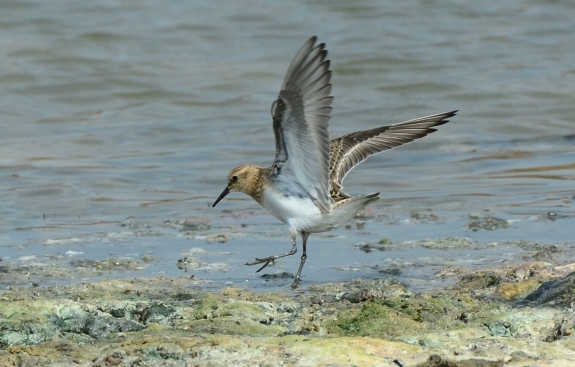
Baird's Sandpipers have longs wings!  So majestic.


Sorry if you thought that last shot was too far away. Here is a closer one.

Most Western Sandpipers I've seen lately have been juveniles, only a few months old.  I can't fathom how these birds (and many other species) hatch on the tundra and then migrate thousands of miles away in the correct direction a few months later. Well, I can fathom it, but it's still a difficult thing to accept.  A human being is essentially worthless at three months of age, and a peep is a globetrotter.


There are a lot of juvenile Least Sandpipers around now as well. Some of these birds are very bright...too bad their reward for making it through their first year will be looking incredibly drab for the rest of their lives.


These tiny flies must look enormous and juicy if you are the size of a Least Sandpiper.

Black Turnstones will abandon their rocky strongholds if there is enough food to attempt them.


There are a lot of crisp juvenile Sanderlings around now as well. While they do have a distinct preference for wintering in saltwater/brackish habitats, they can do it about anywhere. This bird could decide to drop anchor here in San Francisco Bay for the winter or keep going all the way down to Chile or Argentina.


Black Oystercatchers hold down the breakwater with bigger breakwater buddies.


I haven't been to Radio Road in days. By days, I mean hella days, like hundreds of them. They had some avian cholera popping off in the ponds last year so they had them all drained for a while. Eventually they refilled the ponds and it is essentially back to the good birding spot it once was. A bunch of Forster's Terns bred there this year, so I thought I would lurk down to check out the tern scene and see if any interesting shorebirds could be parsed out from the masses.


There were terns of all ages present...tiny downy chicks, recently fledged juveniles (like this one), and somewhat haggard looking adults.


Whenever an adult tern would fly by, all the juveniles would start begging in unison.


Even the juveniles have some burgeoning elegance in them, although it is mostly buried under young awkwardness.


A pair of Black Skimmers were also present, looking weird as usual and being generally enjoyable to look at. Skimmers never fail to make a mark on someone who has not seen one before. Most birds that are so good at leaving an impression are either majestic, facemelting...or an owl. People really like owls. Skimmers win over hearts and minds by just being weird.

Radio Road is the best spot in northern California to see skimmers, which are irregular north of Santa Barbara County. The birds are pretty reliable for a good chunk of the year and do not require any sort of scoping to get a decent look at.


Hella shorebirds at Radio Road, as usual, but nothing weird outside of a couple Lesser Yellowlegs. Here is an s-shaped roost for the hell of it.


No, I'm not going to do a "why did the tern cross the street" joke, that would be highly regrettable and ultimately tragic. Radio Road is in Redwood Shores and is a good place shorebirds, waterfowl (Eurasian Wigeon in winter) and crushing in general, it's a good spot to check out if you're visiting the bay or want to take a beginner out birding.