Showing posts with label California Quail. Show all posts

Monday, August 13, 2018

Saying Hello To The Nikon D7200


The D7000 and I have been together for a long time. Here is a Green-winged Teal back from our early days together, when everything was fresh and exciting and we were still exploring each other's bodies...er, when I was exploring the D7000 camera body. Cropped and color corrected, 1/800, F6.3, ISO 900. Photographed at Radio Road, San Mateo County.

I've said it in this space over and over and over again...I am not a photographer. Have never claimed to be. I do, however, take photos. Get it?

Some of you do, and that is all I can ask for. With that major disclaimer on the table, I have to mention that I do actually put in some occasional effort to take good photos...BB&B has hosted a large number of photos over the years, and hopefully they are only cringe-worthy every now and then (vagues). I rarely go birding with photography as my primary goal, but let's be real, having good photo ops adds to the quality of any birding experience if you are the sort who likes to carry a camera around.

I do get asked about camera gear, techniques, etc. from time to time, and now that I have a new camera, I thought it was time for the rare (first ever?) BB&B gear post. This isn't going to be super in depth, but it will hopefully be informative for a few readers who are thinking about upgrading their camera, or getting their very first.

For a number of years I have been using the Nikon D7000 (first released in 2010), which has been fine, though not amazing. The vast majority of content you have seen on BB&B for the last four years or so has been shot with that. It has been solid, performing well in low light compared to what I was using previously (the Nikon D90), though I have had some noticeable focus point issues the last couple of years that I'm sure are more the camera's fault than the lens I use. These problems were encountered both with birds in flight and birds out in the wide open, i.e. on the water or mudflats. Now it's no mystery to me why a camera can struggle with knowing where exactly it should be focusing for a sandpiper strolling through the muck 300 feet away, but a big Buteo soaring 300 feet away in good light should not be a challenge for a camera to figure out, you feel me? It won't be a crush, at least with a 400mm lens, but I expect sharp images at least.


The D7000 has never had difficulty figuring out what to do with anything in true crushing distance though, like this California Ground Squirrel surveying its domain. Unedited. 1/1000, F7.1, ISO 800. By the way I rarely post full size images to the blog, but this time they all are; double click on any photo to see it full size/high resoultion if interested. Photographed at Rancho de Bastardos.

Good chance a dirty AF sensor or contact is to blame for my D7000 problems, but now figuring it out is not a top priority. I'm happy to say that this summer I have upgraded to the Nikon D7200, which was first released in 2015 (hey, I didn't say this was a cutting edge post), which is two generations newer than the D7000; the Nikon D7100 came out between the two, but it was so similar to the D7000 that I had no interest in it.

So now to the meat of this post...what is there to like about the D7200? How is the D7200 different from the D7000?

*First and foremost, it is said that the sensor is just better, plain and simple. That is my impression as well. Better sensor, better photos.

*The highest ISO the D7200 allows you to use is really, really high. No one actually wants to be shooting at a six-figure ISO...but now they can!


California Quail, cropped but otherwise unedited. 1/640, F6.3, ISO 900. This is the most confident/acclimated California Quail I have ever seen. Photographed at New Brighton State Beach, Santa Cruz County.


Tricolored and Bicolored Blackbirds. 1/5000, F5.6 ISO 400. Very slightly cropped. Kind of surprised this came out considering the low light, but I just let the camera do what it thought was best (while shooting aperature priority) and it worked. Photographed at Alviso Marina County Park, Santa Clara County; I thought the Tricoloreds were a nice find, it's not something I expect to find along the bay in July.

*With the higher ISOs come higher quality performance at higher-than-ideal ISOs. I would love to shoot at 250 all the time but that is a far cry from the reality of bird photography. Photos at high ISO with the D7200 are noticeably not as grainy as with the D7000. With the D7000, I was always hesitant to shoot above ISO 800 due to the grain factor (up to 1600 was sometimes ok if only minimal cropping was needed), but I think I will have a higher ISO ceiling (comfort zone) with the D7200.

*You have much more flexibility with your ISO sensitivity range, and I LOVE having an ISO range to shoot at instead of just shooting at a fixed ISO - this makes a huge difference in how I shoot. With the D7000, the sensitivity range went 200-400-800-1600-3200-Hi1 (whatever that is). Certainly useful but I felt like there was a lot of ground between 800-1600-3200 that was unavailable to use as a maximum ISO. And to be clear, this is just your options for setting up your sensitivity range, not what all your options are when just setting a fixed ISO. With the D7200, you instead get to set a range between 200-250-320-400-500-640-800-1000-1250-1600-2000-2500-3200-4000-5000 etc. etc. all the way up to 25600. Exactly the kind of improvement I was looking for.


Mourning Dove. Tight crop but no other edits. 1/640, F5.6, ISO 1600. The grain is there but it's really minimal compared to what I would expect from the Nikons I have previously used. Awesome. Photographed at Rancho de Bastardos.


And here is the original photo for comparison. It's not going to win any aesthetic awards, but the colors look really nice both in the background and on the bird (and since I am constantly looking at them at extremely close range, I should remind everyone Mourning Doves are actually attractive birds). I'm impressed with the photo quality considering the ISO. Significantly, the grain visible in the crop above hardly looks different from the original photo, and practically no sharpness was lost. 

*The D7200 allows you to wirelessly download images straight from your camera into your mobile device. Pretty sick if you are into social media or getting an image out of a rarity to other birders ASAP, instead of the classic back-of-camera photo that is enjoyed by nobody.

*The D7000 has a small buffer. I have not been able to field test it yet, but the buffer on the D7200 is supposed to be twice as big when shooting JPEG. That means the camera is able to handle shooting a large number of pictures in a short period of time without becoming a temporarily useless hunk of plastic while it processes the photos you just took. The small D7000 buffer was absolutely killing me one day in Texas this spring while warblers were flopping around on the ground mere feet in front of me...there was some serious crushing going on, but how many crushes were missed? I don't think I even want to know.

*Another upgrade with the D7200 I have not gotten to experience much yet is that it supposedly has a more capable autofocus in low light conditions, which would obviously be extremely useful for bird photography, since birding in low light is often par for the course.


Caspian Tern. Mildly cropped with no other edits. The tern's head is partially in shadow but I really dig how much the bird pops, so to speak. 1/3200,F6.3, ISO 500. Photographed at Rancho de Bastardos.

So there you have it. The D7000 will now be the designated macro lens/landscape/people camera, and the D7200 will be doing the heavy bird lifting. So far I'm quite happy with it, and I look forward to all the memories we will make and the souls we will steal together. If any of you use the D7200 and have any tips or preferred settings for shooting birds, by all means leave a comment!

Sunday, February 14, 2016

Owls of The Ground, Owls of The Pine, and Stroking of The Robin


A Belted Kingfisher hunts at Middle Harbor Shoreline Park, Oakland, CA. This is a great birding place where I see the same common species over and over again, which is in high demand these days.

BB&B has been very focused on exotic birds so far this year. I know it. And I know what you really want to be seeing are incredibly common, run-of-the-mill birds that anyone can see without even trying! Am I right? Or amirite? That's what the birding (or perhaps the bird photographing public) seems to crave these days I think, so if that's what the public wants, that is indeed what they shall get! Also, my GLOBAL BIRDER RANKING SYSTEM rank in Mexico isn't anything worth bragging about (Felonious Jive, The Great Ornithologist, has a much better standing than I do), so while posting about Mexico has been fun, it's not a good platform for touting where the GBRS puts me. However, as you may recall, I can totally brag about my GBRS score for U.S. ranked birders.  That would be #7, in case you have forgotten...but how could you? Anyways, lets take a look at some abundant, widespread birds.


Here is a Snowy Egret! Oh, joyous day! How pretty!


My goodness! A fish is pursued!


Ok, I'm not knocking Snowy Egrets and Belted Kingfishers or beginning birders (well...I am a little bit), I just thought I would change things up. I've got a big backlog of pre-Mexico photos to deal with, you know? I wasn't seeing many rarities in late fall/early winter so this is what we are stuck with. And if you are not happy about that, how do you think I feel? For good or ill, any kind of wader is fun to photograph when it gets giddy about catching fish. I'm still waiting for my epic, point-blank Reddish Egret photo session, so until I get spoiled with that we will have Snowy Egrets...


...and Forster's Terns! This is the one and only tern we have an abundance in the bay area in winter. It's a sad state of affairs. We don't even have many tern species in the summer. I miss living in places where seeing Black Terns is a normal thing. Ballena Bay, Alameda, CA.


At high tide, this bird was roosting on a little floating piece of driftwood, and drift it did until it was crushed into oblivion.


Ok, I reckon you have had enough of all the robin-stroking. Here is a Ferruginous Hawk, a bird superior to most birds. Salt Springs Valley, CA.


Judging by the extensive amount of white on the underwing and underparts (including the shaggy legs), this is a young bird. According to Dipper Dan, famed Calaveras County birder, Salt Springs Valley is the best winter birding the county has to offer. I reckon he is probably correct on that account. While we dipped on Rough-legged Hawks (this hasn't been a good winter for them), there was an abundance of Ferruginous Hawks and Lewis's Woodpeckers, and Tricolored Blackbirds and Bald Eagles were refreshing birds as well.


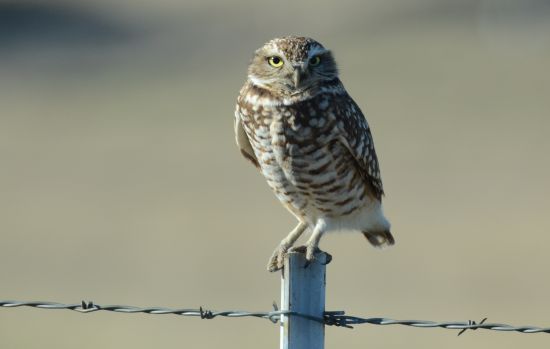
Refreshing birds are nice and all, but certain species reside on a higher plain of perception and enjoyment. I have a special place in my cold, nerdy little heart for Burrowing Owls.


This is the other half of the pair, presumably the male based on the paler coloration (or colouration, if you are so inclined). Shortly after this, while I was attempting the most epic photo anyone has ever taken of a Lewis's Woodpecker, my SD card took a shit and it was hell trying to get the photos off of it...not that you care, but it was a relief to rescue some decent owl shots.


Sometimes I post things photos of things like Black Phoebes, which is not a momentous achievement but it seems to drive the easterners crazy. In that vein, I offer you this California Towhee. Back in December, I went on a ragey camping trip that happened to take place where a few birds live. This brown beauty belongs to a breathtakingly common species, and it also happens to be disgraced former Bird Policeman Adam Searcy's favorite bird...and lets face it, he needs some cheering up. Only a month ago, The Bird Police relegated the besmirched Mr. Searcy to a boring subcommittee and stripped him of his former power. Will he ever rise again, like the phoenix, to become a voting member? We may not know for years. In an apparent snub to Mr. Searcy, Officer John Garrett celebrated Mr. Searcy's demotion by finding a briefly-chaseable Kelp Gull. It rained on Officer Garrett that night...droplets of Glory soaked him for hours. Pinnacles National Park, CA.


While northern California has a deficit of winter terns, we at least have a couple species of quail. California Quail is a fine state bird I reckon, delicious both to the eyes and mouth. Such plumpness and fine patterning is a thing best beheld in person, and behold I did.


Fantastic patterning on these birds, though their roundness may be even more remarkable. And no, we did not see any California Condors.


After Pinnacles, it was out to Mercey Hot Springs in Fresno County. Everyone in the group was excited about soaking in the hot springs...which was fun and led to exacerbated inebriation, but I was looking forward to Long-eared Owls a lot more. I had heard this place was the best place in the state to see LEOWs, and I had also heard that birders can't just show up there anymore without paying (which I cannot confirm or deny to be true at the moment), but I didn't care since we were paying to camp. The owls were easy, really easy to see, thankfully, and my nonbirder roommate Arrison found them before I even arrived.


While I was there, all the day-roosting birds I saw were all in a single pine tree. They were used to people, so it was no problem walking under them and getting a good look. Now this is a bird I will never get tired of seeing.


Incredibly, there were TEN Long-eared Owls roosting in this tree! Here are five of them, looking like oversized pine cones. I never thought I would see a flock of them, but you know what? I have seen a flock of Long-eared Owls. Imagine that. Shortly after this photo was taken, I became completely incapacitated with a hangover. As Flycatcher Jen says, good times!

p.s. #7

Friday, May 4, 2012

Still Ablaze


The internet is still ablaze after reading Cass' Ode a couple days ago. If you haven't done so yet, scroll down and read the screed that everyone is talking about. Indeed, things may never be the same...particularly how you feel about gymnosperms.

As for me, I'm exhausted, and my normally razor-sharp wit has been worn and weathered into a spongy and entirely uninteresting substance. That said, I do still have some bird photos that I think are worth tossing your direction. All photos today are from Agua Caliente Park.


Ash-throated Flycatchers are common in many habitats throughout the southwest. Although they are the drabbest (ashiest?) of the North American Myiarchus, you cannot help but want to be friends with them. 


California Quail have a plump and delicious air about them.


I really like the plume that sticks out of the foreheads of both Gambel's and California Quail. It is the jauntiest thing imaginable.


I don't know what kind of cholla this is, but I really like it. Such an inviting blossom attached to such brutality. If you haven't seen cholla, imagine what a porcupine would look like if it could assume plant form.


MacGillivray's Warblers are the brightly-colored treat that may or may not be lurking in the center of every shrub this time of year. Like it's cousins from Connecticut and it's other cousins in Mourning, they are adept at not being seen.  


I've been keeping eyes and ears fully popped and open for my first Swainson's Thrush of the year, but it has yet to materialize. Here is its commoner cousin, a Hermit Thrush. UPDATE: Right when this post was finished, I heard a distinctive, water-drop "Whit!" come from my backyard...looking out the door of my cabin, there was a Swainson's Thrush, perched upon the old Olympic racing boat that resides next to my cabin.


Phainopepla female. She's hot.


This male Phainopepla is a featureless black hole. Don't get too close, or you will be sucked in and spat out into some other universe...where Phainopeplas govern the laws of physics.


Bigelow's Monkeyflower may only be a few inches tall, but they bring the desert floor to life.


Dusky Flycatcher. I used to be hella good at telling Hammond's and Dusky apart, in the blink of an eye. Now, more often than not, trying to weave together the proper identification feels more like wiping my ass with stinging nettle. I don't hold it against the birds or anything though.


Well....it almost was a good picture. Black-tailed Gnatcatcher.


Compared to chollas, Barrel Cactus appear friendly and hospitable. It's spines are much more springy compared to the spines of other cactus. Sometimes I want to hug them, but sobriety prevents me from doing so.