It was recently brought to my attention that a very well-known birder asked (proclaimed) the following question: "Does anyone really still believe in "natural" trans-oceanic vagrancy?" Yes...he seemed to be serious, but perhaps he was just making a point. However, birding is rife with poorly-conceived theories backed with little or no evidence, and I think it is best we tackle this idea head on...before it is too late. As the Global Birder Ranking System's #7 U.S. birder, I feel it is my duty to respond to these contentious allegations in the name of the Birding Good, not to mention Good Birding.
This birder was speaking, of course, about ship assisted birds. His point was that there are so many ships at sea at any given time, transiting between countries and continents, that this could be the explanation for how and why all Old World birds show up in the U.S. and Canada. So how could this public birding figure, say something so...how can I put this nicely....profoundly baseless? Devoid of logic? Wrong? It suggests a fundamental lack of understanding of what birds are capable of, and what they do. Keep in mind that he is not suggesting that some trans-oceanic vagrants are ship assisted, he is suggesting that
all of them are. To be truthful, I've been wanting to do a ship assisted post for years, but this gaping breach of reasoning is finally making it happen.
Millions of songbirds, like this Eastern Wood-Pewee, travel many air miles over open ocean every year. These flights can be quite protracted, depending on weather conditions...a number of northeastern species are thought to migrate south from the eastern Atlantic seaboard straight to Caribbean islands and South America. When birds can cover vast distances over the ocean, that gives them ability to turn up far off course if something goes "wrong". Photographed at Dry Tortugas National Park, FL.
So, some quick background. There are a lot of ships in the ocean. They travel places. Migrating birds traveling overseas will occasionally land on them to rest. Sometimes they will only land for a few seconds, but some may ride a ship for days, and even longer. These birds are known as "ship assisted". This phenomenon really bothers some birders. They get the notion in their head that any "lost" bird that would have had to cross part of an ocean to get here must have arrived via ship, rather than under its own power. They then blather their bizarre and ridiculous conspiracy theories about ship assisted birds to anyone who will listen. Unless you buy into this (and thus perpetuate the horrible cycle), it's a major bummer to have to listen to or read about.
Let's get into this thing then. Birds land on ships, for sure. Birds have been known to ride to other continents on ships, disembark at their new home, and be located by birders. In some instances, it seems quite obvious what is going on...for example, all of Hawaii's Great-tailed Grackle records are thought to involve ship assisted birds, and I am completely on board (HA! HAHA!) with that theory.
Now lets look at the other side of the conspiracy coin...my apologies if this gets lengthy, but there is no shortage of evidence (not all of which I will even get into....I am only human) to dispute this bizarre claim. Remember, I'm simply dealing with this question: Does anyone really still believe in "natural" trans-oceanic vagrancy?
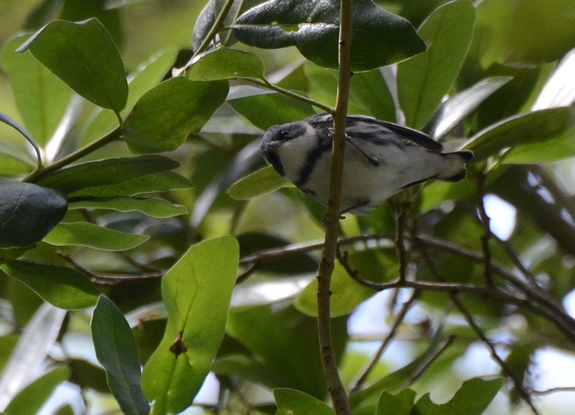
If a Black-throated Green Warbler leaves Mexico's Yucatan Peninsula for the Louisiana coast but encounters unfavorable weather, it may wind up making landfall hundreds of miles east or west from its intended destination. Weather conditions over the open ocean often dictate where overwater migrants end up, and is a plausible explanation behind the placement and timing of many (certainly not all) vagrant records. Photographed at South Padre Island, TX.
- Birds can migrate staggering distances. Obviously. Ships/trains/planes are not necessary for birds to accomplish this, for vagrants or otherwise.
- Birds find themselves where we do not expect them to be, whether they are migrating over a forest, a desert, or an ocean. This is basic knowledge...I'm not going to use an example for this. Combine a bird's ability to cover vast distances during migration and the inevitable fact that some of them get misoriented or blown off course due to weather, and you end up with a recipe for all sorts of vagrancy. Again, this is really basic stuff.
- There are hundreds of bird species that cross stretches of ocean as part of annual migrations, often between two continents...and I'm not talking about seabirds. It is absolutely normal. How can one possibly reason that a bird that crosses nothing but land can be a "natural" vagrant (i.e. a Black-throated Blue Warbler in California), but a bird that has to fly over the ocean is automatically ship assisted? I suppose the hundreds of Red-throated Pipits that have showed up in California and Baja California must relish spending their autumn weeks in the excellent bird habitat and feeding grounds that are transiting cargo ships. If this is true, we should be birding offshore container ships, not wasting our time in places like Attu, St. Paul, or Gambell.

Falcated Duck with Cackling Geese. This duck has been wintering in California for a number of years now; it must somehow have all the North Pacific shipping routes memorized in order to come back to the same place year after year...right? Photographed at Colusa National Wildlife Refuge, CA.
- Countless islands were settled by trans-oceanic vagrants, before ships (and human beings) existed. Did the ancestors of the Galapagos finches and Hawaiian honeycreepers ride out there at the bottom of a Polynesian canoe? No. Birds getting "lost" over the ocean has been happening for eons, and there is absolutely no reason why that phenomenon would suddenly disappear across hundreds of species.
- Shorebirds, ducks, and many other species rarely, if ever, land on ships at sea. If you think that all the stints that show up in the U.S. every year only got here by hitching a ride on a container ship, then you have my pity. A vagrant flamingo, banded as a chick on Mexico's Yucatan Peninsula, is currently living on the Texas coast. Can you picture it spending a week on someone's yacht in the Caribbean in order to get there? If you can, I applaud your imagination.
The Common Rosefinch...is this a ruthless, ship-hopping pirate? Or merely a spring overshoot? Photographed on Buldir Island, AK.
- Think of the masses of Siberian/Russian/East Asian species found on Alaskan islands over the last few decades...now imagine that every single one of those birds spent a few days on a ship prior to making landfall. I know its hard, but just try. Are you doing it? No? Well, I can't either. In fact, it is impossible.
- Huge numbers of birds migrate over the ocean. Now we may think that a bird landing on a ship at sea is not a rare or unusual event, but think about it...considering the numbers of birds that overfly ships every day and night...if even half of those birds took a rest stop on a ship every time they had to make a flight over an ocean, ships would likely be completely coated in birds whenever they were anywhere near a flyway. Sure this happens in major fallout events, but in the big picture, only a tiny minority of birds flying over the ocean ever land on ships in the first place. This does not bode well for those enthralled by the notion that ship assists are the explanation for all ocean-jumping vagrants.
- Here in California, close to 100% of the birds that dredge up the ship-assisted conversation involve migratory species that breed/regularly occur in Russia and have previously occurred in Alaska (and other states/provinces) that could reasonably arrive here. This appears to be accomplished via a bad internal compass (which seems to be how many eastern North American species show up here), strong winds in the North Pacific out of the west, or some combination of both. The much-ballyhooed "pattern of occurrence" is readily visible. How come there are seemingly no birds riding into the port of Oakland or San Pedro (allegedly) from anywhere else?

A Little Bunting. Of course, no one can know exactly how this bird wound up where it did (although I guarantee it was interesting), but if you just assume it was a ship assist, you might as well assume the thousands of Aleutian Cackling Geese in the neighboring field were ship assists; they probably came about just as far as the bunting. In fact, you could go ahead and assume it rode on the back of a goose all the way from offshore Alaska, for the classic "goose assist". In this case, the goose assist and ship assist are equally provable...so why not? Photographed in Mckinleyville, CA.
- Ah yes, there is little more that the birder appreciates than a good pattern of occurrence...including sex. But I digress...if ships are just taking birds willy-nilly across oceans, why do so many trans-oceanic vagrants have such predictable patterns? With all the North American records of Fieldfares and Redwings, why are there no records of European Blackbird? European Robin? If ship assisted vagrants are indeed so rampant, I would expect a lot more fun and wacky birds from other continents being seen on our shores, with much murkier and confusing patterns of occurrence.
- The appearance of many vagrant birds in North America, particularly on the west and east coasts, frequently coincides with significant winds and storm systems over the North Pacific and the North Atlantic. Sure some folks are still trying to attribute rare birds to Hurricane Sandy (please stop), but you get my drift. Birds do not enjoy migrating in strong headwinds; in fact, if a bird meets too strong headwinds or other inclement weather over the open ocean, that could lead to their demise. Following tailwinds (or getting caught up in them) to the closest point of land might be a migrant's only chance for survival, even if it takes them to the wrong continent.
- All worries about Palinian logic aside, Russia and its birdlife really are close to North America. For example, the distance between Russia's Chukchi Peninsula and Alaska's Cape Prince of Wales is a whopping 51 miles...a bird traveling west to east, as bad of an idea as that may be for the bird, could do that crossing in 2 hours or less with a tailwind, and be well on their way to migrating down the wrong continent if they did not correct their course. Oh, and 2 hours of flight time is nothing for a medium or long distance migrant, vagrant or otherwise.
At the end of the day, I am fine with the idea that some of North America's Eurasian vagrants may have spent some time on a ship in order to get here. I absolutely accept that, and want to reiterate that here. Are all of them? I think you know what I think...no. No they are not, its just not a tenable theory.
So how can you possibly demonstrate that a particular individual was ship assisted? One can speculate, sure, but speculation is not evidence. After all, what if the bird only spent 5 seconds aboard a ship? Or 5 minutes? Should that matter? What if it was 25 minutes? How would one know? Aren't these questions annoying? It's time we put them to rest. For many species (not all), particularly those with a pattern of occurrence, it is not possible to know if a particular bird is ship assisted or not. Discussing the semantics of it will always be fruitless; what some would describe as an atavistic endeavor. There are highly suspicious/obvious individual birds that are found where the ship assisted argument is certainly relevant, like with the previously-mentioned grackles or the legendary Snowy Sheathbill that managed to find itself in England...but not for every bird that may have seen an ocean at some point. There is, of course, the whole discussion about whether we should even care about ship assists....most birds utilize human-altered or entirely manmade habitats, after all...but I will let you guys sort that out.