Showing posts with label California Gull. Show all posts

Monday, December 11, 2017

Rarities Return, Featuring: Parakeet Auklet, Little and Red-necked Stints!


Every now and then a birding community will be struck by a rarity so bizarre and unlikely that we are left running around slamming into walls, foaming at the mouth, bleeding from headwonds, uttering incoherently about needing to be somewhere, at any cost. A Parakeet Auklet in July (July!) in San Francisco did exactly that, smashing the 2017 summer doldrums into oblivion and sending birders scurrying to SF. The story of how this vague runt was found was truly unlikely; a birder found it in the water off Sutro Baths in the summer of 2016, but it was never seen again...a year later, the same birder relocated the bird while kayaking less than a half mile further up the coast. This time, the bird was seen sitting on seastacks and cliffs, which as far as I know is the first time a healthy individual has been seen on solid ground in the state. There is a good chance the bird was doing the same thing the previous year, but no one saw it!

I appreciate a good Parakeet Auklet, and this being a good Parakeet Auklet (and a state bird) I dragged the family up to the city kicking and screaming for a chance at this bird...but despite staking it out for hours, it never showed. It was a tough dip to swallow, and most everyone who actually dips will tell you that all dip is tough to swallow to begin with...I'm talking about chewing tobacco of course, but hey it applies to birds as well.

While doing the drive of shame back to San Jose, I analyzed my chances of getting the bird the next morning if I made another chase attempt and decided against it...which I immediately regretted the next day when the bird was relocated quickly. My heart was filled with hate. By mid afternoon I was twitching uncontrollably from the constant updates of resightings, said "fuck it" and rocketed back north. This time I found the bird in about 30 seconds, circling behind Mile Rock. It eventually landed on a distant rock just a stone's throw from the shoreline, which I pointed out to several birders who were clearly there for the same reason as me.


Incredibly, one of the birders I updated totally ignored what I had just said, and instead told me that he believed the bird was currently sitting on a seastack right below us. Keep in mind I had a spotting scope and he did not, so I must have seemed absolutely incompetent to him. Friends, do I give off an air of complete ineffectiveness? For those of you who haven't met me, next time you encounter a birder in the field that you believe has utterly no idea what they are doing, just go ahead and assume it is Seagull Steve.

I had to look at this man's auklet, of course. It turned out to be not a guillemot, or an oystercatcher, or a black bird of any sort...it was a shadow. A shadow.

I booked it to where the actual bird had been sitting and eventually ended up below it, as it had flwon from its rock and was roosting high up on a cliff. Talk about something I never expected to see outside of Alaska. July in San Francisco? Get out of here. State bird! Though California has accrued quite a few records now, this is a very unreliable bird to see anywhere in the state....as Flycatcher Jen would tell you, good times.


July isn't all state birds and Parakeet Auklets though. Least Sandpiper is much more typical birding fare around these parts, and much more confiding as well. Photographed at Don Edwards NWR.


My god...could it be? SHARP-TAILED GROUSE???

No, it can't be, but this Least Sandpiper is striking a pose remarkably similar to what displaying Sharp-tailed Grouse are known for. This bird was having a territorial dispute with another Least.


Remember the barren dowitcherless times? It sure is nice to have dowitchers again, especially pink and orange ones. I think these are all Long-billed.


On another July day, I was out birding and saw a report of an alternate plumage Little Stint that was within easy driving distance. It wasn't a lifer/state/county bird, but seeing as I had gotten to look at all of one (1) before, I picked up the scope and hustled back to the car. The instincts that made me the Global Birder Ranking System's #7 US birder made me stop and scan a blackbird flock just long enough to find my county Yellow-headed Blackbird on the way back, and I was still able to make it back to the car quickly. Things were going splendidly. Unfortunately, at that point my instincts ceased to serve me well...in my haste to get on the road, I broke off TWO door handles to my car. What the fuck?! Who does that? This wasn't even for a life bird. That's what those two gray things are in my palm, freakin door handles.

And to top it off, later that day I was playing bass and I ripped off the plug to the amp from the power cord. Nerd strength was just pumping through my veins that day.


But hey, I saw the Little Stint! Talk about a completely rubbish photo (digiscoped). The light wasn't great and the bird wasn't very close, but I did get really nice, prolonged views. Lifer plumage! Year bird! It was nice to continue my long running streak of taking terrible stint photos.


A few days later I went back to see if the stint was still around (it was not), but I did find a very interesting peep that had me confused for a bit. Not that you can tell, but the bird's back was very bright and boldly marked, with lots of orange and red tones. With the short, straight, tapered bill, it was an intriguing combination, but at the end of the day it was just a Semipalmated Sandpiper.

Just a Semipalmated Sandpiper? That's a bit of an understatement...despite a great deal of looking at peeps all around the bay for many years now, until this bird I have never been able to find one in any bay area county. Anyone who has birded much around here would find that baffling, and they would be right. This was a hard-won bird, thus you are forced to look at a photo (digiscoped) so awful that it is, in fact, art. It was also the most colorful individual I have ever seen, but again you cannot make that out whatsoever. Because art.


Sorry about the run of appalling photos. Here is an alternate Western Sandpiper pondering life in its reflection. This looks to be a male, judging by the relatively short and straight bill.


This adult has already acquired a lot of basic plumage, but retains some old summer chevrons on the breast. More of a femaley bill on this bird.


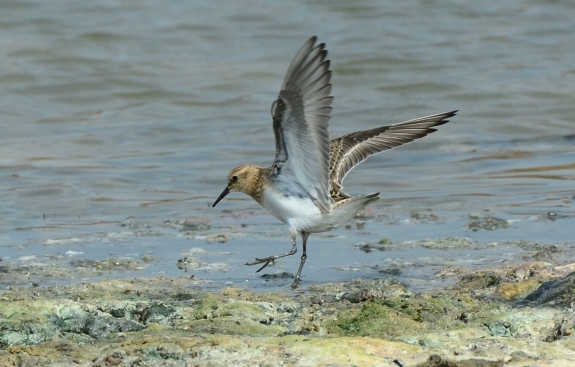
Oh why hello RED-NECKED STINT. It sure is nice to see Red-necked and Little Stint in the same week! That's California birding for you. This one was at Elsie Roemer Bird Sanctuary in Alameda. As I mentioned back in 2015, this place had been due for a great bird! As with my other Red-necked Stint experiences in California, nice prolonged looks at a spiffy alternate bird that was either distant or in crap light. Not sure how that keeps happening, but when one is looking at a stint one cannot complain. But now I really, really need to get a good photo of some kind of stint eventually...

Although they don't inspire the panic of a stint, Baird's Sandpiper is a refreshing fall migrant that only has a short window here. They are refreshing birds in and of themselves, but their presence is always a tasty precursor of things to come...if you are looking at a Baird's Sandpiper in California, chances are you are only a few weeks away from experiencing that holiest of months, SEPTEMBER.

I know, I know, you can roll your eyes, we are far removed from September, but I'm getting there! I won't say that blogging is hard (it isn't, despite everyone who starts one and then gives up), but I will tell you that blogging with a baby is hard. As Corey Finger rightly pointed out to me last year, it's not that you won't have time to bird anymore once you have a baby, it's that you won't have time to blog. This is true.


Refreshing birds are often found in disgusting places. That's not a gross mudflat the birds are on, it is a much filthier floating mat of algae. Juvenile Least Sandpiper on the left for comparison.


Has any bird mastered the filthy floating mat dance like the Baird's Sandpiper? Unlikely.


Ok, I'll throw in a token resident bird, and one that BB&B doesn't cover much. This juvenile California Gull was also holding down the algae mat along with the peeps. I know birders in most states don't get to see this short-lived plumage very often, and we are balls-deep in gull season right now, so enjoy! The Baird'seses and the gull were at Coyote Hills Regional Park in Fremont, CA.

Tuesday, January 3, 2017

Scouting For The 5MC


The Five Mile Challenge (5MC) is coming up fast! It is scheduled for this Saturday, and if the weather allows it, I will be squaring off with two other vicious (have you met Miss Brown???), unapologetic nerds in Portland and Austin. As This Machine Nate is prone to saying, anything can happen. While I do have a major advantage of having San Francisco Bay in my circle, there are shortcomings as well...there is no real, killer hotspot in my circle, and there is a definite lack of fresh water. San Pablo Reservoir is in my circle, but since I don't have an EBMUD permit I do not think I will be able to bird it. I'm also worried I won't be very strong with passerines...well you can bet I will be strong as fuck identifying them, but there just isn't much diversity in my circle, and I think I may have to struggle with getting a lot of the birds that Flycatcher Jen could easily get (i.e. Red-breasted Sapsucker, Varied Thrush). And bla bla bla bla shit, I hope it doesn't rain the whole weekend.

As I mentioned before, my traditional patch is actually over five miles away, so once it was decided that the 5MC was on I had to do some scouting and scouring of some previously overlooked sites. If I was going to win, I would have to bird some places I don't often bird. Scouting has indeed panned out, and now I know a spot that could be critical for me is the area around the Richmond Marina.


I have spent minimal time birding here in the past and didn't have high hopes, but I was happy to see a male Black Scoter, which are very rare in San Francisco Bay. This is a bird I haven't seen in a long time...a long time. And I'm not talking about the species, I'm talking about this particular individual...I last saw it in 2013! This bird has been wintering here for a great many years, so it was nice to be the official refinder of the bird for the winter of 2016-2017. Most birders who have seen a Black Scoter in Contra Costa County have seen this one individual. And this individual, for whatever reason, let me crush the shit out of it.


Black Scoters are very uncommon in most of California, and practically never appear in places where you can get very close to them. Honestly, I had better looks at the Del Norte Common Scoter than I have had of Black Scoter anywhere. This bird was remarkably confiding, hanging out and flirting with Greater Scaup hens just a stone's throw from the shoreline. Even more incredibly, the bird was calling regularly, something I've never heard before...a mournful, descending whistle, kind of a like a more poignant Dusky-capped Flycatcher. I recently went back to the marina and actually found the bird by call...birding is weird.


So while not a major rarity, I was chuffed to get such good looks (yes, they were soul-satisfying) at this bird so close to home.


Of course, you can't see Black Scoter in California without having to sort through Surf Scoters, which almost anyone can muster some enthusiasm over.


Say's Phoebe was a bit of a surprise foraging in a small grassy area on the bayside, and aren't particularly common in my Five Mile Radius (5MR). Hopefully it will still be around for the 5MC.


An adult Horned Grebe uses its terminator eyes to great effect, slaughtering very small fish with cold efficiency.


An immature Horned Grebe uses its dusky eyes to a not-so-great effect, but will hopefully catch enough to eventually be slaughtering very small fish cold efficiency.


East coast birders are likely not so impressed with our faithful, scaup-loving Black Scoter. To compensate, here is a shiny Pelagic Cormorant to get your dirty gripoff juices flowing. Unlike our other saltwater-loving cormorant (that's Brandt's Cormorant for you n00bs), they are fairly common in San Francisco Bay and aren't relegated to the area near the Golden Gate.


On another trip to the Richmond Marina and surrounding bayside, it was low tide and the whole area was just being torn asunder by Black Oystercatchers. American Crows were also mucking about in the intertidal, procuring mussels, which the oystercatchers undoubtedly frowned upon...omnivore poseurs. Occasionally I'll see an individual like this one with pale fringes on its flanks.


To all the aspiring gull lords out there, sorry I haven't been posting many gulls lately, I don't know what to tell you. Do you know how many gulls I saw in Puerto Rico? Two. Do you know how many years it has been since I've seen a Glaucous Gull? Five. FIVE! Did you really need to know that? Possibly. Anyways, here's a Thayer's Gull and a California Gull. Thayer's will be a very good pickup during 5MC, hopefully it will not be a bird that gets left behind.


Out in the great, untamed wilderness that lies beyond the 5MR, other birds can be found. Our resident, introduced moffitti/maxima Canada Goose flocks often lure in other species, usually diminutive Cackling Geese. Martin Luther King Jr. Regional Shoreline, Oakland, CA.


Separating the two species here is usually a no-brainer, though other parts of the country do not have it as easy as we do (there are smaller Canada Geese and larger Cackling Geese subspecies further east). I would be stoked to get any goose species besides Canada during the 5MC, but we will just have to wait and see.

Nate, Jen....5MC is going to break you. After this, there will be nothing left of you beyond cracked shells, empty husks of what once were people. Everyone you love will shun you, beginning with your local birds this Saturday. And if I lose because it is pouring rain this weekend (which is the current forecast), I hope you except my butthurt gracefully.

Thursday, June 30, 2016

Business, Spring Gulling, and Dreams Really Do Come True


We are in the depths of summer now...there is no doubt about it. You know how I can tell? If I wake up late on a Saturday morning I don't have immediate FOMO, thinking there is some rare bird nearby that I should be looking at. It's a disappointment, and also a relief, but reminds me that I should just be out birding anyways.

I do have some more spring birding to catch up on, so let's get to it. After the Siberians packed up and left, it was out to the Hayward Regional Shoreline marshes to look for some migrant Black Terns and a vague runt Laughing Gull. The crippling Black Terns had packed up and left the night before, but the modest young Laughing Gull was easy enough to find, picking up and periodically flying above a Least Tern breeding colony. This is only the third I've seen in the state away from the Salton Sea, and is an exceedingly good bird in this half of California.


By this time, local breeders were already conducting their reproductive business, while other lingering migrants in the area still had thousands of miles to go before they were in the right business-conducting habitat. Black-necked Stilts had already made their cute fuzzy precious babies.


Black Oystercatchers poke around the rocks at Middle Harbor Shoreline Park, in Oakland. They are my favorite resident shorebird. They put a lot more effort into chick-rearing than the other local shorebirds, actually delivering food to their chicks (plover and sandpiper chicks do their own foraging) and continuing to do so for months. Chicks that survive to fledging are thought to migrate with their parents.


That said, I have no idea if the birds present in the bay area through summer are year-round residents or disperse in fall, or both. Our winter climate is pretty tame compared to some of the places they winter, so it seems like there would be a lot of permanent territories here.


This is the view looking west at downtown San Francisco from Middle Harbor...it's not very far away. There are some Red Knots in that shorebird flock between the Canada Geese, which was a nice addition to my patch list.


In late May I went with Billy and several nerds to Point Reyes, with high hopes of eastern vagrants and low expectations to match. Low expectations won out, but it was still a nice day on the point. A couple Rhinoceros Auklets close to shore were a surprise, and hundreds of Pacific Loons migrating past Chimney Rock made for a mellow consolation. The resident Great Horned Owl pair at Mendoza Ranch successfully stopped traffic.


The Common Murre colony below the lighthouse was getting crowded. There is much business to do.


The secret-not-so-secret Western Screech-Owl in Lafayette was still holding it down in May. It's possible this bird did no business at all this year. Here it is dreaming about sitting in a tree cavity all day....luckily for the owl, its dream happens to be its reality.


Earlier in the spring, Billy and I checked out Briones Regional Park after a rain. Other than a Golden Eagle, the birding was pretty weak, so I had to find pleasure in the nonavian. California newts were on the move and provided the pleasure that I was seeking.


One patch along the trail was particularly rife with fungus. I don't know much about fungus, but my friend Christian does...check out his blog! Christian is not just another breed of nerd with a blog though, he just coauthored a pioneering mushroom identification guide that any west coast mycofiend would do well to own. Read all about that here.


I just don't know what to caption a fungal photo with. I know nothing about fungus. This kind likes logs and is pretty.


We better get another bird in here...I don't want ya'll to get intimidated by expertise in mycology. Aside from dipping repeatedly on the gannet at Half Moon Bay this year, I managed to gather up the Kelp Gull to join in my Half Moon Bay Dip Party. The only interesting bird I saw at the mouth of Pilarcitos Creek was this bird on the right. The contrast between the mantle of this bird and the surrounding California Gulls was even starker IRL than it is here. It was so freaking pale...but it was just a California Gull! Gulls continue to amaze and enrage me.

Wednesday, December 10, 2014

Clam Cravers, The Majestic Scale, Winter Gulls


Birding is happening. I'm taking a lot of time off work this month, and more birding is in the forecast. I'm currently writing this from Ventura, so expect some slightly different stuff in the next couple weeks. This post is all about birding the bay area though...and no, I did not see the Rustic Bunting, it was found the day I left Oakland (reported widely the day after that), so I appreciate everyone's concern but I die a little bit inside whenever someone asks me if I saw it...however, it's not a life bird or an ABA bird for me, so I can manage to keep it together...barely. So that aside, this is the first White-winged Scoter I have ever photographed, and I was stoked to get some crushing in. San Leandro Marina, San Leandro, CA.

White-winged Scoters are uncommon in much of California, and rarely seem to be close to shore. This bird was actually present here last year and I kept missing the damn thing, so it was good that we could finally meet. San Leandro Marina, CA.


Come to think of it, this is the best look I've ever had of a White-winged Scoter anywhere. I've definitely never known that they had purple heads (look behind the white eyeliner). Great success. San Leandro Marina, CA.


Scoters are crazy. They just wolf down entire shellfish...just swallow that shit whole. People admire vultures for their ability to digest carrion, but I think scoters deserve some digestive credit too...they must have insanely strong innards to be able to internally pulverize the shell without shredding their entire digestive tract. San Leandro Marina, CA.


A jubilant clam craver. San Leandro Marina, CA.


This White-tailed Kite got aggro on a passing Merlin. This is the first time I ever photographed a kite and a Merlin in the same frame, and I expect it will be my last. Mount Trashmore, Hayward, CA.


I have never completely understood those isolated black spots on the underwing of White-tailed Kites...none of our other raptors show anything similar. How did that evolve? Is there any functionality associated with them? They do look good, I have to say.


While roaming around for longspurs, this Golden Eagle periodically passed overhead. I hope it got to nail a Canada Goose for a Thanksgiving feast. Photographed at Mt. Trashmore.


Whenever I get to see a GOEA up close (which is not very often), I am always struck by how freaking big their talons are. No wonder they can take down a deer. This is one the leading birds on the "majestic" scale, as far as I'm concerned.


And on the opposite end of the majestic spectrum, we have the Lapland Longspur. Oddly, aside from my time in Alaska (where they were everywhere), I have put far more time and effort into finding longspurs than Golden Eagles. I hope that somewhere a hawk counter is reading this and is completely disgusted by that statement. Photographed on Mount Trashmore.


I don't think I saw a single longspur last year, of any species. Pathetic. Now I can say I saw 3 Lapland Longspurs this year, which feels much better.


Now we are really getting away from majesty...but Thayer's Gull has a solid fanbase, myself included. Lake Merced, San Francisco, CA.


Here's an attractive Western X Glacous-winged Gull hybrid (I think)...they normally don't appear this nice and frosty, but they are a winning gull when they do. San Leandro Marina, CA.


I hardly ever post California Gulls on here...but it's not because I'm not seeing them, I assure you. They are fun to watch at Mono Lake, where they dip for brine shrimp and charge clouds of brine flies, but on the coast they are a parking lot bird. Thankfully, they are not big on hybridizing, but they have not been able to convince their larger relatives to stop doing that. Photographed at Lake Merced, CA.