Birding on foot at Crooked Tree can be very good, but no visiting birder comes here without taking a boat trip on Crooked Tree Lagoon and heading up Spanish Creek...I think that is what they usually do anyway. One morning Billy and Annabelle and I all got on a boat with a Euro family who also had a toddler, which sounds like a potential birding disaster but remarkably worked out pretty well. Also, with that many people on board, the whole thing only cost $35 US per adult...what value! Such savings! Bird's Eye View Lodge organizes these trips and have their boats docked right outside - they also do boat trips to Lamanai, which from what I understand can be very good and potentially offer a chance to see a lot of the same specialty birds (plus Yucatan Nightjar sometimes?), and you get to bird the Lamanai ruins.
We were at Crooked Tree before the thousands of water birds crammed into the area (the level of the lagoon was too high), but the birding was still ace, Leonard was a very solid guide and I recommend it highly.

Let's start with a Snail Kite snailing it up. I never knew I would ever be someplace where Snail Kite was one of the most common birds, but I have now been to such a place. The density of Snail Kites here is really impressive...there aren't ungodly hordes of them, but there are hella. Of course, the reason for this is the abundance of apple snails.
Most of the individuals we saw were immatures or females, but we did see a couple crispy male Snail Kites...or, if you prefer, snale mail kites.
Incredibly, Snail Kite is not the only molluscivorous kite in Belize...Hook-billed Kites specialize on tree snails, though they are known to consume nonmolluscs as well. The notable fact that we have both mollsuc-loving kites here in the U.S. is lost on far too many, for our obtuse, mollusc-blind culture does not place enough value on molluscs, let alone hardcore molluscivores.

Limpkins, on the other hand, place a premium on molluscs. They live here in staggering abundance. There really are ungodly hordes of them...their numbers were a revelation. They are so common that it makes you wonder how there can be places in the world that don't have Limpkins, or how one would actually need to expend energy to find them. At times you can hear them calling constantly from the lodge, but it is much easier to actually see them by boat.

Of course, the Limpkins are here for the same reason as the kites...they love apple snails. This Limpkin was caught in the act, snailing it up.

Some juicy apple snail eggs for your edification. Apple snails crawl out of the water at night to lay their eggs on emergent vegetation above the waterline, then apparently try to beat it back below the waterline before they get eaten by Limpkins and Snail Kites in the morning.

Ringed Kingfisher was another surprisingly common bird here, THANK THE MAKER. Of the 4 species of kingfishers I saw at Crooked Tree, Ringed was the most abundant, followed closely by Belted.
True to form, the Belted Kingfishers at Crooked Tree are just as adverse to being photographed as they are everywhere else. Why a common bird that is so happy sitting out in the open yet is so consistently uncomfortable being around people is one of the great avian mysteries of the world.

Luckily, we did not go to Belize to look at Belted Kingfishers, and I was really happy with getting lots of quality looks at their giant cousins instead.

We also saw a number of Green Kingfishers from the boat as well. This is a female - males have the rufous breast band, which is the opposite color scheme that Belted Kingfishers use.

I can appreciate a good Little Blue Heron (this one was good) and there are no shortage of them here for you to appreciate at will. At close range, I've found that gazing at the mellowing blues and purples of this bird can lead to interminable pondering of color, perception, the universe, and why certain bird names are hyphenated and other equitable birds are not. I don't mean Red-breasted Merganser, that is actually a pretty standard format, more like Northern Pygmy-Owl (why the hyphen?) or Great Black Hawk, which until recently was Great Black-Hawk. Speaking of which...

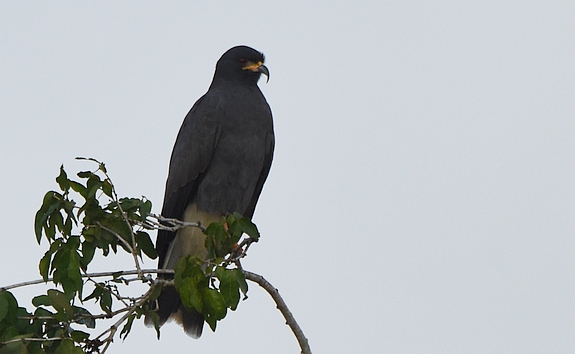
Another species I was hoping to connect with on this trip was Great Black Hawk, which I had only seen once before. This really confiding bird was the first adult I've ever seen. Up close, it has quite a different look to it than a Common Black-Hawk, though at the same time I'm not sure I can put my finger on it...there's more majesty there. Cool to see the fine white barring on the thigh so easily.

In Belize, sorting Common from Great Black Hawks is relatively easy, as Common Black Hawks largely stick to coastal areas, with Great Black Hawks dominating everywhere else. We did not find any birds of either species that deviated from this pattern.

If this bird looks familiar to you, you've either birded in the Neotropics before or you've seen too many pictures of the Maine Great Black Hawk (rest in peace) on Facebook. This immature can be easily told from Common Black Hawk by the lack of a malar stripe.

The last time I saw one of these, it was still called a Gray-necked Wood-Rail. Now, it's a Russet-naped Wood-Rail - it's new sister species, Gray-cowled Wood-Rail, only comes as far north as Costa Rica. You don't need to go on a boat to see these, but these flashy things are hard to ignore.

A species I knew we could see from the boat, but I did not expect to see, was SUNGREBE. If there is a bird with an air of mystery about them, it is the Sungrebe. Don't believe me? Well, they are the only member of the tiny and bizarre Finfoot family in the New World and - apparently - the males allegedly have pouches under their wings where they can carry chicks...while flying.
WTF
This boggles the mind. I had seen Sungrebe before, but this was news to me. If your mind is not boggled by this fact, even if you already know it, then you are clearly operating with some kind of defect and I suggest you seek help. I found a recent blog post on this exact subject if you care to learn more...it turns out to be something ripe for further investigation.

As I said, this is a bird of mystery. It was invigorating to get to see these bizarre river lurkers again after almost a decade. Oh, apparently they have crazy striped feet too, which I have yet to see IRL but I think it adds to their weird goodness/good weirdness.

The Crooked Tree boat trips are legendary for consistently finding Jabiru, and we did find one at the very end of the trip. My photos won't go down in the long and storied history of Jabiru crushes, but it doesn't matter...Jabiru Jabiru Jabiru Jabiru Jabiru yeeeeeeeeeahhhhhhhhooowwwwwwwwww what a good bird.

Things haven't quite been the same since seeing Jabirus. I think I am now in the post-Jabiru era of my life. In these times that seem so constantly filled with fear and loathing, it's comforting to know that there are massive Jabirus out there doing fascinating Jabiru things.

Here's another photo of a bird I mentioned lifering in a previous post, a Black-collared Hawk. These range from eastern Mexico down into South America, but are very patchily distributed in Central America. There are so many species of raptors to be found in Central America, but this is one of the most unique! It is the only member of its genus, Busarellus, it eats fish, and it is shaped like a Black-Hawk but is mostly rufous with a white head. Brilliant.

Of course, Crooked Tree isn't someplace a more familiar fish-eating raptor would pass up and we saw a handful of Ospreys.

Everyone loves Boat-billed Herons. Those who don't have simply never seen one...or have no soul, one or the other. Boat-billed Herons are not uncommon and are pretty widespread in the Neotropics, but are usually much easier to see by boat than on foot due to their preferences for roosting sites. I'd really like to see that boat/giant black oil sunflower seed of a bill in action someday. We saw a few Boat-billeds and I gather they are very reliable on Crooked Tree boat trips, I only regret not telling Leonard to get closer for crushing purposes.

And just when you might think that Northern Jacana is a reasonable, unremarkable bird....

...out come the LONG TOES and the charade is over. Unbelievable. And don't get me started about the weird nub-spurs on their wings.
Phew, I think these photos cover the boat trip pretty well, but should also mention that the passerine birding isn't half bad either. Crucially, this boat can deliver Agami Heron, one of my most wanted birds, but through that day none had been seen the entire winter...no, the first Agami Heron of the year was found on a boat that went out the next day. Fuck! Fuck! Need to see that bird something fierce, I don't understand why it isn't talked about more. Can someone tell me what it is like to see an Agami Heron? Do they make you a cry a lot? Pretty sure that's what I would do.
Even without Agami, birding the lagoon by boat was extravagantly good. Do it if you get the chance!