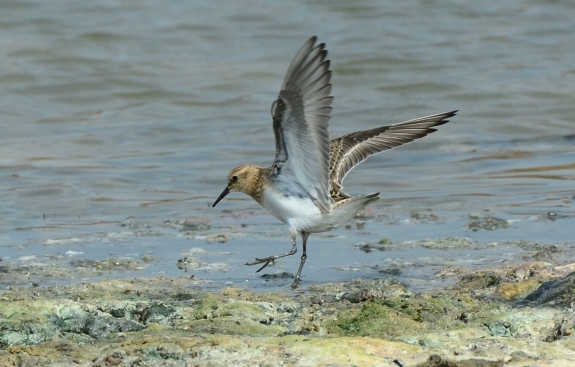
Showing posts with label Long-billed Dowitcher. Show all posts

Tuesday, August 21, 2018

Grasspipering, Winnie Pro Tips, Sea Rim State Park, Sabine Woods


Being true to my nature, I am really dragging out reporting from Texas this spring, but we are getting close to the end. Also, this post somehow seems more relevant now than a couple of months ago, as we are all again experiencing the passage of shorebirds and passerines that are such a big part of what makes us do what we do.

Before BB&B leaves the High Island area entirely, a few more quick notes...grasspipers and Hudsonian Godwits were target species for the trip, and we did quite a bit of driving around in Chambers County (where Anahuac NWR is) before sweet victory. American Golden-Plovers (front bird in the above photo) were fairly common and not difficult to find, but it took a while before we finally connected with Buff-breasted (above) and Upland Sandpipers, which are both marvelous species that I am perpetually starved for here on the west coast. I dig the white wing linings glowing on one of the Buff-breasteds above.

There are a plethora of roads on the coastal plain that could potentially lead you to good shorebirding or grasspipering; we barely scratched the surface. Our Field of Dreams for grasspipers was a very large field with very short grass on farm road 1941, west of TX-124. Flooded fields in a few places had additional Buff-breasted Sandpipers, Ruddy Turnstones (which I don't consider to be ag field birds, but they know better), White-rumped and Baird's Sandpipers, etc.

A few logistical tips for anyone planning on making the trip next spring:

*We stayed at Motel 6 in Winnie. It was relatively cheap and totally fine, aside from the clogged sink that the staff took days to fix. I would stay there again though.

*In Winnie, we ate at Al-T's steakhouse a lot, which you should do as well. We also ate at the Crawfish Box, which was awesome. That was my lifer crawfish meal, and I can't wait to do it again. I also made Dan and Nate eat at Waffle House, because I love Waffle House.

*I looked into Airbnbs before the trip, but the only options in the immediate area were out on the Bolivar Peninsula and they were not cheap, though if you were travelling in a group renting out a beach house would definitely make sense. Any resident of Winnie or High Island who lists their place on Airbnb could potentially rake it in March-May, provided their listing consisted of something nicer than a decaying trailer (which are locally common). 

*As far as we could figure, the best coffee in Winnie (which is not the same as good coffee) is at Brewed Awakening.

*The Market Basket in Winnie has all the groceries you need, aside from liquor.


With the Galveston and Chambers sites wrapped up, let's move on to Jefferson County! Jefferson is the easternmost county on the UTC and is right on the Louisiana border. Sea Rim State Park is one of the hotspots in the area. According to Steve from Kansas City (Hi Steve!), Sea Rim once hosted a willow patch that was an absolute gem of a migrant trap, but was inundated with brackish water from a hurricane several years ago and is no more. The park is still good for a variety of water birds though, including this confiding Solitary Sandpiper.


I'm not saying this is a skulky or wary species, but I have had a hell of a time getting to close to them most places. This bird had no qualms about lingering in crush range.


I think the bird is just expelling some salt out of its nostrils, but this appears to be the equivalent of a Solitary Sandpiper sneeze.


Lesser Yellowlegs are one of the most abundant shorebird migrants on the UTC. This one was still mostly in basic plumage.


Oddly, Greater Yellowlegs were an uncommon bird everywhere we went, which just doesn't compute to me considering the abundance and diversity of shorebirds in the region. Compare the bicolored, recurved and longer bill on this bird with the Lesser Yellowlegs above.


Long-billed Dowitcher. It's not a field mark I use, but supposedly the kink in the bill visible in the first photo is supposed to be a helpful field mark for Short-billed Dowitcher. These days everyone seems to have their own suite of field marks they like to use to ID dowitchers that they apply very liberally...what happened to caution? Has it been thrown to the wind, no longer warranted? At least Short-billed X Long-billed Dowitcher doesn't seem to be a popular identification yet. The increasing (yes, still) tendency of birders to identify birds as bizarre hybrids continues to be disappointing.


Least Bitterns, on the other hand, are never disappointing, even if they prefer to stay hidden in the reeds.


Even Boat-tailed Grackles aren't disappointing if you go long enough without seeing them. This one was doing its best to strike a pose that would eliminate all iridescence and recall a Melodious Blackbird (perhaps the most overdue Mexican bird yet to be found in the states), but with such a boaty tail and unmelodious voice it had no chance.


When Roseate Spoonbills are flying overhead at sunset, all is very briefly right with the world.


Common Nighthawk was a common migrant during our week on the UTC. This one chose to roost on the boardwalk out over the marsh. Like all nightjars, they are extremely novel to see up close.

Sea Rim was nice but not exactly thrilling, though I'm sure it can get really birdy at times. And we didn't even get out to the beach, so who knows what was lounging on the sandy sand? We gave a valiant effort to try and hear a Black Rail, donating blood to mosquitoes at dusk, but none vocalized. We really let Nate down, which haunts me to this day.


The last hotspot BB&B is going to cover from Texas is Sabine Woods. The first afternoon we visited yielded tons of birders (gross), which brought Boy Scout Woods to mind, but more importantly lots and lots of birds, mostly ground-loving and low-in-the-canopy species like this Worm-eating Warbler. Not a fallout, but there were a shitload of migrants. It was an impressive showing - migrants seemed to be everywhere at times - and yet another reminder that migration in the region really is a spectacle. The patch itself was really nice to bird - large, canopy openings, drips, ponds, edge habitat, relatively low numbers of mosquitos, lots of room to spread out and get away from other birders when necessary.


Who doesn't love Black-billed Cuckoo? Everyone was stoked to see Black-billed Cuckoo, especially considering their status as a MEGA (and a BLOCKER) in California. Nate and I had seen one earlier back at Hooks Woods but this is the only one of the trip that was chill enough to be photographed. I'm glad I don't see them very often because I suspect I could get strongly emotionally attached to them if I lived within their range.

There will be one more Texas post, featuring nothing but Sabine Woods, and the best day of birding the entire trip.

Monday, December 11, 2017

Rarities Return, Featuring: Parakeet Auklet, Little and Red-necked Stints!


Every now and then a birding community will be struck by a rarity so bizarre and unlikely that we are left running around slamming into walls, foaming at the mouth, bleeding from headwonds, uttering incoherently about needing to be somewhere, at any cost. A Parakeet Auklet in July (July!) in San Francisco did exactly that, smashing the 2017 summer doldrums into oblivion and sending birders scurrying to SF. The story of how this vague runt was found was truly unlikely; a birder found it in the water off Sutro Baths in the summer of 2016, but it was never seen again...a year later, the same birder relocated the bird while kayaking less than a half mile further up the coast. This time, the bird was seen sitting on seastacks and cliffs, which as far as I know is the first time a healthy individual has been seen on solid ground in the state. There is a good chance the bird was doing the same thing the previous year, but no one saw it!

I appreciate a good Parakeet Auklet, and this being a good Parakeet Auklet (and a state bird) I dragged the family up to the city kicking and screaming for a chance at this bird...but despite staking it out for hours, it never showed. It was a tough dip to swallow, and most everyone who actually dips will tell you that all dip is tough to swallow to begin with...I'm talking about chewing tobacco of course, but hey it applies to birds as well.

While doing the drive of shame back to San Jose, I analyzed my chances of getting the bird the next morning if I made another chase attempt and decided against it...which I immediately regretted the next day when the bird was relocated quickly. My heart was filled with hate. By mid afternoon I was twitching uncontrollably from the constant updates of resightings, said "fuck it" and rocketed back north. This time I found the bird in about 30 seconds, circling behind Mile Rock. It eventually landed on a distant rock just a stone's throw from the shoreline, which I pointed out to several birders who were clearly there for the same reason as me.


Incredibly, one of the birders I updated totally ignored what I had just said, and instead told me that he believed the bird was currently sitting on a seastack right below us. Keep in mind I had a spotting scope and he did not, so I must have seemed absolutely incompetent to him. Friends, do I give off an air of complete ineffectiveness? For those of you who haven't met me, next time you encounter a birder in the field that you believe has utterly no idea what they are doing, just go ahead and assume it is Seagull Steve.

I had to look at this man's auklet, of course. It turned out to be not a guillemot, or an oystercatcher, or a black bird of any sort...it was a shadow. A shadow.

I booked it to where the actual bird had been sitting and eventually ended up below it, as it had flwon from its rock and was roosting high up on a cliff. Talk about something I never expected to see outside of Alaska. July in San Francisco? Get out of here. State bird! Though California has accrued quite a few records now, this is a very unreliable bird to see anywhere in the state....as Flycatcher Jen would tell you, good times.


July isn't all state birds and Parakeet Auklets though. Least Sandpiper is much more typical birding fare around these parts, and much more confiding as well. Photographed at Don Edwards NWR.


My god...could it be? SHARP-TAILED GROUSE???

No, it can't be, but this Least Sandpiper is striking a pose remarkably similar to what displaying Sharp-tailed Grouse are known for. This bird was having a territorial dispute with another Least.


Remember the barren dowitcherless times? It sure is nice to have dowitchers again, especially pink and orange ones. I think these are all Long-billed.


On another July day, I was out birding and saw a report of an alternate plumage Little Stint that was within easy driving distance. It wasn't a lifer/state/county bird, but seeing as I had gotten to look at all of one (1) before, I picked up the scope and hustled back to the car. The instincts that made me the Global Birder Ranking System's #7 US birder made me stop and scan a blackbird flock just long enough to find my county Yellow-headed Blackbird on the way back, and I was still able to make it back to the car quickly. Things were going splendidly. Unfortunately, at that point my instincts ceased to serve me well...in my haste to get on the road, I broke off TWO door handles to my car. What the fuck?! Who does that? This wasn't even for a life bird. That's what those two gray things are in my palm, freakin door handles.

And to top it off, later that day I was playing bass and I ripped off the plug to the amp from the power cord. Nerd strength was just pumping through my veins that day.


But hey, I saw the Little Stint! Talk about a completely rubbish photo (digiscoped). The light wasn't great and the bird wasn't very close, but I did get really nice, prolonged views. Lifer plumage! Year bird! It was nice to continue my long running streak of taking terrible stint photos.


A few days later I went back to see if the stint was still around (it was not), but I did find a very interesting peep that had me confused for a bit. Not that you can tell, but the bird's back was very bright and boldly marked, with lots of orange and red tones. With the short, straight, tapered bill, it was an intriguing combination, but at the end of the day it was just a Semipalmated Sandpiper.

Just a Semipalmated Sandpiper? That's a bit of an understatement...despite a great deal of looking at peeps all around the bay for many years now, until this bird I have never been able to find one in any bay area county. Anyone who has birded much around here would find that baffling, and they would be right. This was a hard-won bird, thus you are forced to look at a photo (digiscoped) so awful that it is, in fact, art. It was also the most colorful individual I have ever seen, but again you cannot make that out whatsoever. Because art.


Sorry about the run of appalling photos. Here is an alternate Western Sandpiper pondering life in its reflection. This looks to be a male, judging by the relatively short and straight bill.


This adult has already acquired a lot of basic plumage, but retains some old summer chevrons on the breast. More of a femaley bill on this bird.


Oh why hello RED-NECKED STINT. It sure is nice to see Red-necked and Little Stint in the same week! That's California birding for you. This one was at Elsie Roemer Bird Sanctuary in Alameda. As I mentioned back in 2015, this place had been due for a great bird! As with my other Red-necked Stint experiences in California, nice prolonged looks at a spiffy alternate bird that was either distant or in crap light. Not sure how that keeps happening, but when one is looking at a stint one cannot complain. But now I really, really need to get a good photo of some kind of stint eventually...


Although they don't inspire the panic of a stint, Baird's Sandpiper is a refreshing fall migrant that only has a short window here. They are refreshing birds in and of themselves, but their presence is always a tasty precursor of things to come...if you are looking at a Baird's Sandpiper in California, chances are you are only a few weeks away from experiencing that holiest of months, SEPTEMBER.

I know, I know, you can roll your eyes, we are far removed from September, but I'm getting there! I won't say that blogging is hard (it isn't, despite everyone who starts one and then gives up), but I will tell you that blogging with a baby is hard. As Corey Finger rightly pointed out to me last year, it's not that you won't have time to bird anymore once you have a baby, it's that you won't have time to blog. This is true.


Refreshing birds are often found in disgusting places. That's not a gross mudflat the birds are on, it is a much filthier floating mat of algae. Juvenile Least Sandpiper on the left for comparison.


Has any bird mastered the filthy floating mat dance like the Baird's Sandpiper? Unlikely.


Ok, I'll throw in a token resident bird, and one that BB&B doesn't cover much. This juvenile California Gull was also holding down the algae mat along with the peeps. I know birders in most states don't get to see this short-lived plumage very often, and we are balls-deep in gull season right now, so enjoy! The Baird'seses and the gull were at Coyote Hills Regional Park in Fremont, CA.

Sunday, June 12, 2016

A State Bird, Spring Shorebirds and a Requirement for Avosex


Early in the spring, I lurked into the Central Valley, where an Emperor Goose would have been a welcomed year bird. Those of you who enjoy their schadenfreude would like to know that the bird decided to leave the night before, but it was a good sunset with lots of Cackling and Greater White-fronted Geese to sort through.

Well, here we are. June. California's best spring in memory has come and gone, with May bolstering the Vague Runt roster with another White Wagtail, Kentucky Warblers, a Buff-breasted Flycatcher, an inner circle Pterodroma caught in a mist net (which is a Meguh) and another mainland appearance by the Kelp Gull. Don't worry, I did manage to at least get out and look for the Kelp Gull...which I dipped on. I also dipped on the Northern Gannet a couple times, which is so unsurprising that it doesn't even bum me out any more. Dip dip dip dip dip dip dip fucking dip.

That said, I did go birding this spring, and I did see some birds, including some good ones.


A friend of mine, "Fob Rowler", is one of the admins of a 5,000+ member birding group on Facebook. His members look up to him like a birding god...and who is to say that he isn't? It often looks like a thankless task, but one day Fob was looking at one of the bazillions of bird pictures that is posted to the group every day and noticed something strange in a flock of flying White-faced Ibis...there, in the corner, was a unmistakable Glossy Ibis. This is a rare bird in California...one that I hadn't seen in the state before. So a week after Fob's Facebook find, it was off to Yolo Bypass Wildlife Area, and I have to thank Fob and Facebook for this sexy state bird.


Yolo Bypass has a healthy population of Swainson's Hawks, which I never tire of seeing. I also got my lifer mink that morning, which was a bird I was not thinking I would get that day. Some kind folks pointed it out to me as it swam out to a patch of reeds, but unhelpfully tried to convince me that it was a small river otter with a short furry tail. The nerve!


Every spring I spend some time shorebirding, partially because I am always hoping to find a spring vague runt plover or sandpiper (which rarely happens) and partially because spring shorebirds are really, really good looking birds. Dowitchers suddenly become exponentially more interesting...you don't have to sweat IDing them by sight, they make weird noises that go unuttered in fall and winter, and they actually are very appealing birds. This is a Long-billed Dowitcher, at Middle Harbor Shoreline Park, Oakland.


Here is a Short-billed Dowitcher. Look at that short bill. It's like rosy Jack Snipe.


Another Short-billed. No one thinks of dowitchers as gaspers, but I will argue that they are worthy of the occasional gasp.


I want to be real with you nerds, so here we go...BB&B is one of the only trendsetters in birding. So with that in mind, let me ask you this...do people take pictures of Canada Geese anymore? No? Good...well I'm bringing them back. Soon everyone is going to be posting Canada Goose photos. Cardinals are going to be over, and the masses will instead glorify the majestic Canada Goose.


One morning Billy and I cruised to Bedwell Bayfront Park in San Mateo County to look at Pacific Golden-Plovers, a decent bird almost anywhere in the bay area and rarely encountered in alternate plumage. They had been roosting on a salt pond for some time, and we found them just hanging out and looking great. This species is a pain in the ass to photograph though, at least in this state...go to Hawaii if you want to crush them, as they are a lawn bird there. It's really trippy.


A rare (for me) spring visit to the Radio Road ponds in Redwood Shores was productive. Short (front) and Long-billed Dowitchers provided a great comparison when we showed up. If only it were always this easy to tell them apart.


There probably isn't a better place in the bay area to see breeding Forster's Terns, which nest on the small islands here relatively close to the edge of their favored pond. On this visit, there was a lot of courtship going on and a lot of birds on nests already.


As always, American Avocets were around, sporting the buffy heads required to convince each other that they should have avosex. The bay area has both long-legged shorebirds in abundance.


This is the other long-legged shorebird, obvi. Black-necked Stilt is another signature, sometimes-annoying shorebird species of many of California's marshes. Like the avocets, they are resident year round and are common breeders at many marshes around the bay. The debate continues over which nesting shorebird is more annoying to be around...Killdeer (dee dee dee dee), avocet (kleep kleep kleep) or stilt (yap yap yap yap yap yap yap).

Sunday, November 17, 2013

How To Bird The Bay Area (Winter Edition): Part 1


WINTER IS COMING...and yet the onslaught of visiting birders never ends. I frequently get asked by out of state birders where to go around these parts, so instead of writing the same thing over and over again, I'm just going to lay it out all right here. I'm keeping out of state/country birders in mind here, so you locals please excuse all the titmouse-stroking that is about to occur.

Before we get started, there are some precious resources out there...make use of the new eBird Hotspot Explorer, the fantastic San Mateo County Birding Guide, this site and this site for Sonoma County...there are several more out there as well if you are willing to get a little dirty and do some cyberdigging. Being on top of all the listservs (and there are many) and eBird RBAs will keep you current on all the relevant rarities...but you already knew that, of course.


Short-tailed Shearwaters begin arriving off our waters in October, but are still far outnumbered by Sooty Shearwaters. Though this bird was photographed off of Bodega Bay, Bodega Head can be a very productive seawatching site.

Let's start with ocean birds. If you come in November, you might still be able to hop on a late-season Shearwater Journeys trip for pelagics, which could be very fruitful. A second option would be doing a whale watching trip that runs out to the Farallon Islands...this has been especially popular with birders in the past year because you can see the Pacific Ocean's only Northern Gannet that lives out there (yes, its still there). This won't be quite as productive as a real pelagic trip, but its far better than being stuck on land.

Northern Fulmar is the most abundant tubenose in winter months, and can sometimes be seen from shore. Photographed off Half Moon Bay.

If you are stuck on land and care to try your luck at seawatching, you can try places like the Pigeon Point Lighthouse (San Mateo County), Bodega Head, and various spots in San Francisco. You probably aren't going to be able to pluck out an albatross from the ether, but birds like Red Phalaropes, Ancient Murrelets and Northern Fulmars are possible. Of course, a scope is necessary. Red-throated, Pacific and Common Loons are common and can occur in many places along the coast.


A Black Oystercatcher at Miller-Knox Regional Shoreline, in Richmond. Oystercatchers are common along rocky shores and breakwaters up and down the coast, as well as various sites in the East Bay. They may blend in with wet rocks, but their piercing (borderline annoying) calls are hard to ignore.

For rockpipers, you have a lot of options...don't expect to be slinging glass at Rock Sandpiper (they are further north), but Black Oystercatcher, Surfbird and Black Turnstone are all common in the area, even in the east bay. Wandering Tattler is more common in fall, but is a winter possibility as well. Good places to see rockpipers include the Sutro Baths (and offshore rocks), Pillar Point Harbor, and the jetties at the mouth of Bodega Bay.


Long-billed Dowitchers (above) and Short-billed Dowitchers alike often roost in large flocks at the Radio Road Ponds in Redwood Shores. Photographers especially will be interested in visiting this place, where you are free to crush at will.

While we're at it, why don't we cover other shorebirds? San Francisco Bay supports huge numbers of shorebirds, both in migration and during winter. There are a multitude of places to get good looks at shorebirds...Radio Road, Foster City Shell Bar (Redwood Shores), Corte Madera Marsh (Larkspur), Bolinas Lagoon and Bodega Bay, Schoellenberger Park (Petaluma) to name a few. Of course, if you are planning on tracking down shorebirds anywhere around here, it's good to know what the tide is doing. Schoellenberger is the best place in winter for Pacific Golden-Plover, and there is often a Ruff around someplace in the late fall and winter months. Mountain Plovers winter inland, in Yolo and Solano Counties.


Cinnamon Teals are common and widespread in the bay area. The Radio Road ponds, where this bird was photographed, is a good place to see all three teal species, Eurasian Wigeon, Black Skimmers and Red Knots.

The bay area has a lot of good waterfowl to offer as well. Eurasian Wigeon, Harlequin Duck, Barrow's Goldeneye and Tufted Duck are all present in winter months. Lake Merritt in Oakland has had at least one Tufted Duck every winter for many years in a row now, and is very reliable for Barrow's Goldeneye in small numbers...also expect close-up views of five species of grebes, Canvasback, Common Goldeneye, both scaup, and some of the tamest night-herons you will ever meet.

Eurasian Wigeon can readily be found at Radio Road and Bolinas Lagoon, among other places, and may be present in any large concentration of American Wigeon. Black Scoters are regular off of the Great Highway (San Francisco) and near Mussel Rock, in Daly City; the latter site can have Harlequin Duck as well. If you are in the Point Reyes area, the waters around the Fish Docks on the outer point can yield Harlequin Duck, Long-tailed Duck, and three species of scoters. This area is very reliable for Red-necked Grebe as well.


Thayer's Gulls are fairly common in the bay area, but pose a difficult ID challenge nonetheless. A small female Herring Gull bellows in the background. Miller-Knox Regional Shoreline, Richmond, CA.

The bay area has been blessed with great gulling. Good gulling can often be found at Golden Gate Park (San Francisco), the Yolo County Landfill, Pilarcitos Creek (Half Moon Bay) and various creek mouths along the San Mateo coast. It's really not hard to find a good gull flock around here. A few Glaucous Gulls are found every winter, and it's definitely worth being on the lookout for Lesser Black-backed, Kumlien's Iceland Gull and Slaty-backed Gull, the latter particularly at Venice Beach (specifically, the Pilarcitos Creek Mouth) and nearby gull flocks in Half Moon Bay.


A pleasing first cycle Glaucous Gull photographed in San Francisco's Golden Gate Park. The small "lakes" in Golden Gate Park often attract a nice variety of gulls, including a number of Thayer's and the occasional Glaucous. Be sure to check Lloyd Lake for friendly Hooded Mergansers.

Of course, one of the highlights of bay area birding are the winter herring runs that occur December to March. At this time of year, herring come into San Francisco Bay en masse to spawn in shallow water, and when they do there can be tens of thousands of gulls feeding on both the adults and roe. Usually the listservs light up about the huge feeding congregations, so they can tell you where to go look at filthy gulls all day.

I'll wrap this post up with rails...aside from many coots, some Common Gallinules, and Virginia Rail and Sora, the bay area also hosts numbers of Clapper and Black Rails (and a handful of Yellows). I should stress your chances of actually seeing a Black Rail are very, very low (I've neither seen nor heard them) but it is not out of the question for the dedicated and/or lucky. A quick check of eBird will show they are found in a number of spots in the bay area (Palo Alto Baylands, Martinez Regional Shoreline, etc.); I recommend doing some research and going out at an extreme high tide where they are prone to be flushed from a marsh or pursued by predators (egrets, herons, gulls). And, of course, don't be a dick and blast rail calls into the marsh, they are a state listed and very sensitive species.

Unlike their smaller/excruciatingly timid cousins, Clapper Rails are not so secretive...their extremely loud calls and "duets" often give them away. The Palo Alto Baylands and Arrowhead Marsh (Oakland) are good places for these birds.

I think that covers a lot of good spots, although I know I left some out, (i.e. the huge network of salt ponds in Santa Clara County). Stay tuned for where to track down your most sought-after raptors and passerines. 

Wednesday, March 6, 2013

Winter Shorebirds


Long-billed Dowitcher, not a species I usually get to see close up. I'm surprised the bird could tolerate the giddy, astoundingly annoying photographer flailing around in the mud next to me flushing birds while he tried to get down on his belly. Typical. Radio Road, Redwood Shores, CA.

Shorebirds get more attention during warmer times of the year, but in winter here in California we get close to 30 shorebird species that are expected (untouchable compared to any other state), although some are obviously more rare than others. I think it's actually surprising how infrequently we get a rare shorebird in the winter, considering the size of the state and amount of habitat we have (Ruff is the rarest "expected" winter shorebird). A Sharp-tailed Sandpiper that wintered at Bolsa Chica in Orange County years ago is my personal best...I dipped on the damn Greater Sand-Plover.

Which is irrelevant, for the time being. Here's a sample platter of some of California's wintering shorebirds, hopefully you will find them visually delicious. A flock of winter shorebirds may not have as much potential goodness as a big flock of gulls, warblers or sparrows, but they shouldn't be overlooked unless you are a real bottom of the barrel lister.


Marbled Godwits are abundant up and down the coast, although you get lucky to run into a big roosting flock like this. Do you see the one with the white breast and belly? Not a Bar-tailed, in case you were wondering. Radio Road.


Long-billed Curlew is one of my favorite shorebirds...they breed on the prairie, winter on the coast, have crazy proportions while being huge, kill large crustaceans, and have some cool vocals too. What's not to love? Photographed at San Leandro Marina, San Leandro, CA.


Whimbrel is the understated curlew that doesn't get as much attention. We would probably look closer at them if a similar-looking relative (Bristle-thighed Curlew, I'm looking at you) were more prone to vagrancy. When I lived on Midway, I (successfully) had to scan flocks of Bristle-thighed Curlews to find vagrant Whimbrels, heh. Carpinteria, CA


I have countless better pictures of Willets, I just think this is a funny mixed flock. San Leandro Marina.


Black Turnstone is the most abundant "rockpiper" in the state, followed by Surfbird, Ruddy Turnstone, Wandering Tattler and Rock Sandpiper, the latter of which don't care to go south of Humboldt Bay very often. Wandering Tattler can be frustrating to find at times as well. Photographed at Emeryville, CA.


While on a recent gulling trip, I was surprised by this Black Oystercatcher that let me crush it over and over and over again. This was one of the worst pictures I kept, not bad eh? Oystercatchers are a species capable of spiritually enriching any birder. Miller-Knox Regional Shoreline, Richmond, CA.


Sanderling. Although I am affected by these birds for other reasons, my favorite Sanderling field mark is the lack of hallux (hind toe). Pillar Point Harbor, CA.


I think this Dunlin is a big improvement over the last photo of one I posted. I'm looking forward to seeing them in alternate plumage, a superior garb to what they wear in the winter. San Leandro Marina.


The controversial Snowy Plover. I really enjoyed working with them last year, but it's back to seabirds in a few weeks. Photographed at Half Moon Bay, CA.


Mountain Plover. Not a bird of any shore, although they often can be found in the same places as Long-billed Curlews throughout the year. They are most easily found on the Carrizo Plain (where this bird was photographed) and the Salton Sea, although I have seen them on the Oxnard Plain and in Solano County as well.


I like that you can see the webbed feet of this American Avocet, that's not something I notice very often. An early breeder, some birds around here are already getting their summer ruddy colors. Radio Road.


This Black-necked Stilt has its mind on things other than me sitting there attempting to render it two-dimensional, but those subtle glossy highlights on its back are nice. Photographed at Radio Road.

That should provide a good sample of California's winter shorebirds, this certainly isn't a "photo study" (not sure how I feel about those, no offense). Hopefully I'll get some opportunities to shoot some birds in spring color this year, or better yet, find a spring shorebird vagrant! It can be done, but it's not easy...even for Number Seven.