Showing posts with label Magnificent Frigatebird. Show all posts

Tuesday, October 11, 2016

The Death of The Bird Blog


This gleeful horsetender used to dwell in the Birdosphere. In fact, that is the only reason I know her. Like many, she got sucked into the gravity well of a non-blogging black hole, where so many of my comrades have met their fate.

Ah, the bird blog. At one time, it was very popular to be a blogging birder...but like so-called patriots telling us to "never forget", those days are long behind us. Most bird blogs lie fallow, with no fresh material being added for years. My flock, once large and thriving in the Birdosphere, is dwindling rapidly...there are only a handful of bird blogs I look forward to checking now. We are going the way of the Dodo...or to be more contemporary, our population decline mirrors that of the Lesser Prairie-Chicken. Our fate is uncertain, but it is decidedly gloomy for now.

So what has lead to the decline of the bird blog? It's not difficult to figure out.


Sometimes, when I'm not feeling particularly creative, I can slap something like this into a post and all I can really think of saying is "This is a Double-crested Cormorant...I sure see a lot of these. Yup...Ok moving on now...". That is neither fun to read, nor is it fun to write.

Most bird blogs are really similar in content and format. The vast majority of bird blogs that have surfaced followed the tried and true "I-went-here-and-saw-these-birds" format, with little variation. I'm not the first one to point this out, nor is this the first time I've stated this here. Obviously there is nothing wrong with this format (I follow it constantly) but unless you can really make your posts interesting and not the same stale, recycled trip report over and over again, it can be hard to get much of a readership...and knowing people actually read your content is key to having the motivation to create more. This leads us to a plain and simple fact:

Most people are not good writers. There is a reason that not all people are writers...most people are not good at it. That includes birders. If you don't have the ability to write in a way that draws people in, that makes people want to come back for more, then your writing won't gain much traction. Sure some bloggers honestly don't care about accruing readers, but hella people do. Of course, another reason bird blogs were popular was because it was a good place to see bird porn, which leads us to...


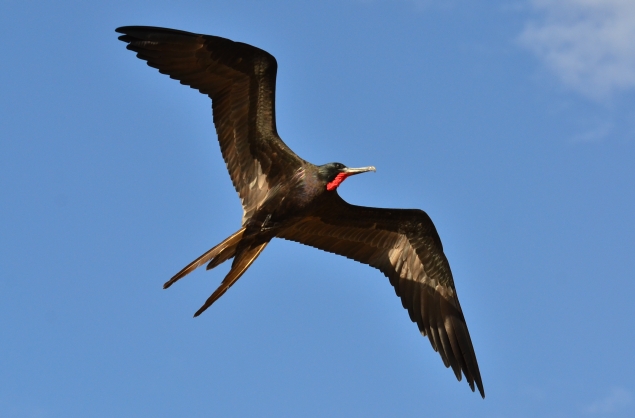
I like this Magnificent Frigatebird photo. It's not the most amazing photo, but I think it's definitely likable. Good bird, good pose, sharp, good light, no editing done except the slightest bit of cropping. Not long ago you wouldn't see bird photos of equivalent quality plastered all over Facebook or embedded in every listserv post or eBird checklist; blogs were actually a good place to check out bird porn. Bird blogs no longer have the significance they once did for photographers.

Photographers. Everyone is a photographer now. More birders carry some kind of camera than those do not, at least that is my impression, and there are a great many photographers (who aren't really birders in the traditional sense) who specialize on birds. This was not the case 6 or 7 years ago. And not only are there more photographers now, everyone is also sharing their photos everywhere they can. It's easy to see tons of bird porn on Facebook without even trying. Ugh, remember the "seven day nature photo challenge"? Glad that's over...I wasn't in to the whole birdspam thing. You couldn't avoid seeing bird photos if you wanted to.


A spring male Rose-breasted Grosbeak is a true thing of beauty, the sort of bird that can turn someone into a birdwatcher (sorry Savannah Sparrow). Is there room on Facebook to do this bird (verbal) justice? Is someone really going to launch into a profound ode to Rose-breasted Grosbeaks in a podcast? If so, please tell me when that becomes available. 

Social media is not just for sharing photos of course, the anecdotes and stories that once were prime blog fodder now get posted elsewhere as well. Aside from Facebook, podcasts have also begun to take up space in what was formerly blog territory. Who doesn't love podcasts? That said, if you are going to do a birding podcast you have to put a lot more effort into that than a blog post, and you better be good at it if you are going to have an audience. I can only imagine that making a consistently entertaining podcast is a hell of a lot more difficult than slapping a string of decent blog posts together, so I am very skeptical that podcasts are really going to catch fire in the birding world considering the necessary talent and effort required...also, birders tend to be very conservative in their public displays of humor, and that is not a recipe for good podcastery.

Many bloggers quit out of sheer laziness. That's cool, laziness happens. I can be pretty slothful myself. Life can get in the way too; yup, some birders have those. This is all totally understandable.

So there you have it - the bird blogger population is dwindling rapidly, and it is no great mystery why. With that all said, BB&B is going to call it quits.

Nah. I lied. BB&B has no plans for throwing in the proverbial towel...what would all of our interns do? Maybe we are atavistic scum-nerds with shit for brains, but we will blog onward. There are stories to tell, birders to lampoon, photographs to post in between the realms of Facebook and Flickr. The Birdosphere is not a popular place to be anymore, and that's just fine by me...if you really care about what is popular, then you shouldn't be birding. However, I will soon be facing a hurdle in my blog output...I'm going to be a daddy in a few months. Isn't that fucking crazy??? Not that it should surprise you (have you read the title of this blog?). I won't use that as an excuse to bury BB&B though, you have my word. As I said, what would all of our interns do?  

Monday, March 24, 2014

The Boobies Were Real


Ah, Baja. It wasn't that long ago...but sitting here in Harlingen, Texas, I feel very removed from that trip. But a dream it was not...the boobies were real. And so I thought I'd churn out another post before I get overloaded with work and get caught in the deep and fast-moving current that is spring migration on the Gulf Coast.


Unlike Todos Santos, an apparent booby wasteland, Blue-footed Boobies were lusciously abundant in La Paz. They were easy to see from the main waterfront, where these photos were taken.


Plunge-diving birds bring me much joy...you need good form if you are going to plunge underwater from great height and expect to catch something. There were also a number of Brown Boobies in the area, but I didn't manage any photos of them.


Being on the Sea of Cortez side of the peninsula, the common large gull in La Paz is Yellow-footed (above), not Western. Western Gulls are puny in comparison to the mammoth Yellow-footed.


Yellow-footed Gull is truly a gnarly beast. I wonder how they would do in a duel with Great Black-backed Gull. Let's hope they never hybridize, for all of nature will be lost.


Here's a young Yellow-footed. Unlike other large gulls, a 3rd cycle Yellow-footed Gull is essentially an adult bird. They grow up fast in Mexico.


Moon Vulture. Photographed at Playa Balandra, an awesome beach north of La Paz.


Ash-throated Flycatcher is a true creature of the scrub. You show me scrub, chaparral, and trees of unimpressive height...and I will show your Ash-throated Flycatcher. Their habitat doesn't change very drastically throughout their range, and it doesn't look that different down by the cape either. Photographed at Playa Balandra.


Atop the coke villa for a sunset, we ooze sexy.


I got my best ever looks at Gilded Flicker on this trip. Photographed in the cemetery at Todos Santos.


Having gorged on sweet sweet sweet Mexican nectar, the flicker contemplates the irony of feasting on bright flowery wonderfulness amid a barren field saturated with human remains. Gilded Flickers, after all, are known for leading a rich and rewarding inner life.


Hooded Oriole seems to be one of the most abundant winter birds in the Todos Santos area. Most of the males were a bit dingy looking...but they are still honorable birds. Todos Santos.


Xantus's Hummingbird...a bird that I saw many of, and a bird that I miss. Sure I can walk across the street today and see Buff-bellied Hummingbirds, but the Trochilid of Xantus lives in a league of its own. Do go and visit them when you have the chance. Todos Santos.


Magnificent Frigatebird doing a Black Skimmer impression at La Poza, Todos Santos. Truly versatile birds.


Moon Frigate. Photographed at Punta Lobos, south of Todos Santos.


Frigatebirds have a habit of furnishing some of the best birding memories. La Poza.


I have taken many frigatebird photos over the years...I think this is by far the funniest. Keep in mind the bird is not directly overhead, it's actually flying low and "standing" vertically in midair.


I do love me some Bonus Herps, although I depend on the kindness of nerds to identify them for me most of the time. This is a Red Diamond Rattlesnake (thanks Natalie).


Ok, here's a mystery lizard that lived at our coke villa in Todos Santos. Any of you cold-blooded folk familiar with this? I also saw a San Lucas Banded Rock Lizard on the side of the house one day, but failed at getting any documentation. It was a crippler though.


Our complete pinche Mexican crew on an ill-fated walk through the desert. It turns out jamming seven people into a tiny rental car doesn't work very well...but thanks to our overheating car, we all got some Wild Ass.

Friday, February 14, 2014

Flying Nightmares, Beloved Belding's Yellowthroats, and The Hummingbird of Anxiety


Old Man Pelican. All photos today from the Todos Santos area, Baja California Sur.


Frigatebirds are the best. They usually look like this; majestic, awe-inspring, and confident. However, it does not take much for them to turn into living nightmares.


If I showed this photograph to a nonbirder and told them these birds have been known to snatch babies from their cribs, they would probably believe me.


Ah yes, the last thing countless toddlers will ever see.

I struggle to come up with an apt description of this...perhaps an example of post-nuclear-fallout-avifauna.


Motmots aren't the only birds who can tick-tock their tails...which perhaps is a scary notion to some.

Laughing Gull, Mexicrushed.


We saw a handful of Herring Gulls at Punta Lobos, just south of Todos Santos, which seemed to have the best gull concentrations in the area. Larids gather there in the afternoon to eat discarded fish scraps from the panga fisherman; unfortunately I failed to pull out anything very remarkable; the best was the Laughing Gull (above) and a disturbing number of yellow/orange-legged Western Gulls. If you go there expecting Yellow-footed Gulls, I can only offer the old adage "caution is warranted".


If you are a white person and move to Baja, you end up looking something like this after a few years.


There are hordes of Belding's Yellowthroats at La Poza, the big pond on the beach in Todos Santos. It was nice to see so many, considering the tiny distribution this subspecies (beldingi) has.


Hella yellow underparts.


Here's a considerably duller-looking individual, but still with significant yellow coming up the side of the mask and onto the forehead. A younger male?


Females were surprisingly pretty easy to tell from Common Yellowthroat...surprising because I wasn't using a field guide and just thought I'd wing it. As with males, there is much yellow on the head, which frames a grayish auricular patch.


Scott's Orioles were greatly outnumbered by Hooded, but they were still easy to find. Every morning I could hear their soothing meadowlarky songs sung from our house.


There are birders out there who think it is completely unethical to photograph a bird on its nest...ever. Why? Because birds can't handle the stress and will abandon their nest, which is often true...but always is a considerable stretch of the imagination. Well, have a look at this disturbed, stress-ridden bird. It is the Hummingbird of Anxiety. What do you say to do this crush? The bird is pretty much life-sized in this picture. Is your blood boiling?


Look at her sleep. What a sleepy hummingbird. This Xantus's Hummingbird was nesting inside a restaurant in Pescadero where we had lunch one day, so I wasn't exactly worried about disturbing her. Maybe she likes the big fiestas and live music they have every weekend...the waitress said she nested there last year too.


Male Xantus's Hummingbirds are too cool to not stand next to and blow hundreds of photos on.


Young male Costa's Hummingbirds have some fresh facemelt growing into their faces, but only when the sun hits them right.


I could not identify this bird.

Tuesday, December 11, 2012

Running Amok Around Garden Key


Running amok around Garden Key may or may not yield many birds...but there will always be Sandwich Terns. Well, in fall, at least.

I have crossed the Rubicon (or was it the Eel River?), and finally have returned to Humboldt County, where birds and birders and plentiful and everyone is high (especially the birders). I won't be here much longer, but its been good times. This place has been riddled with birders for years, and its been good to see a bunch of familiar faces again. My 2012 year list has grown to be even more corpulent in the last week, but with Bostick taking a trip to Hawaii, he is back in the lead again. Fuck. Maybe I will end up winning the year in the NIB category (that's Non-Introduced Birds, for you less nerdy people), but he may take the overall cake. Time will tell.

Here's some more scenes from the Dry Tortugas. Its easier to take pictures there than in Humboldt County.


Meet the first Swainson's Thrush to grace the pages of BB&B. This indelible Catharus of catharsis spent a day tamely hopping through our campsite, deftly avoiding the enormous hermit crabs that littered the ground.


Look at this White-eyed Vireo. It looks like it's teleporting into another dimension. That's where they really go in winter.


More teleporting. This one looks more like a Blue-eyed Vireo (***MEGA***).


The outer wall and moat at Fort Jefferson. Not a bad perch up there.


American Kestrels are another one of those birds that can be hard to talk about, because everyone knows what a kestrel is and how great they are. The roof of Fort Jefferson turned out to be a good place to get flight shots of them as they zoomed around having territorial battles.


Northern Parula sez: NOMNOMNOMNOMNOMNOMNOMNOMNOMNOM
NOMNOMNOMNOMNOMNOMNOMNOMNOMNOMNOMNOMNOMNOMNOMNOMNOMNOMNOMNOM


A barracuda making faces.


What a sweetheart.


This was the lone Northern Harrier that made it to Garden Key during my trip. I found her in a frigatebird flock.


Magnificent Frigatebird. The first one you see will trigger an agonizing reappraisal of all the birds you have previously seen that you hold so dear...they can really put the kibosh down on any motivation to watch non-charismatic avefauna.