Showing posts with label Lesser Scaup. Show all posts

Wednesday, March 13, 2013

Diver Cavalcade


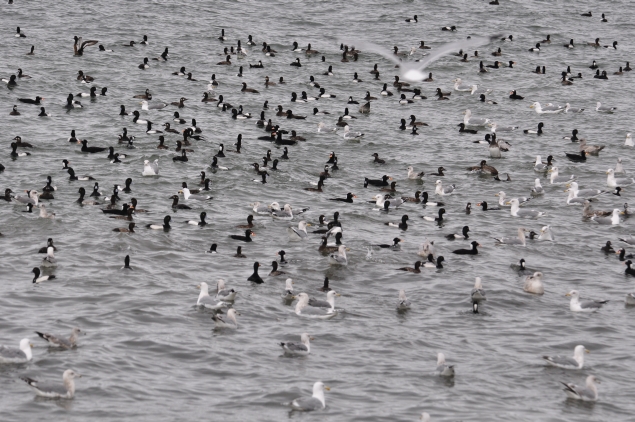
The bay area is blessed (cursed??!?!!!?!?!) with an enormous diving duck population in the winter months...some of the state's biggest concentrations of divers are here, if the not the biggest. Mount Tamalpais watches over them, no doubt a knowing and powerful duck god. Miller-Knox Regional Shoreline, Richmond, CA.


Surf Scoters and Greater Scaup. Thousands of ducks convened at Miller-Knox last month to feed on the herring roe that had also brought in enormous numbers of gulls.


Herring runs are fun for ducks and gulls alike. Here they mingle in harmony...the mind reels.


Among the throngs of Surf Scoters was this lone male Black Scoter. Their preference of wintering sites in the state are generally not conducive to photography, so it was nice to finally get some photos of the yellow-knobbed enigma.


Black Scoters are rare, or at most locally uncommon in coastal California...they are probably not overly enigmatic either, although they have been less studied than other sea ducks. Population estimates and trends are imprecise at best.


Black Scoters of western North America breed entirely in tundra lakes of Alaska; the closest population of breeding eastern birds is in Hudson Bay. I wonder how genetically divergent these birds might be.


It was truly a vulgar display of fowl. The seas seethed and frothed with egg-laden ducks.


A high-density scaup flock scrambles for handouts. Nothing will churn the placid waters of the lake like a bunch of carb-loading ducks. Lake Merritt, Oakland, CA.


Aside from the coots and Canvasbacks, these are almost all Greater Scaup, with one obvious Lesser mixed in. Can you find it? If you can't, the Global Birder Ranking System will note your failure.


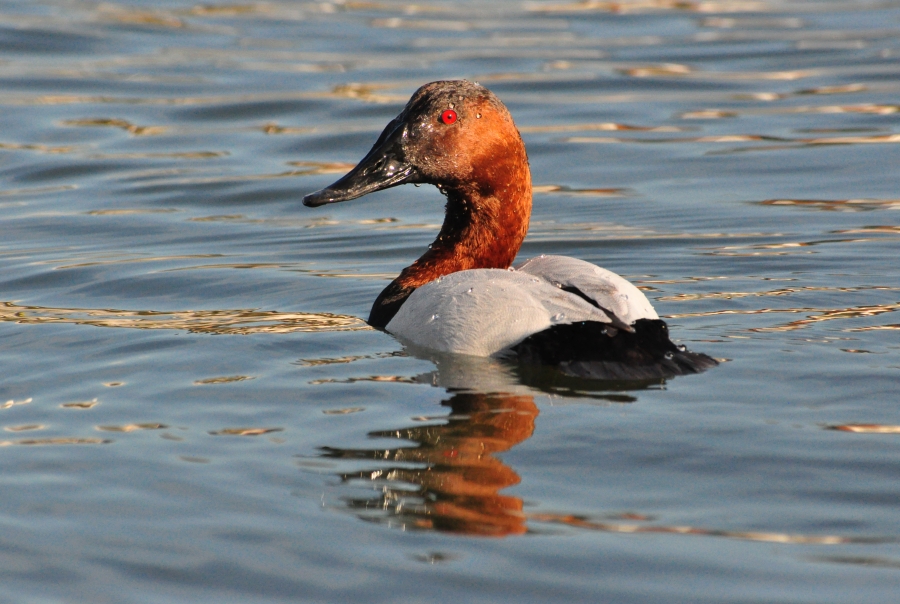
Is there a better place than Lake Merritt for Canvasback watching? I have yet to find it.


Red-breasted Mergansers around here are mostly females and young males...older males mostly winter to the north of us. Not sure if this is a young bird or if it's still molting out of eclipse (this was photographed a few months ago).


This Common Goldeneye is going into classic stealth mode, where they swim with their neck extended and head held just above the water. Doesn't seem particularly stealthy to me but they think it works.


Locals will recognize this female Redhead that has been wintering on Lake Merritt for the past several years. The white flecking on her head (a result of leucism, not old age) makes her easy to identify as the same returning bird.

Tuesday, November 20, 2012

Felonious Jive's Introduction to Unlocking Birds

Once upon a time, in a galaxy far, far away, I was not the Number 7 birder in the nation. Unlike The Great Ornithologist Felonious Jive, I was not born with an unnatural ability to correctly identify and locate a huge variety of birds. I still remember what it was like to see a bird and not know what it was, although those memories are getting quite fuzzy now. But lets face it...the world needs more good birders (or perhaps more birders that are good?), so we at BB&B are going to endeavor to make you, the reader, a better birder.

As everyone knows, some birds are easier to tell apart than others. Jays are simple. Drake ducks are a cinch. Spring warblers are no problem, and neither are male hummingbirds. Owls? If you are lucky enough to see them, its usually no sweat to know what you are looking at. But many up-and-coming birders cower at other birds. Like the professional drinker who loves all booze except for that ONE kind of liquor (most people say its tequila), many developing birdwatchers can't bear the thought of dealing with a certain group of birds, be it gulls, sparrows, shorebirds, flycatchers, shearwaters....you get the picture. They are all so similar that budding birders often don't even know where to start. So we at BB&B are going to make it happen for you...for absolutely free! Sure you could (and should) buy Kenn Kaufman's advanced birding guides, but consider BB&B to be at your service.


Brewer's Sparrows are one of my favorite sparrows, although more for their amazing vocal abilities than their good looks. Some birders would be offended that I have good things to say about such a bird, since so many are incapable of even identifying one. Can we do something about that? YES WE CAN. Agua Caliente County Park, CA.

Before we delve into these specific bird groups, I'm going to ask The Great Ornithologist Felonious Jive to reiterate some crucial birding points to keep in mind. This is important, basic shit, that people forget over and over again, so it bears repeating. Apologies if anyone is offended, but my colleague is a crude man. Take it away Felonious...

#1) Use a good field guide. For Christ's sake don't depend on Google Images or some internet group to identify birds for you. I endorse Sibley and National Geographic Guides only. They're not perfect, but they do come close. Even better, get more than one guide.

#2) Use a field guide...correctly. Look at the range maps. Look at a bird's size. Read about its habits and habitat preferences. IT IS ALL INCREDIBLY HELPFUL. Sure it takes more effort than glancing at a pretty picture, but the payoff is that you might end up identifying birds correctly.


Look at Gray Flycatcher in any field guide and it will appear depressingly similar to other Empidonax flycatchers. But if you read about its habitat preferences and tail-bobbing obsession, you will learn about what makes this sage-baron unique. Photographed at Mono Lake, CA.

#3) Never assume you found a rare bird unless you know exactly what you are doing. Rare birds are to be treated like huge scientific discoveries...you should not be announcing them unless you are completely confident in your own abilities. Inexperienced and experienced birders alike are always turning common birds into rare birds, much to the chagrin of everyone. This is a terrible habit, kind of like picking scabs or popping zits...on strangers you don't even know. It's just a poor idea, plain and simple, doomed to failure. I fiend for rarities as much as the next birder but its important to be accurate.

#4) Go birding with people better than you. Listen to other birders. If you point out a Slaty-backed Gull to your local birding guru and he/she politely says it is a Western Gull, said guru is worth listening to and is likely correct. Of course, if your local guru impolitely says its a Western Gull, you are free to tell them to fuck off.

#5) Beware the internet...it is filled with lies. It can give you the answers you seek, but sometimes at great cost. Once you enter the world of cyber-birding, don't expect to get treated like a prince or princess. People in email groups, messageboards, forums and facebook groups are painfully anal and occasionally straight-up dickish, and its easy to take things out of context. This isn't because birders are bad people, its because the internet is a cruel place.


Black Turnstones love a good pile of rocks, although they will settle on sand if they have to. This one seems to be pretty enthusiastic about rope as well. Point Reyes, CA.

#6) Be aware of a bird's surroundings, not just how a bird looks. What habitat is it in? Pine trees or willows? Rocky shore or sand? How high was it foraging? Was it in freshwater or saltwater? Was this blackbird in a MacDonald's or Burger King lot? The more you notice, the easier a difficult identification can be rendered.

#7) Birding by camera makes sense at times, but I guarantee you you can see so much more without one. Keep in mind each and every birder who occupies the high realms of the Global Birder Ranking Scale learned to bird before the advent of the digital camera. We didn't identify birds by chimping, we did it by looking at them and listening to them. When you do use a photo to help identify birds, be very aware that poor lighting can transmogrify one bird into another.


This dude was desperately crashing through the underbrush, trying to catch a glimpse of a Common Cuckoo perched somewhere above him. Other birders watched his reckless actions in wonder from across the pond. This is exactly how you don't look for rare birds.

#8) Whether you are a photographer or not, don't do dumb shit like scare birds off, trample habitat, lurk next to active nests, use recordings excessively...its just bad news, and will earn you an interesting reputation very quickly. This kind of behavior will lead to both birds and birders avoiding you, which isn't very good for building your bird skills.

#9) Learn bird anatomy. Learn the terminology. Many bird field marks don't have anything to do with recognizable human body parts....lores, tertials, undertail coverts, scapulars, and supercilium are all words that make no sense to nonbirders, and can all be very important in bird identification. Get to know the lingo quickly and you will have a great head start, it will help you learn what to key in on when looking at a confusing bird.


If you knew what the "nail" on a scaup's bill was, we would have a much easier time communicating about what this bird could be. This slim-nailed Lesser Scaup was at Lake Merritt, Oakland, CA.

#10) There are some fucked up birders out there. Seagull Steve and I have been forced to say it time and time again, but birders are strange. If you haven't run into these people yet, it is either A) just a matter of time or B) because you are actually one of the bizarros, so everyone else seems pretty normal in comparison. The lesson here is to not let a negative exposure to a couple of poorly-socialized bird freaks dissuade you from an unabashed lust for birds.

Well, I guess that last one isn't related to bird ID, but Felonious is a bit of a loose cannon. That's all for now everyone...see you after Thanksgiving!

Friday, March 23, 2012

Death To The Perpetual Weekend


An immaculate looking Ring-billed Gull. Look at that orbital ring! Lake Merritt, CA.

Well, this it...Bourbon, Bastards and Birds' final transmission from the beloved bay area. I've been here since September, living The Perpetual Weekend...but as a seasonally-employed biologist, my departure has been pre-ordained. In fact, I have not stayed ever stayed here this late into spring...so although it pains me to do so, I must go.

Here's a smattering of shots taken from the last several weeks. Have a positive weekend!


It's been a good year for Black-legged Kittiwakes in California. A lot of them have been spending time in Humboldt Bay, like this one, where they can conveniently be watched and photographed from shore. King Salmon,CA.


Tidal slough at sunset. Arcata Marsh, CA.


Hordes of Aleutian Cackling Geese are staging on the northwest coast this time of year. Strange to think that this subspecies used to be listed as endangered! Humboldt Bay National Wildlife Refuge, CA.


A Bewick's Wren assumes classic Bewick's Wren posture. Albany Bulb, CA.


Just what the blogosphere needed, another picture of an American Robin. I really like this picture for some reason, I think the catkins add a lot of depth. Humboldt Bay National Wildlife Refuge.


Shorebirds wheel, lurk and generally amass on some east bay mudflats. Albany Bulb.


Although there are many signs of spring in the air, many wintering species like this Lesser Scaup are still holding down the bay area. Lake Merritt.


Unlike the scaup, the local Canvasback population has plummeted recently...they have begun to wing their way back to the prairies for the summer. Lake Merritt.


I'm not sure if I've ever put one of these on BB&B before...it's a California Towhee. Heinously common for some readers, strange and exotic for others. Albany Bulb.


Horned Grebes in different stages of molt. Last time I went out a lot of Eared and Horned Grebes were coming into breeding plumage or, in the case of Clark's and Westerns, already doing courtship displays. Lake Merritt.


Another first for BB&B..behold the Brant. Humboldt Bay is one of their most important staging and wintering sites in California. King Salmon.

Wednesday, March 7, 2012

Lake Merritt: The Realm of Fuligula and Friends


Buffleheads even attract the attention of nonbirders. Little do they know that they actually nest in the ear cavities of American Buffalo, a highly specified niche.

I've been spending a lot of time in Oakland this year. Who knew? I've always felt loyal to sweet sweet West Bay.

Like San Francisco, there is a lot of concrete around here, but birds can be found with the right pair of eyes...or access to BB&B. The obvious best birding/photography spot around is Lake Merritt, which is filled with diving ducks all winter long, not to mention grebes, gulls, herons and various songbirds around the lake. That's pretty cool in and of itself, but these birds are quite acclimated to people, as anyone who tried to go hunting here would probably end up on the losing end of a shootout with a local gang. Bring a camera and you can spend many hours there...November-February are the best months, but get there soon and you can probably still find most of the regulars. All pictures today are from Lake Merritt.

PS Although not from Lake Merritt, I highly recommend looking at this gem from Postsecret. Swans > Kids any day and every day.


Canvasbacks can be a bitch to photograph, which is a shame, because they are brilliant ducks...superb, even. I once saw a Peregrine Falcon grab a Canvasback from the sky, and then drop it into a pond from 150 feet up. THE DUCK SURVIVED. You will have no problem getting cornea-bending looks of them at the lake.


This American White Pelican can't fly and has been living off fishy handouts at the lake's nature center for several years. Occasionally a wild birds drops by and keeps it company/steals its meals. It still goes into breeding plumage late every winter and is fun to look at when its around.


Of course, the avian celebrity of the lake is the annually returning Tufted Duck. For the past several years this has been the most reliable place in the state to see one.


His tuft doesn't always look so immaculate, and it needs to be shampooed and conditioned on the regular. It reminds me more of a droopy mohawk (stylish in it's own right) in this picture.


Well I have a feeling this is a hybrid, but maybe (against all odds) it's a Glaucous-winged Gull. Kind of a pretty bird though. The lake can hold good numbers of gulls from time to time, and should be checked for some of the rarer species.

One of the Great Egrets that frequents the lake has lost most of it's fear of people, which allows you to get pictures like this one...


...and this one. Maybe someone can bring it some moisturizer?????


Green Herons are there too, although aren't as notoriously cooperative as some of the other herons. In fact, I haven't met a truly abiding Green since 2009 in the Everglades....what a bummer.


Eared Grebes appear harmless, but their terminator eyes say otherwise. Between their eyes and their fluffy, pillowesque bodies, they are one of the great mysteries of nature. 


Lake Merritt and scaup on a cloudy day.


There are birds without webbed feet found at the lake too, like this Nuttall's Woodpecker. Nuttall's is practically endemic to California, so my heart swells with pride whenever I see one.


Lesser Scaup. I dig the fine patterning on it's back (scaupulars?!), that's not something non-hunters get to see very much. Go to sleep my scaupy friend.


Friday, January 29, 2010

I Want To Be Your Shirt, So I Can Hug You While You Work


A male Bufflehead. Note the spirit-trapping iridescence that enshrouds his massive head.


A male Greater Scaup. The brown on his flanks points to the fact that he's not that old. I like the large water droplet suspended mid-air.


Here's an older bird for comparison. Check out the round dome....one of the ways to tell Lesser and Greater apart.


A male Lesser Scaup ponders his existence. It must be descaupinizing, being the lesser of two scaups.

Urban birding. What to say about it? Some places, that's all we can really do while staying close to home. Some places have incredible potential, and support large numbers of birds certain times of the year (i.e. New York's Central Park, Orange County's Bolsa Chica Ecological Preserve), but some, not so much. Which, at least for me, is pretty depressing, considering what used to lie under all that pavement.

In the bay area we are lucky to have Lake Merritt in Oakland, where waterfowl are not persecuted for being tasty and therefore don't really mind people more than people mind people. Cassowary, Lizard, The Grebe and I also came across a male Tufted Duck and a Red-necked Grebe while we were there for a couple hours last week....I definitely recommend checking it out if you're around in the winter.


A lot of people diss Canada Geese, but I don't mind them. You can poo in my parks any day, Canada Geese.


Just thought I would spice things up with a flycatcher. Hello Black Phoebe.