Showing posts with label American Pipit. Show all posts

Monday, February 26, 2018

A Nice Refreshing Winter Dip (Or Two)


Yes! Tundra Swans. When you suddenly realize you are in the midst of abject failure, a big flock of Tundra Swans is the right salve for the wound. Photographed at Yolo Bypass Wildlife Management Area.

In the past few months, I've had the opportunity to search for two life birds. In both cases, I was searching for them less than 24 hours since the last time they were reported. In both cases, I saw neither of the desired birds. This is just how birding goes some times, you don't always see what you're looking for, but two consecutive dips on lifers? These are not paltry county birds or year birds, these are birds I have not seen before. Ever. Anywhere. And they were within driving distance. The stakes were high...those sorts of birds don't come by very often anymore, and recalling this double dip makes me wince reflexively.

The first dip was the Citrine Wagtail in Yolo. Talk about a bird that caught everyone with their pants down. So while this is an ultramega anywhere on the continent, only a total of three people ever saw it, and none the day I was there. In fact, this is a bird so rare and so unexpected that I don't even think about them, so I actually didn't come home from this dip all butthurt. Like, do you sit around and daydream about seeing White-crested Elaenia or Southern Martin? Both of those birds have made it to the ABA Area in the past. Yeah, those would be cool to see, but my mind typically drifts toward more charismatic birds like Little Curlew and Eared Quetzal instead, which may also show up again in the ABA Area one day. This Yolo wagtail was a bright, very attractive bird (more so than many other wagtails) but I still am not all torn up about it. I thought I handled it all rather maturely.


I love American Bitterns. Still have yet to find one in my no-longer-new home county. Along with the swans, this was a nice consolation bird.


The wagtail had been seen in a muddy, puddly impoundment, which was also frequented by American Pipits. I looked through a lot of pipits that day. Some of the parking lot pipits had little fear of people, so I did some opportunistic crushing.

Then this other bird had to show up. The second dip involved a bird of a very different nature...the Gyrfalcon in Monterey. Unlike Citrine Wagtail, Gyrfalcon is a bird that belongs on this continent, and has visited California many times. While up to this point in my life, I've probably only thought of Citrine Wagtails for a combined total of several minutes, I've contemplated Gyrfalcons for considerably longer. They come to mind on the regular. Perhaps this could be a new way of quantifying how much someone desires a bird...certainly, a bird dwelled on for many hours, or a bird that surfaces in one's thought repeatedly, can be considered more desired than one thought about for less than ten minutes.

Actually, let's flesh this concept out for a minute - I think it could be worth holding on to. Imma go ahead and call this the Lifer Desirability Index (LDI). It does not try to explain why a certain species we have yet to see grabs a hold of us, it just attempts to assess the effort spent contemplating it. So a species with a low score on the LDI would be some species that I forget exists, like the decidedly ununique Rusty-margined Flycatcher (it's a Social Flycatcher lookalike), or something drab, like Dusky Hummingbird. Species high on the LDI include Ivory Gull (combo of many reasons, including the worst dip of my life), Dovekie (adorable, and the last North American alcid I need to see), Snowcap (crippling and dipped on), Strong-billed Woodcreeper (giant woodcreeper of the cloud forest, seen by friends while separated in Mexico)...and of course Gyrfalcon.

I have lost track of the number of Gyrfalcons I've looked for before this one...three (?) in Humboldt County? Dipped on all of them. All of these birds had huge territories and were totally unreliable, and I stupidly did not try for the last Humboldt bird, the white one that actually was chaseable. So I knew what I was getting into and unsurprisingly spent over 7 hours dipping on the Moss Landing bird other day.

There was much fog at first, which made seeing anything impossible. After than, I saw two falcons that were too far to identify, and an obvious Peregrine. Weak. Rumors abound about rampant stringing going on...though the bird has been reported being seen on at least ten days (probably more), there are only identifiable photos of it from the first two days it was observed. That seems...unusual. I'm not going to claim that no one has actually seen it since day two (others do claim that), but let's get down to brass tacks...there was a Gyrfalcon, I looked for it, and I did not see it. Again. I tire of dipping on this grandiose bird. Well, I've heard a lot about Nome...

The birding wasn't totally awful, at least not for the entire day (it was awful most of the day though, just so we are clear). While staring at the power plant at Moss Landing (where someone had claimed to have seen in it earlier that morning), there was a flock of Red-breasted Mergansers cooperatively foraging in the shallows right beneath me.


The mergansers had to go around the large raft of sea otters. Sweet combo.


Working the shallows, scooting to catch up to the front of the flock.


Around here, females and immatures far outnumber gaudy adult males like these most of the time. I was chuffed to get to see some close up for the first time in too long.


Birders tend to limit their descriptions of "stately" birds to big waders like herons and egrets, but I think female Long-billed Curlews are worthy of that description. This is easily one of my favorite west coast species, a laudable bird worthy of many accolades.


I was surprised to see a Western Gull wrestling with a worm (a worm of the Sea, not of the Earth) in the shallows...that's typically a more curlewian task.

So here we are...after a very productive run in late fall in terms of connecting with rarities and finding some myself, it seems I've run out of luck. The well has run dry. The birding is poor...I'm not suggesting that is the state of things for everyone, the birding is poor for me. Chasing rarities? Doesn't work. Finding my own vagues? Napes. What about seeing the expected stuff and being content with that? Can't find common birds. The last time I tried to go out, I left my binoculars at home...talk about a sign.

Right. This isn't supposed to be a pity party post, just the state of affairs. Things will turn around at some point here, as they always do. March may be an uneventful month for rarities, but unless I go blind and deaf, there will be year birds!

I love year birds.

Thursday, January 15, 2015

Marin Birding: The Le Conte's Sparrow, A Suspect Sapsucker and Reversed Gender Roles


Most sparrows don't earn the title "crippling"....but most sparrows are not Le Conte's Sparrows. Abbott's Lagoon, Point Reyes, CA.

The rut is over.  The birding doom and gloom that plagued the Global Birder Ranking System's #7 U.S. birder late this fall has lifted, and the Vague Runts have been raining down upon me ever since I lurked back north from the Salton Sink.  Have you ever had a vagrant shower? Try it some time...it is invigorating.  It is cathartic.  You are not immune to despondency...you need birds, and rare birds will really jolt your system.

As 2014 drew to a close, a few things became apparent:

Despite my consistent denials, people think I am Nelson Briefer. The One True Nelson Briefer.

Since we are on the internet and you can't see me, I can neither confirm nor deny that I am Nelson Briefer.

Therefore, I am possibly Nelson Briefer.

In my mind, I really don't think I'm Nelson Briefer. But am I? Dark forces may be at work.

None of this is relevant today's post, of course, which features some fine recent birding in western Marin County.


Le Conte's Sparrows are well known as one of the most skulking passerines to be found north of Mexico, and in the past that's held true for me. That said, if I were to have written this bird up for the Bird Police (which I did not do), I would have used this phrase to characterize it's behavior: It didn't give a fuck.


It truly didn't. We were all surprised. This was by far the most confiding member of it's species I've seen, which is fantastic since it looms on the verge of facemelting and I've only seen a handful in the past. It's also blindingly rare here on the west coast. No wonder this very species was responsible for tearing the San Diego birding community asunder, as "Todd Ingress" knows so well.


Perhaps you would prefer a more panoramic view of the Le Conte's Sparrow. Here it is, surveying it's domain of lupine.


When winter storms come through and strong winds blow off the ocean, it is not unreasonable to expect to find Red Phalaropes in northern California's coastal wetlands. On this cold, rarity-infused morning, Red Phalaropes had come off the sea to take a mellow respite at Abbott's Lagoon.


Look at this face. How can one know this face? How can one truly come to grips with a pelagic sandpiper? I get the strong impression that this is the most didactic of all shorebirds. It is telling us something, of this there is no question....and I think that something is this: Reverse your gender roles. Wear hella red, have sex and get in fights for one month a year, then dress simply and live at the whim of the ocean for the other eleven months. And whatever you do, don't raise your own offspring.


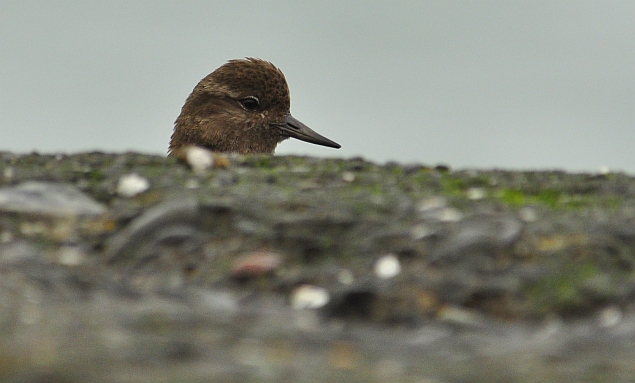
If you ever thought Seagull Steve was some kind of pipit stroker...you would be right. Here is an American Pipit, balancing on a pole. This is the sort of bird that makes casual bird enthusiasts not want to dive into actual birding...fuck that noise. I love pipits.


After Abbott's Lagoon, we headed back to Bear Valley Road, where both Yellow-bellied and Red-naped Sapsuckers had been reported from the same tree. We saw this bird, which definitely had a red nape.


But wait...something is off. The red cap seems almost contiguous with the nape, which no California birder ever wants to see. But there's something else...something is missing...


What is wrong with its face????


That's right...the bird has no white eye line on either side of the face. Not even a hint. Whiskey Tango Foxtrot. It's not like the bird is a super obvious hybrid, it doesn't have red all over it's head, but where there should be white there is only a resolute and very definite blackness. I've never seen a bird like this, have you? In any case, due to the nape patterning and facial weirdness, I suspect this is a hybrid Red-naped X Red-breasted, possibly backcrossed with a Red-naped.

Sunday, April 28, 2013

Birds For Bullshit Artists, A Pipit of Excellent Posture, and More


American Pipits have captured the hearts of birders almost solely on personality alone, although no one can deny their excellent posture. Maybe that is why vagrant Red-throated Pipits always hang out with them in fall...the assertive strut of the American inspires nothing but confidence in the disoriented Russians...er, Red-throateds. San Leandro Marina, San Leandro, CA.

As some of you know, I am in the midst of what biologists call "the field season", when we are constantly working out of doors for long hours, being stressed out, exhausted, occasionally risking extreme bodily harm...and have the lame ability to go to sleep before 9 PM. So my apologies for not keeping up my rigorous BB&B posting schedule of the gone (but not forgotten) Perpetual Weekend. In honor of said seven month long weekend, here are a few birds from the end of winter that never made it onto BB&B.

I hope you all are getting a stronger dose of spring migration than I am. I did get my FOS Olive-sided Flycatcher here on Santa Cruz  Island the other day, although it wasn't a year bird (thank you Costa Rica).


Somewhere...somehow...a Black Turnstone is watching you. North Jetty of Humboldt Bay, CA.

This the Purple Finch's first visit to BB&B...although not rare by any means, I just don't see them too frequently in California. I always thought the huge hole in their range in the Lower 48 was strange...I'm sure Cassin's Finches fill their niche in many mountain ranges, but you can find them side by side in some places in California. Golden Gate Park, San Francisco, CA.


A homely Hooded Merganser hen nibbles a stickleback. Mergansers eat a lot of sticklebacks in this little pond at Golden Gate Park, and they always nibble the shit out of the fish before actually swallowing them...perhaps they just need to get the fish into the perfect position to swallow, or else they will get stickled. Stickled? Stuckled? Stuck.


American Wigeon. The abundance and variety of subtle patterns found in waterfowl feathers blows me away. Golden Gate Park.


Great-tailed Grackle. I think that brownish wash in the iris is leftover color from being a young bird...adult males have bright yellow eyes. Lake Merced, San Francisco, CA.

Although I am writing this at the height of spring migration, I know some of you sick bastards secretly are really missing gull season. Here is a weird worn and whitish Herring Gull...this was taken almost 2 months ago, so it's probably doing a good Glaucous Gull impression somewhere by now. Golden Gate Park.


Although superficially resembling a Thayer's Gull (ok...not superficially, it really does), check out the size of the bill on this bird. Not exactly cute, is it? What we have here is a Glaucous-winged X Herring Gull, not a rare bird in northern California but always worth a good study. Lake Merritt, Oakland, CA.


Compare the above bird with this little bird. Look how cute and neat it looks! Look at that little-bitty bill! This is a first cycle Thayer's Gull. Many in late winter have extensive pink in the bill, as this bird does. Lake Merritt.


Enough of gulls already. Gulls are essentially bullshit, just fodder for birding bullshit artists. Forster's Terns are not. San Leandro Marina.


After missing them entirely in 2012, I finally ran into some Red Crossbills at Redwood National Park, in Humboldt County, CA. The (red) woods were teeming with them, in fact. Check out the length of the primaries of the bird on the right! These birds were literally built to be nomads.


Some photogs would have just thrown this picture out, but I think this fleeing Red-tailed Hawk (which I did NOT flush, thanks) has its own merits. This picture is a poor imitation of what Walter Kitundu can do...he is a bay area photographer who gets some amazing perspectives. Photographed at Golden Gate Park.

Tuesday, April 10, 2012

Hexed At Tijuana Slough


American Pipit in breeding colors. It was roaming the beach, chasing flies relentlessly around the mounds of kelp and algae.

One of the few places I've birded around here in the past was the mouth of the Tijuana River, when the Belcher's Gull showed up back in the 90's. There aren't any megacripplers like that hanging out there now (and yes, I saw the hell out of that bird), but I do remember it as looking like an amazing place to stare at the birdlife....so not long I ago I found myself retracing the steps of a younger, even nerdier version of Seagull Steve.

The place looks about the same as I remember it. Tijuana Slough National Wildlife Refuge (aka Tijuana River National Estuarine Research Reserve) has lots of tidal channels and saltmarsh, with a very birdy river mouth accessed from TSNWR trails, Border Field State Park or Imperial Beach. Nesting Yellow-crowned Night-Herons nearby are a nice perk as well. Offshore you can see the Coronado Islands, which lie in Mexican waters. They hold Brown Boobies and American Oystercatchers, birds I hold in high regard.

Unfortunately, on the day of my visit it was exceedingly dark and gray, which just makes me want to back there even more. It will happen soon. All photos today are from TSNWR.


Snowy Plover. This, at the moment, is the bird my life revolves around...that is, until the Least Terns start nesting as well.


One of the perks of the San Diego area is its abundance of terns. As you may know, I am a huge proponent of birds with forked tails. Forster's Terns are one of a number of tern species that breed in San Diego County.


Gull-billed Terns abound here, which is not something I remember from years ago. I'm not certain how their population over at the Salton Sea is doing, but they have been increasing in San Diego County. The Californian/West Mexican subspecies, Van Rossem's Gull-billed Tern, was recently petitioned to be listed under the Endangered Species Act, but Fish & Wildlife declined to do it (probably more for ill than good).


Do you see? It's like the Mercedes of terns.


This was the first time I managed to get some deec Long-billed Curlew pictures...the terns and shorebirds along the beach are somewhat acclimated to people, which is what a bird has to do to get by in these parts.


You see this clump of mussels? Whimbrel heaven. Delicious.


While California may be devoid of frigatebirds, at least we have Brown Pelicans to fill our skies.


This was the rarest sighting of the day. It's a birding church group. I have no idea what the priest is doing in this picture, maybe trying to part the slough? Put a hex on me? At any rate, it's a good thing to see.


Savannah Sparrow. When I took this picture I thought it was a Belding's (the locally common but endangered subspecies), but now I don't think it is, it's not dark enough. How embarrassing!


I never get tired of watching Sanderlings' neverending struggle to be as close to the water as possible without actually touching it. The Black-bellied Plover left for drier pastures.


There aren't many crappier looking birds than worn, first-year Western Gulls. They truly look trashy. So trashy, in fact, when they pick up an unappealing clump of mussels (maybe it was the Whimbrel's?), it makes them look better.

Thursday, February 23, 2012

The Perpetual Weekend Rolls On...


This Dusky-capped Flycatcher is one of the rarer birds I've seen in 2012, and apart from a few Heerman's Gulls probably the only bird I've seen this year from south of the border. Golden Gate Park, San Francsico, CA.

Having been Funemployed for the whole winter (which, granted, is getting old), a lot of birding has been happening. Birding, in fact, is the key. I have not been lacking in a night life, but the sad fact is that most people I know usually work or go to school during the day. I feel really bad for them, as it prevents them from seeing birds. Fortunately, the birds have been entertaining in the diurnal hours....here are a few images from earlier this winter that I haven't posted yet.


A Snow Goose family. Snow Goose family units are probably much less dysfunctional than American families (human), but losing members to predators and shotguns probably doesn't help. Sacramento National Wildlife Refuge, CA.


American Pipits really know how to strut. Check out that tarsal length! Sacramento National Wildlife Refuge, CA.


A female Mountain Bluebird in the process of disfiguring a Jerusalem Cricket. You should see what a flock of these things can do to a horse....nightmarish stuff. Armour Ranch Road, Santa Ynez, CA.


Black-necked Stilts have both style and class...unless you are near their nests, when they transform into headaches. Radio Road, Redwood Shores, CA.


I don't think I've ever posted a Bewick's Wren shot on BB&B, so I would like to rectify that. Rare, no. Jaunty, yes. Abbott's Lagoon, Point Reyes National Seashore, CA.


Glaucous Gull is another bird virgin to BB&B. I am happy to say, virgin no more! This bird has been present for several weeks at Golden Gate Park in San Francisco.


I probably should've posted this around Christmas, oh well. White-crowned Sparrow, Lake Merced, San Francisco, CA.


Greater White-fronted Goose, Mallards, Cackling Goose. This is a common fourgy in some parts of the state, but not so much on the coast. Stern's Wharf, Santa Barbara, CA.


Northern Shoveler, an appealing duck. Radio Road, CA.


Everyone likes Great Egrets, I would say they are one of the top 5 birds nonbirders ask me about. "I saw this big white crane next to the freeway last week, yadda yadda yadda...". Golden Gate Park, San Francisco, CA.


Corvids and raptors do not mix, and the Corvids usually win. Such was the case with this Common Raven and Red-tailed Hawk. Ano Nuevo State Park, CA.