Showing posts with label gull hybrids. Show all posts

Friday, November 16, 2012

Gullible


If you did not identify this bird in under 3 seconds, you clearly need to study up for gull season. Lake Merced, San Francisco, CA.

Well it's officially gull season here at BB&B...while California birders make blood sacrifices to that Big Gull In The Sky in attempts to get an early fall Little Gull (like most prayers, they usually go unanswered), gull season hasn't started in earnest until now. California's first Lesser Black-backed Gull of the winter has been reported from Alameda County. I did search for the (well-documented) Lesser Black-backed today, but as with most of my recent chase attempts, it ended in failure...but it turned up at a great gull-watching spot (not surprisingly, next to a dump) so I will be back soon. Birders up and down the state can now start their search for Black-tailed, Slaty-backed, Iceland, Black-headed and other species in earnest, and those looking for the state's first Greater Black-backed Gull have another crack at claiming Victory.

Much has been written about gulls...mostly how unpleasant it is to identify them, how people generally aren't very good at it, and even how some birds just can't conclusively be identified. Indeed, whinging about gulls is an atavistic endeavor at best, so I won't go rehashing the same old shit...but that doesn't mean what they say isn't true.


Well...it's a hybrid. The small, almost delicate bill points to Glaucous-winged X Herring in my opinion, but Glaucous-winged X Western is a possibility, especially considering the mottled breast and belly. Note the small bill with reddish base, checkered back and light brown primaries...these birds are deceptively similar to Thayer's Gulls, but don't look as neat and usually have paler primaries.


Here's a first-cycle Thayer's Gull for comparison...note the round head, big-eyed look, meager bill, and dark (not black) primaries with pale tips. This was photographed in late winter, young birds usually don't have so much pink on the bill right now. Lake Merritt, Oakland, CA.


Of course, real gull addicts don't want to be seeing straightforward looking birds unless they are extremely rare, so here is another genetic monstrosity...I would tentatively go with Glaucous X Herring Gull hybrid, or perhaps Glaucous X Glaucous-winged. Large, heavy-billed, extremely pale, with a dull (but extensive) pink base to the bill and a lot of white in the primaries. Lake Merritt.


Probably a very pale Glaucous-winged Gull...note the difference in bill shape from the above bird. Some may be tempted to call this a Glaucous, due to whiteness and pink in the bill, but of course they would be Wrong. Lake Merritt.


Ah, a Glaucous Gull. So white. So easy to identify. So rare but regular. What a relief. Golden Gate Park, San Francisco, CA.


Birders don't hold a grudge against Mew Gulls, since they aren't completely slutty and don't closely resemble other gulls. Lake Merced.


Wednesday, March 7, 2012

Lake Merritt: The Realm of Fuligula and Friends


Buffleheads even attract the attention of nonbirders. Little do they know that they actually nest in the ear cavities of American Buffalo, a highly specified niche.

I've been spending a lot of time in Oakland this year. Who knew? I've always felt loyal to sweet sweet West Bay.

Like San Francisco, there is a lot of concrete around here, but birds can be found with the right pair of eyes...or access to BB&B. The obvious best birding/photography spot around is Lake Merritt, which is filled with diving ducks all winter long, not to mention grebes, gulls, herons and various songbirds around the lake. That's pretty cool in and of itself, but these birds are quite acclimated to people, as anyone who tried to go hunting here would probably end up on the losing end of a shootout with a local gang. Bring a camera and you can spend many hours there...November-February are the best months, but get there soon and you can probably still find most of the regulars. All pictures today are from Lake Merritt.

PS Although not from Lake Merritt, I highly recommend looking at this gem from Postsecret. Swans > Kids any day and every day.


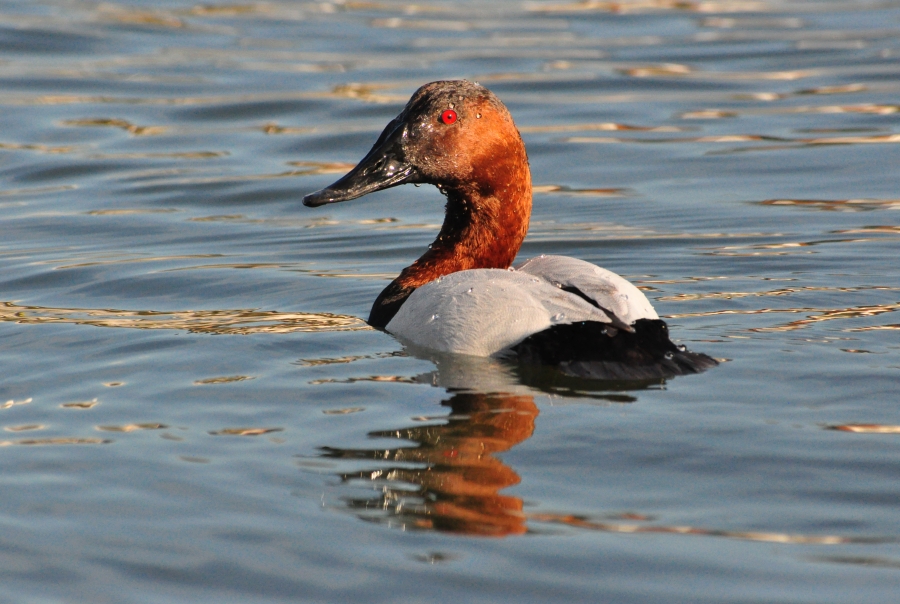
Canvasbacks can be a bitch to photograph, which is a shame, because they are brilliant ducks...superb, even. I once saw a Peregrine Falcon grab a Canvasback from the sky, and then drop it into a pond from 150 feet up. THE DUCK SURVIVED. You will have no problem getting cornea-bending looks of them at the lake.


This American White Pelican can't fly and has been living off fishy handouts at the lake's nature center for several years. Occasionally a wild birds drops by and keeps it company/steals its meals. It still goes into breeding plumage late every winter and is fun to look at when its around.


Of course, the avian celebrity of the lake is the annually returning Tufted Duck. For the past several years this has been the most reliable place in the state to see one.


His tuft doesn't always look so immaculate, and it needs to be shampooed and conditioned on the regular. It reminds me more of a droopy mohawk (stylish in it's own right) in this picture.


Well I have a feeling this is a hybrid, but maybe (against all odds) it's a Glaucous-winged Gull. Kind of a pretty bird though. The lake can hold good numbers of gulls from time to time, and should be checked for some of the rarer species.

One of the Great Egrets that frequents the lake has lost most of it's fear of people, which allows you to get pictures like this one...


...and this one. Maybe someone can bring it some moisturizer?????


Green Herons are there too, although aren't as notoriously cooperative as some of the other herons. In fact, I haven't met a truly abiding Green since 2009 in the Everglades....what a bummer.


Eared Grebes appear harmless, but their terminator eyes say otherwise. Between their eyes and their fluffy, pillowesque bodies, they are one of the great mysteries of nature. 


Lake Merritt and scaup on a cloudy day.


There are birds without webbed feet found at the lake too, like this Nuttall's Woodpecker. Nuttall's is practically endemic to California, so my heart swells with pride whenever I see one.


Lesser Scaup. I dig the fine patterning on it's back (scaupulars?!), that's not something non-hunters get to see very much. Go to sleep my scaupy friend.


Sunday, February 26, 2012

A Weird Time Of Year


Golden-crowned Sparrows are often found in blooming willows and fruit trees this time of year, bucolically devouring flower petals. Golden Gate Park, San Francisco.

Late February. It's a weird time of year. Some people hate February. Winter has been around for a while now, and people in colder climates are starting to get sick of it. The sharp and jagged pains from a million Valentine's Day disasters are felt from coast to coast. Birders have been staring at the same birds for months, and desperately look forward to spring migration. A kind of catatonic depression begins to sink in...long, loving relationships fracture and explode into flames...The Fear sets in, fingernails are chewed off...who are these bastards watching me from the shadows anyway?...and we ask ourselves how much more we can really take...

Well, I'm sure that's the case for some people anyways. Personally, February has always been a month of transition for me, as every year I typically cease my Perpetual Weekend and go back to being a field biologist. At this time last year I was taking up residence west of Veracruz, Mexico, standing on a roof all day looking for raptors and being force-fed caguamas at night (in this case caguamas are 40 oz beers, not tortoises)...but at this point, I've managed to completely fail at lining anything up. Life is pain, as they say, but my luck is bound to change.

Yup...February. Today's blog is a quick snapshot of birding around the bay area this time of year. And before I dive in too deep in to the philosophical bowels of the month, I must assist The Great Ornithologist Felonious Jive in finishing his next 10,000 Birds post, before it is too late. See you soon, bird geeks.


Next month most Western Grebes that intend on breeding this year will begin retreating from the coast to inland lakes. Once there, they will commence spectacular courtship dances and making grotesquely adorable babies. Lake Merritt, Oakland.


Clark's Grebes will do pretty much the same thing as Westerns...they used to be the same species, ya know. Lake Merritt, Oakland.


Hooded Mergansers will be departing in a few weeks. It is a great shame. Golden Gate Park, San Francisco.


Black Phoebes and other "resident" passerines often begin nesting earlier than the migrants. By the way, this is my best Black Phoebe shot to date...Californians may feel insulted to have to look at another phoebe, but maybe the rest of you will appreciate it. Golden Gate Park, San Francisco.


Varied Thrushes are uncommon winter visitors to much of the bay area. They won't be around much longer, as the urge to retreat to the redwoods grows stronger every day. Golden Gate Park, San Francisco.


Raptors, like Peregrine Falcons, often get started breeding during the winter months. This one won't be bumping cloacas quite yet though, it's too young. Point Reyes.


Seawatching birders will be detecting northbound migrants soon, if they haven't started already. Pacific Loons are one of the commonest spring migrants along the California coastline. Half Moon Bay.


A few miles offshore, Cassin's Auklets occupy California waters year round. Much like me, they are probably growing tired of just hanging around for the past several months and doing nothing but socializing and eating...it's time to breed! Well, I don't actually intend on doing that, but you know what I mean. Half Moon Bay.


February is a great time of year to look for weird gulls....herring runs can trigger thousands of gulls to accumulate along stretches of coast for days at a time. I thought this beefy beast was well-proportioned for a darker Herring X Glaucous Gull (aka Nelson's Gull), although it could be a Glaucous-winged X Herring. Fort Baker, Golden Gate National Recreation Area.

Tuesday, February 14, 2012

Gulls Gulls Gulls Gulls Gulls


An Iceland Gull doing something weird. All photographs today are from Fort Baker, Sausalito, CA.

WARNING: This is a full-on gull post. It will appeal to no one but gull fetishists. If you are larophobic, go away! But if you consider yourself a leading light in gull identification, feel free to throw in your two cents on any of the bizarre birds below.


Iceland Gull. So dainty. And white. And pink-billed. And dainty. AND RARE. Jesus Christ! So rare!


Iceland (back) and Thayer's Gulls. The Iceland is slimmer and smaller than Thayer's, and longer-winged. Some would even say...daintier. If you didn't catch it before, I have more photos of this bird up over here.


Well...here is a bird that looks like an Iceland Gull, but I reckon it's a super bleached Thayer's. That's a serious tail band. What do ya'll think? It seems like people have been claiming to find Iceland Gulls up and down the state for the past several weeks, including at Fort Baker, and possibly even including this bird...I am skeptical. No offense. There are a lot of bleached birds around, making them appear far whiter than they did a few months ago.


Some folks who know their gulls better than me got me on this bird....they were calling it a possible Vega Gull. We did see it fly....it had a giant, thick black tail band, which is not a good mark for Vega Gull as far as I know...if anyone has any legit input on this bird, I'd love to hear it.


A pale-eyed second-cycle Thayer's. Not a plumage I see a lot.


A big beefy hybrid of some sort. Herring X Glaucous-winged?


Another awful hybrid. Is this just a super bleached Western X Glaucous-winged? WTF????


Herring (rear) and Thayer's Gulls.


Mew Gulls are a relief to look at compared to everything else, as they are easy to identify.


There have been a lot of gulls down there. It was scary.