Showing posts with label greater yellowlegs. Show all posts

Tuesday, August 21, 2018

Grasspipering, Winnie Pro Tips, Sea Rim State Park, Sabine Woods


Being true to my nature, I am really dragging out reporting from Texas this spring, but we are getting close to the end. Also, this post somehow seems more relevant now than a couple of months ago, as we are all again experiencing the passage of shorebirds and passerines that are such a big part of what makes us do what we do.

Before BB&B leaves the High Island area entirely, a few more quick notes...grasspipers and Hudsonian Godwits were target species for the trip, and we did quite a bit of driving around in Chambers County (where Anahuac NWR is) before sweet victory. American Golden-Plovers (front bird in the above photo) were fairly common and not difficult to find, but it took a while before we finally connected with Buff-breasted (above) and Upland Sandpipers, which are both marvelous species that I am perpetually starved for here on the west coast. I dig the white wing linings glowing on one of the Buff-breasteds above.

There are a plethora of roads on the coastal plain that could potentially lead you to good shorebirding or grasspipering; we barely scratched the surface. Our Field of Dreams for grasspipers was a very large field with very short grass on farm road 1941, west of TX-124. Flooded fields in a few places had additional Buff-breasted Sandpipers, Ruddy Turnstones (which I don't consider to be ag field birds, but they know better), White-rumped and Baird's Sandpipers, etc.

A few logistical tips for anyone planning on making the trip next spring:

*We stayed at Motel 6 in Winnie. It was relatively cheap and totally fine, aside from the clogged sink that the staff took days to fix. I would stay there again though.

*In Winnie, we ate at Al-T's steakhouse a lot, which you should do as well. We also ate at the Crawfish Box, which was awesome. That was my lifer crawfish meal, and I can't wait to do it again. I also made Dan and Nate eat at Waffle House, because I love Waffle House.

*I looked into Airbnbs before the trip, but the only options in the immediate area were out on the Bolivar Peninsula and they were not cheap, though if you were travelling in a group renting out a beach house would definitely make sense. Any resident of Winnie or High Island who lists their place on Airbnb could potentially rake it in March-May, provided their listing consisted of something nicer than a decaying trailer (which are locally common). 

*As far as we could figure, the best coffee in Winnie (which is not the same as good coffee) is at Brewed Awakening.

*The Market Basket in Winnie has all the groceries you need, aside from liquor.


With the Galveston and Chambers sites wrapped up, let's move on to Jefferson County! Jefferson is the easternmost county on the UTC and is right on the Louisiana border. Sea Rim State Park is one of the hotspots in the area. According to Steve from Kansas City (Hi Steve!), Sea Rim once hosted a willow patch that was an absolute gem of a migrant trap, but was inundated with brackish water from a hurricane several years ago and is no more. The park is still good for a variety of water birds though, including this confiding Solitary Sandpiper.


I'm not saying this is a skulky or wary species, but I have had a hell of a time getting to close to them most places. This bird had no qualms about lingering in crush range.


I think the bird is just expelling some salt out of its nostrils, but this appears to be the equivalent of a Solitary Sandpiper sneeze.


Lesser Yellowlegs are one of the most abundant shorebird migrants on the UTC. This one was still mostly in basic plumage.


Oddly, Greater Yellowlegs were an uncommon bird everywhere we went, which just doesn't compute to me considering the abundance and diversity of shorebirds in the region. Compare the bicolored, recurved and longer bill on this bird with the Lesser Yellowlegs above.


Long-billed Dowitcher. It's not a field mark I use, but supposedly the kink in the bill visible in the first photo is supposed to be a helpful field mark for Short-billed Dowitcher. These days everyone seems to have their own suite of field marks they like to use to ID dowitchers that they apply very liberally...what happened to caution? Has it been thrown to the wind, no longer warranted? At least Short-billed X Long-billed Dowitcher doesn't seem to be a popular identification yet. The increasing (yes, still) tendency of birders to identify birds as bizarre hybrids continues to be disappointing.


Least Bitterns, on the other hand, are never disappointing, even if they prefer to stay hidden in the reeds.


Even Boat-tailed Grackles aren't disappointing if you go long enough without seeing them. This one was doing its best to strike a pose that would eliminate all iridescence and recall a Melodious Blackbird (perhaps the most overdue Mexican bird yet to be found in the states), but with such a boaty tail and unmelodious voice it had no chance.


When Roseate Spoonbills are flying overhead at sunset, all is very briefly right with the world.


Common Nighthawk was a common migrant during our week on the UTC. This one chose to roost on the boardwalk out over the marsh. Like all nightjars, they are extremely novel to see up close.

Sea Rim was nice but not exactly thrilling, though I'm sure it can get really birdy at times. And we didn't even get out to the beach, so who knows what was lounging on the sandy sand? We gave a valiant effort to try and hear a Black Rail, donating blood to mosquitoes at dusk, but none vocalized. We really let Nate down, which haunts me to this day.


The last hotspot BB&B is going to cover from Texas is Sabine Woods. The first afternoon we visited yielded tons of birders (gross), which brought Boy Scout Woods to mind, but more importantly lots and lots of birds, mostly ground-loving and low-in-the-canopy species like this Worm-eating Warbler. Not a fallout, but there were a shitload of migrants. It was an impressive showing - migrants seemed to be everywhere at times - and yet another reminder that migration in the region really is a spectacle. The patch itself was really nice to bird - large, canopy openings, drips, ponds, edge habitat, relatively low numbers of mosquitos, lots of room to spread out and get away from other birders when necessary.


Who doesn't love Black-billed Cuckoo? Everyone was stoked to see Black-billed Cuckoo, especially considering their status as a MEGA (and a BLOCKER) in California. Nate and I had seen one earlier back at Hooks Woods but this is the only one of the trip that was chill enough to be photographed. I'm glad I don't see them very often because I suspect I could get strongly emotionally attached to them if I lived within their range.

There will be one more Texas post, featuring nothing but Sabine Woods, and the best day of birding the entire trip.

Thursday, July 20, 2017

March Mildness, Marin Wildflowers, The Pullout Method


And so we blog onward, in the heat of the desiccating and unrelenting San Jose sun, until BB&B is all caught up with current birding events. I'm not sure how long this will take, but I'm happy to put the work in. You know, BB&B will be ten (10) (!!!) years old next year, and it's never too early to start ramping up the blogging activity in anticipation of this epic milestone. We have a lot of special things in store for you next year, and as long as this microdosing thing keeps working, the inspiration to do even more will keep flowing!

A long time ago, in a harbor far, far away, a Greater Yellowlegs was molting in some crisp, clean alternate coverts. It was springtime in Alameda. Is there anywhere that matches the glamour and glory of an Alameda spring? Yes, a great many places...no offense Alameda birders. Photographed in Ballena Bay, Alameda, CA.


This Long-billed Curlew would would soon be exchanging it's patch of mudflat for grassland. Like some other shorebirds, curlews may defend nonbreeding territories - this bird may have already returned to this patch of mud by now. Unlike my species, procrastinating and other forms of lollygagging have not been documented in curlews.


On another March morning, I birded China Camp State Park to see if I could get a couple Marin birds that had been holding out on me. This White-throated Sparrow was not a county bird, but was an unexpected surprise. Around here, March is not a month that bursts with the potential of coming across extremely uncommon birds, so this gave me a good birdbuzz.


It was a very cooperative bird, but spent most of its time feeding actively in the deep shade. Some genuine, potentially legendary crushes were missed, but I was happy to spend some quality time with it. Year bird!


A male Spotted Towhee took a break from wailing against the leaf litter to soak up some sun.


I did succeed in getting one county bird that morning...Black Rail. There was one calling from the saltmarsh pictured below...


...and several calling from this freshwater marsh, which really surprised me. Black Rails in the bay area generally are found in saltmarsh or wetlands with tidal influence, though they use freshwater habitats in many parts of the state. I suspect this marsh is totally dry during drought years, so the rails were probably chuffed to have this habitat available this spring.


Billy has used her powers to make me unwittingly pay more attention to plants than I used to, so I couldn't ignore some of the mellowing wildlowers in bloom, particularly the iris. Pretty sure this is Douglas iris (Iris douglasiana).


This could be the same species, I think they are pretty variable. That said, I have almost no idea what I'm talking about.


An even paler blossom. Is this a different species, or is this still douglasiana?


Death camas! Not only deadly, but replete with aesthetics.


Not sure what species this is, but owl's clover has always been one of my favorite wildflowers.


This was a wallflower we hadn't seen before. Headland wallflower (Erysimum concinnum)? This was in the coastal scrub of the headlands just south of Muir Beach, Marin County. Not sure if there are any other wallflowers with white blossoms growing in the area.


On another March morning, Matt Sabatine and I went out to Mines Road, south of Livermore, to see what we could find. Mines Road offers some of the best road birding in the bay area, and one of the only spots to easily find Yellow-billed Magpie in Alameda County. I got a number of Foxtrot Oscar Yankees and new Alameda birds that morning, including chaparral-loving Rufous-crowned Sparrows. But aside from finding a Golden Eagle nest, the other highlights all appeared at the same random pullout.

Immediately after getting out of the car, I thought I had found a Red-naped Sapsucker, though the bird was distant and I was unable to get photos. Aaron Maizlish eventually crushed the bird, which turned out to be an apparent Red-naped X Yellow-bellied Sapsucker, an extremely rare hybrid in the state. His photos can be seen here. I wish we could see the right side of the bird, but shit, I wish for a lot of things.


This bobcat was much more cooperative than the sapsucker. So far, no hybrid allegations have been brought forth, but I wouldn't put it past your average birder to do so. This hybridphilia has got to stop...but I digress. Bobcat is a great bird!


Bobs usually don't casually saunter across the road a stonechat's throw away while you are standing there fumbling with your camera. They are still fairly common in many parts of California, but my stoke for seeing them is genuine, prolonged and sustained.


You may be thinking to yourself, "Goddamn Steve, how much shit can you possibly see at a random pullout in fucking Alameda County?" Well, how about a blazing-hot county rarity, one that is not a stupid hybrid? This Townsend's Solitaire flew in from up-canyon, perched nearby for a few minutes, then continued on its way north, never to be seen again.


And it seems to me you lived your life like a candle in the wind...so long, solitaire. I would have liked to have known you, but I was just a kid. Few birders have ever had the pleasure of seeing one in Alameda, a decidedly unpleasant county for solitaires to linger in.

Yes, that was from an Elton John song. I am unapologetic, but I should probably quote Minor Threat instead next time.

Monday, May 2, 2016

An Ancient Harlan's Hawk, Newt Problems, Shades of Merlin


As any California birder knows, Humboldt offers a lot more than just the (very) occasional Great Gray Owl. There is no shortage of good birding spots to scour during the winter, so of course I had to check some other shit out while I was up there. I birded Arcata Marsh, since it is conveniently located right in town and just about anything can show up there...the dependable Swamp Sparrows I was looking for were not very dependable on this day, but the much more range-restricted Golden-crowned Sparrows were there in predictable abundance.


Unlike most birding spots, the marsh continues to grow in size and simply gets better and better when it comes to shorebirds and waterfowl, possibly to the detriment of the local Short-eared Owl population. This Greater Yellowlegs was feeding right in the face of this Green-winged Teal, foraging on little inverts the teal was stirring up with its bill. When you have a height of only a few inches it must be strange to have a yellowlegs looming over you, but the teal did not seem to mind.


This was apparently a successful foraging technique, as the yellowlegs did grab something while I was watching.


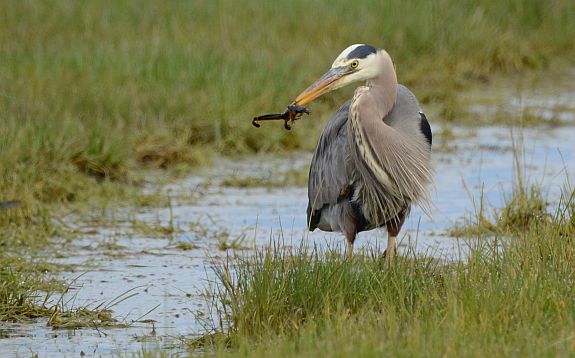
Over on the V Street Loop, this Great Blue Heron had gotten a hold of a much more interesting prey item...a large newt.


The heron did not appear to have a good idea of how to go about eating the newt, repeatedly dipping it in water, bashing it against the grass and not giving attempting to swallow it at all while I was there. This is an awkward thing to prey on at best, extremely toxic and deadly at worst. Native Americans in the Pacific Northwest used newt juice as a poison...


On the far side of the loop a cooperative Merlin was posted up on...a post. This bird struck me as being fairly pale, with no mustachial stripe...in the field I thought it was a female, but looking at the photos now I don't feel so sure about that. Interesting bird, I'm not quite sure what to make of it as far as age/gender/subpecies.


Elsewhere in the bottoms, I came across another, especially confiding Merlin. This bird was noticeably darker with heavier markings on the breast and belly than the first Merlin of the morning, but I'm not enthusiast about pulling the trigger and calling it a "Pacific" Merlin (I would expect a darker face and even more streaking/barring on the breast and belly). The vast majority of Merlins I've seen over the years usually zip by, giving shitty looks...I'd like to have more time to watch these birds and get to know each subspecies more.


For all you robin-strokers out there, here is an American Robin. There are thousands in the Arcata Bottoms in the winter. It is known.


Much, much more interesting than the area robins was this Harlan's Hawk. This bird has been wintering along the Highway 101 corridor between Eureka and Arcata for over a decade (!), usually near the Jacoby Creek Cutoff. In the past, I had only seen it while on the freeway, getting a quick naked-eye glimpse of it perched on a billboard or something and thinking "Oh, that was probably the Harlan's", but I finally managed to get great looks at the bird on this trip.


The bird is extremely dark, lacking any "warm" tones whatsoever. Fitting for an Alaskan bird. The uppertail (not visible in any of my photos) appeared dark gray without a hint of red, with a prominent dark subterminal band.


Although I never saw it fly, this bird definitely provided the best looks I've had of any Harlan's. Hopefully it will make it back to Humboldt this fall once again.

It was a relatively quiet winter in Humboldt as far as rarities go, but with a Snowy Owl (that I gleefully did not chase) showing up shortly after I was up there, the winter Vague Runt season ended for local birders on an extremely high note. What will show up next winter? Steller's Eider? Gray Wagtail? Black-tailed Gull? Siberian Accentor? The possibilities boggle the mind.

Thursday, August 28, 2014

GBRS Rule 8425.8: Exterminating The Mystery Bird


Female and immature Brown-headed Cowbirds are one of the most abundant American Mystery Birds. An impressive portion of birding America are not capable of identifying them, despite their horrific abundance and depressing distribution, which is almost everywhere. Can this bird be difficult to identify? Yes. Is it...mysterious? No. Photographed off of Half Moon Bay, CA.

You may have heard by now...I am the Global Birder Ranking System's #7 U.S. birder. I don't like to talk about it, but I think it serves as a salient starting point for today's topic. With high ranking comes great authority. With great authority comes great power. With great power comes great responsibility.

Today, we are talking about the "Mystery Bird". If you are reading this blog, you know what that means. In fact, taking a different route I have previously tried to put this topic to rest, but the Mystery Bird lives on. The Mystery Bird is as popular and widely distributed as a Bald Eagle or Red-tailed Hawk. But before we get into the current status of the Mystery Bird, a little background.

I began birding in 1994. Back then, we didn't really have the internet. The internet was in a sort of fetal state back then. Birders communicated through phone trees and rare bird hotlines. Mystery birds, per se, did not exist, as there was almost no public, electronic forum for them to be talked about. A few years later, email lists became a popular tool for birders, and the Mystery Bird was born. At first, Mystery Birds were not used in the abundance that you see today. Experienced birders tended to use the phrase, because if you are an experienced birder and saw a bird you could not identify, the bird's identity was truly a mystery. Use of the Mystery Bird title was very select and discrete. So when a Mystery Bird was reported, it often was of interest to many other birders. It was a meaningful phrase.


Orange-crowned warblers are apparently very mysterious. Ugh. Coyote Hills Regional Park, CA.

Now, of course, we are in the Facebook Generation of birding. The usage and meaning of the phrase "Mystery Bird" has changed considerably. The phrase is now most often used by relatively new and inexperienced birders, and it is used a lot. The unsaid but obvious definition of the phrase is "I cannot identify this bird". But inexperienced birders are not supposed to be able to identify everything correctly. We have all gone through this stage; it's part of birding. So now the real meaning of the phrase is: "I cannot identify this bird because I am not good at bird identification." This could, in fact, explain why a certain bird can not be identified...there is nothing mysterious about that. We are left with a simple truth: there is no mystery left in the Mystery Bird. 


Greater Yellowlegs know what it's like to be a Mystery Bird. So do their relatives, Lesser Yellowlegs and Solitary Sandpipers. They should all be renamed "mysterylegs". Famosa Slough, San Diego, CA.

And with this in mind, I come to you bearing exciting news...none other than the Global Birder Ranking System has issued a new ruling regarding Mystery Birds, and I have been authorized to release it! Without further delay, I present it to you in it's entirety:

"Rule 8425.8: A mystery bird is defined as a bird that is extremely difficult to identify by expert birders, even when provided passable documentation. A bird that cannot be identified by inexperienced or otherwise unskilled birders is not mysterious; it is a bird that cannot be identified because said observer does not possess the necessary knowledge and/or skills to make an accurate identification, and/or they failed to obtain useful documentation.

GBRS highly recommends that birders discontinue the use of the phrase "mystery bird" in subject lines of email messages or forum/messageboard posts, or any other context. In recent years, it overwhelmingly and wrongly communicates to other birders that the bird's identity is a mystery. GBRS finds "identification help needed" to be acceptable in place of "mystery bird". Research conducted by GBRS in 2013 concluded that of all ABA Area reported mystery birds, approximately 4 percent warranted that phrase; in 2012, that figure was only 2.9 percent. Since the exact definition of "mystery bird" has become so clouded, experienced birders are now directed to post mystery birds as "interesting"; for example, instead of titling a listserv message "Mystery Bird" or "Mystery Booby", experienced birders will instead post "Interesting Flycatcher", "Interesting Shearwater", etc.

With these new rules in place, please remain conscientious of GBRS Rule 8336.1, which remains in place and reads as follows: "Birders shall not ever, for any reason, title a message "Interesting Bird", as this phrase carries almost no meaning, has been proven to be found exceptionally obnoxious, and is rarely true."

Violation of these rules may result in a decrease in your GBRS score, which could lead to a lowering of rank."


Even the ubiquitous Red-tailed Hawk knows how to play the Mystery Bird role. And if a Red-tailed Hawk can be a popular Mystery Bird, then we know that we cannot tolerate this so-called "mystery" for any longer. Carrizo Plain, CA.

So lets come correct birders. Let our GBRS overlords smile down upon us, and let their love (that we so need and desire) seep into our bones. Let us put the old Mystery Bird on the shelf, and let it collect some dust...forever. I know we can do it...after my colleague and awful friend The Great Ornithologist Felonious Jive put "Birds have wings. They use them." in the spotlight, this phrase has almost been extirpated from the ABA birder lexicon.

If we can accomplish this, perhaps one day, birds can have some mystery again.

Sunday, October 20, 2013

The Spark That Set The Nerd Ablaze


Over the years, I've had a number of people ask me what my "spark bird" was. I typically just launch into the story about ducks and a sewage plant, but I think it is time I come clean. It was not a fowl-saturated sewage plant that cast my fate, but a wayward Ruff.

What is a "spark bird", you ask? It is the bird that took you by the hand (or for some, the throat) and made you the birder you are today. It is the bird that inspired you, that kicked you over the edge of normalcy into the oblivion of birdwatching. People have all sorts of spark birds...something common in their backyard, something exotic seen on a tropical vacation, a majestic raptor soaring overhead. It is the spark that lit the fire so to speak, but I prefer to see it as the fateful dose that plunges one into a hopeless and beautiful addiction.  If you are wondering why "spark bird" is so damn cheesey sounding, I have the answer: it's a term made up by a birder. What else would you expect? To my ears, the phrase is reprehensibly corny, but the term has been accepted by the birding community, and not even my hefty influence can stop it.


The reason I usually tell people the sewage treatment plant story is because it took my interest in birds from about a 6 up to a 8. My father, although he isn't a birder, gave me the nature bug, so I knew about hella birds even before birding. Being born a nerd, as a kid I would look though bird books in awe of all the different birds out there that I assumed I would never see. But one day, my dad and I stumbled upon a sewage treatment plant that was loaded with birds. There were all these ducks that I'd only seen in books before...Canvasbacks, Redheads, Blue-winged Teal, etc., and it wasn't too challenging to tell them apart. I was pretty stoked.


Somehow that foul experience translated into meeting some birders. One day I went out with Don DesJardin, holder and protector of the highest Ventura County (CA) list. We went to all these seemingly random, kind of disgusting places where I never expected anything interesting to occur. We saw all sorts of new birds for me...Pectoral Sandpiper, Common Snipe (Wilson's didn't exist back then), Mountain Plover (a pretty rare bird).


One spot we checked was this gross cement-lined drainage ditch. Don said he Saw a Ruff there recently. Being 12, and not a birder, I didn't know what the fuck a Ruff was. Don explained it was this Old World shorebird that looked sort of like a fat yellowlegs, except with bright orange legs. This was the first time I really understood the concept of a "vagrant"; I had no idea that A) Birds got lost, B) Birds got really, really lost and C) people look for these birds and D) people actually find these birds. It was a watershed moment.


It wasn't difficult to pick out the Ruff, foraging between overturned shopping carts and empty plastic bags. Despite it's glowing legs, it was a nondescript bird, but I was captivated. CAPTIVATED. Looking at it did not get old. I remember the thought occurring to me that this was strange. Why couldn't I stop looking at this relatively large sandpiper? I didn't even know it existed just an hour before.

And so after that fateful day, I immediately went into deep decline and became a total birder. My childhood enthusiasm for reptiles and amphibians practically vanished, replaced by a neverending thirst for bird observation. The rest is history.


This Ruff, of course, is not the bird of 1994, but a continuing bird in Alameda, CA. Crab Cove is a random tidal cove that I never even knew existed until this bird was reported, although the location is only 15 minutes from my house. One of the many benefits to skankily chasing a bird you've seen many times is getting introduced to new places...and when you've been birding for as long as I have, new places to bird are embarrassingly exciting.


As with many of the Ruffs I've seen over the years, this bird likes to travel with yellowlegs. If you go out to Crab Cove for this bird (which is likely still there), look for the flock of Greater Yellowlegs. If the yellowlegs aren't there, the Ruff probably isn't either. Get there right after high tide, and watch the shorebirds come in to feed.


While the Ruff was pacing back and forth in front of me, this bright male Black-necked Stilt was doing the same. Stilts are far more likeable this time of year than when they are nesting, when seeing them often entails getting divebombed and scolded (yap-yap-yap-yap-yap-yip-yap-yap-yap, etc.), which gets old quickly.

It's a good thing I chased the Ruff, because the list of decent birding spots within 15 minutes from me is very, very short, and it's nice to have a new local place to check out. But the real story here is that its always nice to meet up with an old friend, especially one who changed my life forever. Post-Ruff, things have never been the same.