Showing posts with label Harris's Sparrow. Show all posts

Friday, April 12, 2019

Requiem For A Sparrow


querula: giving forth a mournful sound; a requiem.

We sit by the window, cups of coffee cradled, watching the sparrows happily feed. Scout Kremlin had invited me over to see, first hand, the latest in his Brazenly Anti-Domestic Cat Access Technology (BAD CAT). A half circle of hog wire zip-tied to a crumbling wooden fence provides the birds safe foraging and exemplifies the bleeding edge in feline determent.
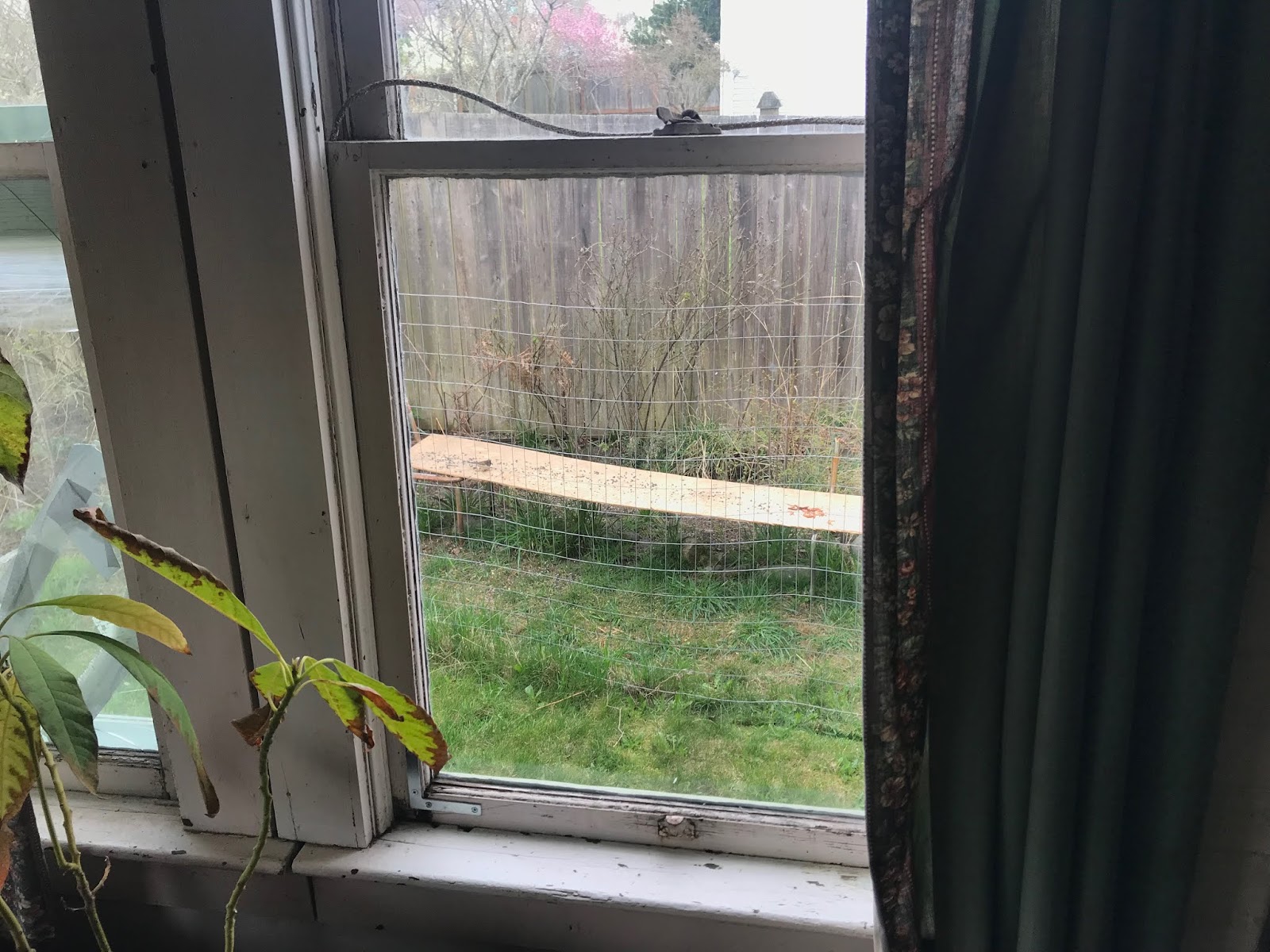
 

The 'Zono Zone', featuring a newly installed cedar bench onto which the highest quality bird feed mix is generously sprinkled. The bench provides shelter during inclement weather and allows for safe perching/viewing. A Dark-eyed Junco can be seen on the left side, enjoying a stress-free sunflower seed and eyeing a pile of dried local pears on the other side of the bench.

As we sit sipping and waiting for a Lincoln's Sparrow that he has promised me is a regular visitor, Scout reminds me that the last Harris’s Sparrow seen in Clallam County, in the fall of 2017, was behind this enclosure. ‘It was here for at least 3 weeks. Loved to perch on that lilac branch right there and preen. And then one morning in the alley, I found the trail of feathers. It should of never left the enclosure!'
Scout pointing out the location of the last recorded Harris's Sparrow in Clallam County.
He rattles off a couple of facts concerning the Harris's (biggest sparrow in North America, only songbird to winter in the US but breed completely outside of it) before choking up and quickly looking away. With moist eyes he begins talking about possible colors he might paint the interior of his charming and dilapidated residence. As he drones on about the merits of Eniwetok Peach over Caramelized Ginger, I am whisked away to a far away place and a long ago time. To a graveyard at the edge of town. To the Desert Memorial Park, located at the outskirts of Ridgecrest, California, the place where I first laid eyes on a Harris’s Sparrow...

It was late fall in the Mojave. My 1-year-old daughter and I found the cemetery near the county line. There had been reports of a Harris’s Sparrow lurking in the northwestern quadrant of the graveyard.

We make the right turn off the highway, my little girl lightly snoozing in the backseat. It is idyllic, this moment. Her asleep and angelic looking in the rear view mirror. The solitude and peace of the burial grounds before us. The building excitement and expectation of seeing a bird I’ve never laid eyes on before. I’ve tried in vain to see this species for years, been thwarted and frustrated by each attempt. But I am happy that it is here that we are destined to meet. Long ago it was decided that this was the day. That this was the place.
Upon entering the grounds, I notice two massive piles of whitewash and pellets on either side of the road. Above each of these mounds is perched a Long-eared Owl. Feathered gargoyles. Gatekeeper and Keymaster. Winged shepherds of souls, their pellets and turds forever fertilizing the buried bones beneath their roosts. The worms crawl in and crawl out and are then are eaten by rodents, which in turn are consumed by the owls. The bodies below nourished by the pellets and excrement. The dead fed by the dead.

We slowly pass beneath the owls, unsure if permission has been granted by these sentinels. As we lurk along the perimeter, a Blue Grosbeak, cerulean omen, a bird known to weave rattlesnake skins into its nests, appears on a nearby fencepost. In the rearview mirror I see my daughter's eyes snap open.

We reach the zone indicated in the reports and park the car. I exit, open the back door and lift the little girl out and onto the ground. With her tiny hand in mine we shuffle towards a group of birds near a brush pile. A lone bird is off to the side, taking a dust bath. The Moment is here. It has finally arrived.

In this place, in this strange second, it comes to me that this listing of birds, the drive that sends us to these bizarre corners of the earth, this accumulating of memories is an affirmation of life, true. Of life lived, goals achieved and small victories won. But this moment also carries with it a doppelganger. Something sprouts in the vacuum it creates. Seeing a life bird is a void filled, yes. But it is also a dream vanquished. It is another mile marker passed on the road to our own personal oblivion. With each new bird collected, our own shadow grows longer. Death looms larger.

Finally, the full weight of the bird's beauty hits me and I become unstuck in this existential bardo. Time seems to stop. The massive pink bill, its stabbed -in-the-throat-plumage, the sheer mass of it. The beauty bleeds out from the bird and infects everything around it. The colors of the world burn brighter, the smells of the desert grow more intoxicating. After an unknowable length of time, the world finally dulls and I come out of my reverie and look around. The girl has disappeared. I spin wildly, frantically searching for her. Rows of corpses radiate out from me like I am some hub of death. There she is teetering amongst the headstones. I turn back to the sparrow and steal a final guilty look at it before going to retrieve her. Adorable baby babble as she finds her footing on the uneven ground, righting herself on the headstones when she gets wobbly. I call out to her and she turns to me smiling, chewing something. She has a plastic red berry in her hand and, upon examination, 2 in her mouth. Panicking, I dig them out and worry about the toxic paint she's just eaten, how many she has already consumed. She continues to smile, amongst the fake flowers and graves, newly awake in this garden of earthly oblivion.


The last known Harris's Sparrow (Zonotrichia querula) recorded in Clallam County, Washington. RIP.


Wednesday, June 28, 2017

I Got Rails, Rails Around My Feet


The bay area is blessed with numbers of a couple very special rail species - Ridgway's and Black. Luckily, Ridgway's aren't nearly as elusive as Black Rail, which I've still never actually seen (they slip in and out of other dimensions at will, it is known). One day last winter I was out in the saltmarsh during a particularly high tide, and the Ridgway's were forced out of their usual haunts. Several rails had their souls stolen on that fateful day. Corte Madera Marsh, Corte Madera, CA.


Behold the peerless grace and unmatched power of this ultra-efficient flying machine.


Though rails are famously good dispersers and accomplished migrants, this bird did little to convince me it was capable of dispersing more than six feet.  Here it is falling out of the sky. Have some dignity, rail.


Ridgway's Rails aren't afraid to go for a swim...in fact, there is little that they are afraid of. Their courage compensates for their wraithlike, shadow-dwelling Black Rail relatives nicely.


This is a weird juxtaposition. Those are 2 Ridgway's Rails aquatically convening in the foreground, which is an odd thing to see in and of itself. More noticeable is San Quentin Prison in the background, which houses a great many inmates on death row.  It was also the venue for one of my favorite live albums, Johnny Cash's At San Quentin (yes, I do think it is better than At Folsom Prison).


I wasn't at Corte Madera for rails though, what really lured me there was this SONG SPARROW.


Just kidding. I can robin-stroke with the best of them, but even I cannot pass off such bullshit to my treasured readers. I was there for the Nelson's Sparrows, obvi.


Sweet, sweet Nelson's Sparrow. A regular wintering bird in many marshes up and down the state (though you are overdue for another, Humboldt), yet rare enough to cause a lot of birders to chase. I suspect they are also regular winter visitors to parts of Baja, but incredibly this species has yet to be eBirded from anywhere in Mexico.


Who will be the first to eBird a Nelson's from Mexico? They have been recorded in the country, just not eBirded yet.


Nelson's, as anyone who has seen one knows, is one of the best sparrows in existence. They are mild-mannered to a fault, inhabit very interesting habitats, and of course are marked boldly with artisinal streaks and stripes. No one would describe their song as inspirational, but few birds are perfect. A high quality county bird to be sure.


On another day, I met up with Matt Sabatine and had good luck with the Harris's Sparrow that was wintering at the Las Gallinas Ponds. Like the Nelson's Sparrow, the Harris's had some mellowing ochre tones in the face that were hard to resist, not to mention a comforting plumpness.


This Cinnamon Teal would not lift it's head up, even though I hurled numerous rocks at it (like any good photog would). This made Matt very uncomfortable, though I have no idea why. In the end I accidentally crippled it with a piece of cement and all I got was this lousy photo to show for it.

Kidding, kidding...I don't really consider myself a photographer.


Let's wrap up this post with Bufflehead, because Bufflehead.

Monday, April 17, 2017

Las Gallinas - Zono Zone, Let The Kinglet In, The One You Least Suspect (LISP)


Sorry for the lack of output lately buddies. Unsurprisingly, it becomes harder to blog when you are hanging out with a baby all the time. I've gotten plenty of good birding in this winter/spring though, so I have no shortage of material to work with...shit, I even have flowers.  But before I could even blog it, the Quasi-Perpetual Weekend (QPW) has come grinding to a halt...it's back to work for me. I've been off since my daughter was born in January, so this is going to be weird.

One of the things I've been able to take advantage of during the QPW was my proximity to Marin. Among northern California birders, few counties hold the appeal that Marin does. While I've lived in a number of places in the bay over the last ten years, I've never managed to live in Marin, which is widely considered the best birding county. That said, my current home in Albany is just a quick 15 minute drive over the Richmond Bridge to the Promised Land. I've spent a great deal of time birding in Marin since last fall, which has paid no end of dividends in terms of rarities and quality outings.

The Las Gallinas Ponds is a default birding location on the Marin bayside...you can rack up over 60 species pretty easily for much of the year, it has rarity potential, and a lot of the birds are highly crushable. Indeed, if you enjoy running into photogs who can't identify the birds they are shooting (who doesn't?!), then spend some time here!

Marsh Wrens are extremely common here (not unusual), but there are so many of them that you are bound to get good looks at a couple (unusual).


Common Gallinules are a highly local species in the bay area, and there is no better place to see them than at Las Gallinas. They are totally fearless here, even more so than the coots. Close observations of gallinules will lead you to conclude they are more interesting than coots in almost every possible way, except their feet are not as cool. Coot feet are hard to top. I'm not sure why gallinule feet are so simple in comparison, considering their niches and behavior overlap so much.


Did someone say "common"? Oh good, now I have a reason to post a White-crowned Sparrow. We have them year-round here, but they still are very much a scourge of winter.


Your friend and mine, the Great Egret.

This photo begs a question...without googling, does anyone know what bird species has the longest neck? Either in proportion to its body, or actual length? This seems like important trivia to know.


Don't worry locals, I managed to slip in one rarity in this post. After a substantial time spent dipping on this bird, eventually I connected with the Harris's Sparrow at Las Gallinas. Though not a MEGUH by any means, this is a solid rarity in California, and since I didn't see any last year it made for a fine yankee bravo, as well as a Marin County bird. Unfortunately it disappeared after about 30 seconds, and I was left wallowing around in more common birds...


Golden-crowned Sparrows are abundant and often very confiding...too bad most of them don't look very impressive until April or so. But what they lack in aesthetic appeal, they make up for in humble plumpness.

Wow, did I just throw up pics of three Zonotrichia? Perhaps it is time to brush up on these horsemen of the apocalypse.


Unlike Zono sparrows, Cooper's Hawk is not a bird I encounter up close very often. Practically everything at Las Gallinas is begging for merciless crushing.


I am not above posting the occasional House Finch photo...and by occasional, I mean this is the third one BB&B has ever posted since 2008. It was time. Come on, I know you are programmed to not even look at it, but it's a pretty bird, admit it. It looks good with that lichen...this is something you and I have to accept. Hey, if you are ever going to find that vagrant rosefinch, you're going to have to look closely at some House Finches.


Now that we got that out of the way, we can let this Ruby-crowned Kinglet into the empty cavities of our hearts. Don't be afraid...just let it in.


This is, without doubt, the best Ruby-crowned Kinglet photo I have ever taken. This is not a boast (that would be embarrassing), just simple fact. I dig how yellow the tail looks on this individual, that's not something I notice in the field very often.


Lincoln's Sparrows often fit the descriptions of murderers that you hear about on local news stations...they are quiet, nice, keep to themselves. Wouldn't harm a fly...or so you would think. No one would ever suspect them of breaking the law at all, let alone capable of killing nine people.


This is definitely a species pulling stakes right now; I've probably seen my last of the spring already. I've mentioned here before how they never sing at wintering/stopover sites in California. Do they just fail horribly the first few times they sing each year? They are probably spot-on, but I like the idea of them having to sing out the rust.


A few minutes away from Las Gallinas is the Marin Civic Center. There's a big, weird artificial pond there which attracts some gulls and ducks and has pulled in a couple interesting birds in the past. I recently discovered that it has tame Common Mergansers, which is heck of novel to me.


I've never seen them so close before. That is probably an odd notion to some of you, but now you know you can become #7 without ever getting close to Common Mergansers. As you definitely can tell, they were looking for delicious bread handouts (that's why they evolved serrated bills, obvi), but they are pretty striking birds regardless of the lowly intentions of these individuals.

Ok, I think I used up all my blog stamina. I've got to save energy for the next post, as that will deal with something I've been needing to tell you about for a long time....a long time.


Sunday, March 31, 2013

Zonotrichia, The Four Sparrows of The Apocalypse


Today BB&B offers you another guest post by the unimpeachable CASSOWARY, master of avian prose. Cass is a close ally of BB&B and is currently in the throes of phase two of back-to-back big years of nudibranch-twitching.


Zonotrichia...to some, the word may conjure up images of B-movie super villains, otherworldly castlescapes, or irruptive genital flora. But to birders in North America, it manifests in our minds as a different type of horror. Four massive sparrows, each endowed with a phantasmagorical voice that can, by turns, charm, disorient and haunt. Four winged horsemen, intoxicating in their song and beauty, all harbingers of the apocalypse awaiting each of us at the end of days.


I know I sound stark raving mad. And I am. For I have just seen my last of the Zonotrichia, Querula (I can’t bring myself to say the H word, so inadequate of a moniker is it for the incredible force of nature that is the Requiem Sparrow), Murder-throat, Dirge Sparrow, Famine. The Black Horse. It was in a graveyard on the edge of the desert, near a county line, borderlands, where my 1-year old daughter ate from the forbidden fruit (actually a sparkly, plastic red berry, probably horribly toxic, not unlike Eve’s Apple) from a garish bouquet upon a headstone. Most certainly there were snakes nearby. Where a coupled Long-eared Owl pair (Gatekeeper, Keymaster) were forever shitting and pelleting onto the graves of the dead...feeding the dead, it seemed, with the recently dead. It was here that the vision overtook me, the inherent identity of Zonotrichia revealed.

Zonotrichia, bird with bands, the alternating light and dark, destruction and rebirth. Both the riddle and key to understanding these birds true nature lies in the Greek and latin of their names. To see only the luminous third eye of the Golden-crowned Sparrow and ignore the bottomless black of its skull (“Atricapilla”) is to miscast the bird. To see only the plumal beauty of the White-throat and to ignore the implications of its song is a mistake most severe. But to comprehend the full bird in its regal and grotesque entirety is to help prepare you for the darkest of hours. The most dire of days.


White-crowned, Leucophrys, The White Horse, Conquest. A seemingly peaceful bird with a veritable halo around its head. Its song sometimes a pitch perfect rendition of the opening 6-notes of the maddeningly catchy chorus of J. Geil’s Band’s 1981 classic, “Angel in the Centerfold.” What could be more saintly and wholesome, never mind the moral questionability of centerfold portraits? I’ll let the Master Melville expound on the double nature, the Holy and the Horror, of the color white:

...Not yet have we solved the incantation of this whiteness, and learned why it appeals with such power to the soul; and more strange and far more portentous- why, as we have seen, it is at once the most meaning symbol of spiritual things, nay, the very veil of the Christian's Deity; and yet should be as it is, the intensifying agent in things the most appalling to mankind.


Golden-crowned, Atricapillia. Keepers of the Burning Eye. When they take wing and head to the northern, fertile battlegrounds, the gold is Dopplered, the red shifts to a blood crimson and their true form is there for all to see...not any golden horse, but a Bird of War, The Red Horse. After disappearing mysteriously for the summers on various military campaigns, these subtle and devoted followers of the Economy of Style would first reappear in the high country in September in NW Washington, foreheads blazing, like some sect of mystic monks, fresh back from foreign lands and crusades, heads on fire, smoldering with some esoteric knowledge. And throughout the winter they would keep vigil against the darkness, their golden crown oft the only light I would see in a week of rain and high pressure doom. Their mournful voices recounting the Victories of Summer and the Horrors of having to remember them…


White-throated, Albicollis. The Pale Horse, Death. When this bird sings, I hear not “Old Man Peabody” or “O, Canada”, each degradingly anthropomorphic and simplistic, but instead an incantation of Death and of the eternal void waiting for us beyond the horizon of our days. The song emanating from its brilliant white throat encourages one to go towards the light, towards the white, to accept our destiny as dust. The song of Albicollis is the same song of Whitman’s Mockingbird in “Out of the Cradle Endlessly Rocking,” the same song the ocean sings to the young narrator in the same poem. The mockingbird, Whitman’s childhood friend and confidant,

Whisper'd me through the night, and very plainly before daybreak,
Lisp'd to me the low and delicious word death,
And again death, death, death, death

This is the message. And the Zonotrichia are the messengers. The 4 Winged Horsemen, “old crones” in their “sweet garments.” Exquisite reminders of the apocalypse awaiting each of us at the end of our life lists. A soundtrack to our Final Migration to the wintering grounds of Eternity…

The word of the sweetest song and all songs,
That strong and delicious word which, creeping to my feet,
(Or like some old crone rocking the cradle, swathed in sweet
garments, bending aside)…
Hissing melodious, neither like the bird nor like my arous'd child's heart,
But edging near as privately for me rustling at my feet,
Creeping thence steadily up to my ears and laving me softly all over,
Death, death, death, death, death

---------------------------------------------------------------

The Cassowary has been featured several times on BB&B. You can find his two part interview on the newly-updated Human Birdwatcher Project page. All Zonotrichia (Harris's Sparrows, White-crowned Sparrows, Golden-crowned Sparrows, White-throated Sparrow) photos today by Seagull Steve and The Great Ornithologist Felonious Jive. The existence of a Fifth Horseman/Zonotrichia in Central America is widely rumored.