Showing posts with label Northern Parula. Show all posts

Thursday, November 29, 2018

The Best Birding of The Year: April in Sabine Woods


I'm not sure if anyone has noticed, but I am pretty awful at finishing trip reports in a timely manner. However, I love trip reports (though they seem to be dying) and I love fantastic birding, so I would be crazy to not make one last installment from this year's trip to Texas. Our second trip to Sabine Woods not only warranted a blog post, it was the best birding I experienced the entire year. So hop on in to the BB&B time machine one last time, as we make the quick leap back to April of 2018...

The day started out innocently enough. After Great Success earlier in the week at Sabine Woods, Dipper Dan and I headed back, hoping for a repeat. The southerly winds that prevailed over much of the previous day had switched to winds out of the north, so conditions were right for a good morning, if not a facemelting one.

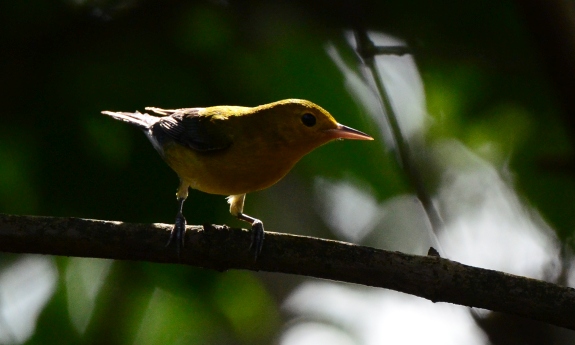
At dawn we started the birding the trees at Texas Point National Wildlife Refuge, which is right on the way to Sabine Woods. It's not an impressive looking patch (some pieces of private property in the area appeared better suited as migrant traps), but since this is the UTC it should be checked! It was really slow at first, but after a while we began to see sweet sweet migrants coming in off the coast. Not many were stopping, but it was encouraging. The Northern Parula above was very accommodating, and ended up being the only one we would see that day.


After exhausting the relatively small Texas Point patch, we returned to Sabine Woods. Birding was on the slow side at first...acceptable, but not anything crazy. The forest floor was not crawling with Ovenbirds and thrushes, like it was when we visited earlier in the week though. This Canada Warbler that Dipper Dan found was an early highlight.


After talking to BB&B reader Steve from Kansas City for a while and learning about how terrible fans of the Kansas City Royals are...and looking at the Cerulean Warbler he pointed out to us...I found this Blue Jay getting high on sunbeams in the forest floor. Things were getting interesting.

Incrementally, the birding got better and better as the morning progressed. What began as dull birding became mediocre birding, which turned into decent birding which turned into good birding. A few hours after we arrived, the number of birds in the patch had seemed to double, then triple. By about 2PM there were simply birds all over the place. Woods totally empty of Ovenbirds earlier now were filled with them. The birding had gone from good to great; migrants just seemed to be piling in to the patch.

Eventually, we came to that rare and special realization that it was happening, much like it was at High Island the first day of the trip. This was the birding I had come here for, the birding I had hoped to experience but dared not expect. There were simply too many birds, too many birds to look at, mainly thrushes, vireos and warblers. Migrants galore. At one point, Dan and I split up for a while, and he encountered this Swainson's Warbler (left). It was only a few feet from him, falling asleep inside a bush, so the only photo he could get of it was with his phone. Obviously, the bird had just dropped in from who-knows-where and needed a nice nap before turning up the skulk meter to normal Swainson's Warbler parameters.

Well, when it's happening, it's happening. This is the sort of thing that happens when it's happening.


I missed Dan's sleepy Swainson's by a few minutes but managed to find my own in a different part of the patch. It was slightly more cooperative than I expected, which I was happy about. The brown wonder was a lifer only a few days before.

We birded vigorously through the afternoon. It was great. Not a fallout...lots of very approachable but otherwise normal-acting birds...but I had difficulty thinking that the birding could be much better than it was.


Eventually, we were fully saturated by migrants and the day was drawing to an end. We made our way back to the entrance, where a confiding Worm-eating Warbler greeted me...


...and promptly flopped down to the pavement. I love seeing warblers flopping around on the ground...it is a sign of excellent birding. Sure, some warblers are inherent ground floppers, and some may flop at any height...but it can be a sign. Worm-eating Warblers aren't exactly ground-phobic though, so I merely appreciated the bird's gesture and went on my way.

But I didn't get far. The day's final act was about to unfold, and the few tattered remains of what was once my face were about to melt off completely.

Right next to the entrance, some birders were looking at some Blackburnian Warblers...certainly not an unusual event but I felt these Blackburnians needed some special attention.


It turns out these Blackburnians were especially tired. They were in full just-crossed-the-Gulf mode and treated us with the same amount of caution they would give to an oak tree...in other words, we might as well have been invisible. I've met some confiding Blackburnians before, but these really took it to another level. When one of them started passing out on an open branch about 15 feet away, I knew that not only was it happening, it was happening really hard.

In short order they flopped to the ground and did their best Brewer's Blackbird-in-a-parking-lot impressions. I've been lucky enough to be really close to Blackburnians before, but this was a different level of close.


Incredible.


Here is an uncropped photo - the dark blob on the right is my shadow.


I looked up into the trees and saw a Bay-breasted Warbler, then two. They had been fairly common the past few days, but it was strange to see them perched just a few inches from one another; I got the clear impression that they had just fallen out of the sky together, their long Gulf crossing just completed. The Worm-eating Warbler on the ground had foreshadowed what was unfolding before my very eyes...


Warblers were now flopping around on the ground in front of us. This adult Tennessee Warbler, a known ground hater, flopped about without apologies.


Another Tennessee jumped into the ground frenzy. The growing terrestrial congregation of fearless warblers wasn't completely surrounding us, but were very focused or concentrating on an area in front of us about the size of a small lawn.


A Hooded Warbler, known to groundabout, was especially floppy.


The pair of Bay-breasted Warblers descended from the trees to join the growing flock of warblers in the grass for soul-satisfying looks.


Considering all the warblers on the ground, gravity must have been especially strong. This Blue-winged Warbler felt the pull but mostly managed to stay a few feet above it.


Gravity's pull was so forceful here that it was holding on to a leaf with one foot for dear life. Clearly, this was some sort of Bermuda Triangle for warblers.


This crippling Chestnut-sided Warbler materialized a few feet above the ground-fray.


The Bay-breasted Warblers in particular had little interest in going back up into the trees.


We should probably make sure a combo gets in here...Blackburnian/Bay-breasted ground combo is a sweet one. There were other warblers here in groundtown as well, but this post has to end eventually!

I'm still not sure how to describe this event. This was not normal. Kansas City Steve, who had logged a great many years of springtime birding at Sabine Woods, admitted he had never seen anything like it. It was like what I expect a full-blown fallout to be like, except happening on a weirdly small scale. I have always maintained that there is no such thing as a small fallout, but it appears time to reexamine that position. Keep in mind, of course, that there were huge numbers of birds in the patch that were not acting like this, but I'm thinking a small wave of extremely exhausted migrants had arrived at the edge of the patch just as we were leaving, giving us....well...a micro fallout? It makes me wince to read that but I can't think of a better label for the event. No matter what it was, it was unlike anything I've experienced before, things will never be the same, and I really hope a springtime return to the Gulf Coast happens sooner than later. We ended up getting new high counts in eBird for Acadian Flycatcher, Swainson's Thrush and Ovenbird at this heavily birded site.

I did have one more day to bird in Texas with Dipper Dan and Officer Shaw at High Island, which was ok but nothing like what happened at Sabine Woods the previous day. We then went to Shaw's, where we drank incredibly good beer, I had an incredibly bad allergy attack (how embarrassing), and a freaking Chuck-will's-widow flew over his suburban yard in broad daylight!

This will conclude BB&B's coverage of 2018's fantastic foray to Texas. Thanks to This Machine Nate for coming all the way out to the coast, shortly before being banished to the depths of an uncharted corner of Ohio. Thanks to Dipper Dan for being my ride or die and coming out from SoCal. Thanks to Officer Shaw for meeting up with us (twice!) and letting us crash in the Land of Sugar. You all battled Geri, you all won, and you are all birding heroes.

Monday, March 27, 2017

Puerto Rico Y2K16: Bosque Susua, Punta Higuero (Rincon), Rio Abajo


Suddenly, time was running out for the group from MAX REBO BIRDING TOURS...we only had a couple days left in Puerto Rico, and the time had come to leave the southwest corner of the island, where many of the island's hotspots are located. Today we would bird a couple less popular spots, starting with Bosque Susua. Why? Geotrygon. I had never seen any kind of Geotrygon, and Bosque Susua is known as one of the best places in Puerto Rico to find both Key West and Ruddy Quail-Doves. To my astonishment, I got great looks at a cooperative Key West Quail-Dove on an overgrown trail northeast of the picnic area.


Now this was a seriously juicy lifer. The photos do not do the bird justice at all...the blue cap struck me like a punch in the throat. I'm still surprised I didn't start coughing up blood while looking at this bird. Though obviously not an endemic, this was one of the species I wanted to see the most, and considering how fucking skulky they are I couldn't have been happier with the looks at this confiding crippler of the shadows.

Afterwards I wandered south past the picnic area back on to the access road, and saw a wide road/trail with a gate across it going southeast. This turned out to be a pretty appealing birding trail that paralleled a river (heck of scenic), and seems like just as good a place as any to bird here. About ~250 feet past the gate I had another look at a Key West Quail-Dove, but that would be the last Geotrygon for the day.


Friendly Puerto Rican Todies provided me company.


I am still having difficulty grasping these bizarre and indisputably fantastic birds. Does anyone know what their closest relatives are? From my understanding, that situation is fairly muddled.


A number of Red-legged Thrushes were along the trail as well. We ended up with a pretty solid checklist for the site that morning, with other highlights being Puerto Rican Lizard-Cuckoos, Lesser Antillean Pewee (only found at one other site on the trip), Antillean Euphonia (only found at one other site on the trip) and Puerto Rican Oriole (found nowhere else on the west side of the island on the trip).

Dipper Dan did some Oscar Mike ebirding while we worked our way up the west coast, and directed us to the Puerto Higuero lighthouse in Rincon. At first it seemed bleak and windy, but eventually we started finding some new birds.


A flock of disgusting Pin-tailed Whydahs fed on the lawn, but the more interesting exotic species was a pair of slightly less disgusting Saffron Finches, which was yet another reluctant lifer for me.


Not disgusting at all was this Zenaida Dove trotting around proudly.


A flock of Cave Swallows foraging next to the lighthouse contained a single Northern Rough-winged Swallow, new for the trip. The Cave Swallows were much more interesting though. Other birds of note here were a few flyby Brown Boobies and a pair of American Oystercatchers on the rocks below.

The best birding here was in the forest across the street from the lighthouse - look for the trail that starts on the edge of the cleared area. This was only one of two spots we birded on the trip that had a lot of North American migrants.


A Puerto Rican Woodpecker threw some cripple our way at the beginning of the trail.


The woods quickly began coughing up birds. Hooded Warbler, Magnolia Warbler, Ovenbird and White-eyed Vireos were all new for the trip! I fucking love trip birds and eastern neotrops, in case you have not figured this out by now. We also had redstarts, parula (above) and Prairie Warblers. Not a bad little patch. Of course if you are from the eastern U.S. you will not find this patch very tempting, but we were relieved to sate our fierce warbler hunger.


Believe it or fucking not, I was into herps before I was a bird addict. I still don't know shit about herps, but I am an admitted herp sympathizer (as opposed to a herp synthesizer). This is the one and only herp from the trip (other than green iguanas, which are jaguar-sized and therefore not herps) that I have bothered to identify.


Look at the size of that fucking dewlap, wow! This is a barred anole (Ctenonotus stratulus).

After our modest victories at El Faro, we barged northeast to be at Rio Abajo for sunset. Of course, this was to get Puerto Rican Parrot. To make a short story extra short, the forest here was mature and really nice to walk through, but the only one of us who really saw the parrot was Officer Searcy, and his looks were poor poor poor poor poor poor poor. There are hardly any canopy openings...I'm surprised folks actually see them so regularly. I heard them well (free-flying birds, not the enclosed birds at the end of the road), but that is nothing to write home about. Considering that all the wild birds here were released here recently, I wasn't too bummed to not get looks, but I wasn't reveling in this defeat either. Good news for the parrot and for birders - a third flock will soon be holding it down in the Maricao forest. 

Wednesday, February 22, 2017

Puerto Rico Winter Tour Y2K16: Refugio de Vida Silvestre de Boquerón, Cabo Rojo


It's been a weird winter here in the bay area. It seems to rain constantly, and I am in a persistant daze due to the newborn baby that strangely requires frequent attention. However, I can't bitch about not getting to the tropics this winter, because it was only back in December that our group from MAX REBO BIRDING TOURS were slaying Caribbean birds in Puerto Rico. The trip report must go on...

It is about time I posted a picture of one of my first lifers of the trip...Greater Antillean Grackle. I somehow did not get to crush them as well as I could, so I had to settle with photographing them while sitting around eating lunch after we birded Laguna Cartagena. An old lady with bad Parkinson's was feeding them rice, so I stole a few grackle souls.


These are one of the most abundant native birds of Puerto Rico. They are quite small, more like a Common than a Great-tailed, and haven't totally abandoned native habitats in favor of streets and parking lots. They are also much less cacophonous and obtrusive than Great-tailed...I ended up liking them a lot, considering they are literally a trash bird.

After lunch we decided to check out Silvestre de Boqueron, a coastal site that is not mentioned in a single trip report that I could find, but boasts a very robust (for Puerto Rico) site list in eBird. We found the entrance road easily enough and parked at the admin buildings. Here, there is a boardwalk trail through the mangroves, and longer trails that go to the south and to the west. We chose to walk the southern trail, which ended up being very rewarding...almost immediately we got our first White-crowned Pigeon of the trip, which was a lifer both Officer Searcy and Dipper Dan. They turned out to be fairly common there, and one of the dudes who works at the refuge says they nest next to the other trail that we did not take.


White-crowned Pigeon did not turn out to be the highlight though...a few minutes later, we were blessed with an increasingly rare group lifer (#grouplifer)...at long last, we had found a Lesser Antillean Pewee!  YESSSSSSSSSS!!!!!! This was a major target bird of the trip (again, all Caribbean species were targets for us), and I was getting worried that we might end up dipping on it. The Puerto Rican birds population may be treated as their own species someday, so it was a very bankable bird as well.


We saw multiple pewees on this trail, in a habitat where none of us were expecting them...they are not exactly considered a mangrove species from what I could tell. Though the birds would rarely sit in crushable light, they were bizarrely cooperative, which I appreciated very much. Their buffy underparts and trusting ways were most mellowing. We would not go on to see them anywhere else, though I did hear one at Bosque Susua.


Puerto Rican Woodpeckers were common and widespread. This eye-catching endemic is built to last, occupying many different habitats...unfortunately I never got the crush that this bird deserves. It is much, much more interesting than your average Melanerpes.


The most surprising thing about our time at Silvestre de Boquerón was how fucking birdy the place was. Almost everywhere we birded on the island was somewhere between not birdy and kinda birdy, but there was a lot of activity here. Northern Parulas were very common, showing up in almost every mixed flock we crossed paths with.


As with most sites, Puerto Rican Flycatchers were holding it down.


Unlike the pewee, Prothonotary Warblers are known to be lovers of swamps and mangroves. This dimly-lit (but still facemelting) rarity was another excellent trip bird; a Black-and-white Warbler near the parking area was another new North American migrant for the trip list. Good times at this place...if you are interested in checking out this site, our eBird checklist can be viewed right here. Note that during the hunting season the refuge is not accessible seven days a week. We were also told that it was ok to park outside the entrance gate and walk in to bird outside of normal hours.

We had some daylight left, so it was back to Cabo Rojo to continue the never-ending search for trip birds (other than the mythical Masked Duck, we had run out of lifers to get in immediate area). Our spot that previously produced a huge peep flock and Franklin's Gull earlier was almost devoid of birds, which did not surprise any of us. Still a bummer though.


This friendly Merlin provided some consolation. I don't know about ya'll, but friendly Merlins are few and far between out here. Oh, and while I think of it, how come Merlins seem to be so unpopular with falconers? Seems like the next logical bird to graduate to after a kestrel, and they are fun as hell to watch hunt. Oh well, leave them in the wild, suits me.

Our search for waterbirds took us all the way to the end of the road, at the parking area for the hella popular beach. Despite a great deal of good habitat, there was little to see...maybe the tide was too high?


We did see some cool terrestrial snails at least. Who doesn't appreciate a good snail?

On the way back we pulled over where some shorebirds and a group of icterids were roosting; Dipper Dan noticed some Yellow-shouldered Blackbirds in the flock, so we hung out and looked around.


The trees along this stretch of road were clearly the site of a significant night roost for Icterids. It was fantastic to see Yellow-shouldered Blackbirds in a more natural setting than the La Parguera hardware store.


A little while later, we refound the Franklin's Gull picking at shit out in the lagoon...a nice bird, but there was a lot more to look at...the closer to sunset it got, the more and more birds we noticed began to arrive...and that is when we realized it was happening.


Thousands of icterids flew south down the peninsula to roost next to where we had parked. Shiny Cowbirds (above) comprised a large portion of these birds, which I had mixed feelings about; they are a major factor in the decline of the blackbird...but they were also a bird I had just lifered only days before. We also started seeing Prairie Warblers fly in to roost (!), which was a most fetching thing to watch.


Luckily for us, Yellow-shouldered Blackbirds came streaming in over our heads with the grackles and cowbirds. Ace.


Amazing looks at these hell of rare birds. While it is easy to think of them as just a Red-winged Blackbird with a different wing patch, there is another major difference between the two species, phenologically speaking...the sexes have identical plumage. Yup, these might be females. Astounding, no? I wonder how this unisex plumage evolved.


Flocks of Stilt Sandpipers and Lesser Yellowlegs wheeled around over the laguna while we watched the blackbirds fly in, adding to the birding ambiance.


The laguna and distant Guanica Dry Forest glowed beneath afternoon storm clouds in the fading light. Our time here at the blackbird roost was one of the definite highlights of the trip, and I would highly recommend attempting to see the blackbirds here (17.954779°, -67.198514°) in the late afternoon instead of the mutant bread-lovers at the hardware store.