Showing posts with label harlequin duck. Show all posts

Sunday, February 15, 2015

All Aboard The Scote Train


This is a scote train.  One of the passengers is not like the others, and it's not the Western Gull...

Every now and then, news goes around of a bird so rare that you are just completely blindsided. It is not a bird on your radar...you don't even think of seeing this bird because your brain is busy pining away for more realistic birds that you also haven't seen.  You just aren't expecting to ever see that bird...you just aren't prepared.  And let me tell you, as the #7 birder in the United States, I am prepared for a lot of different birds that I have not seen.  I am prepared for a Swallow-tailed Gull.  I am prepared for a Wandering Albatross.  I am prepared for a Sinaloa Wren.  Do you see?  There has been much preparation on my part to be ready for the mental blow these birds would inevitably cause.  Just hearing about a legit sighting would trigger a cavalcade of birding emotions...shock, jealousy, envy, intense desire, and wanton birdlust.  So while I can't even tell you what a Pycroft's Petrel looks like, I can say with 100% certainty that if someone called one out on a pelagic trip, people better get the hell out of my way.  I am prepared for that.

What I wasn't prepared for was a scoter.


I wasn't the only one.  California birders were so unprepared for this creature that several folks didn't even know it was a species.

"Common Scoter you say?  Cool subspecies bro.", was the collective dismissal of a multitude of birders.

It was only in 2010 when the AOU deemed the Common Scoter it's own species, severing it from the Black Scoter we all know and love.  However, since no one had ever documented one in North America before, this split received little fanfare from ABA birders.  When one did show up, people just weren't ready.  Even the AOU wasn't ready...the current edition of their checklist lumps them with Black Scoter!  How embarrassing.


Still reeling from my failure with BRAMBRING, I was loathe to just get back in the car for another chase up the coast.  Crescent City is a long ways from Oakland, over 6 hours, but I knew I couldn't let this MEGA of all MEGAs just pass me by.  What choice did I have?  As luck would have it, the bird had stayed put in the exact same place ever since being found, which made the decision that much easier.  All aboard the scote train!


I think you have figured out by now that this is not another sob dip story, this is a story of Great Success.  People were already on the bird by the time we arrived, and after a bit of waiting the choice scoter abandoned the open water outside the boat basin and recklessly steamed in to shore, right to where we were standing.  The bird could care less about the very moist, very stoked group of nerds observing it from a stone's throw away; in fact there were many times the scoters were so busy diving we couldn't even find the Common Scoter, although it was obviously somewhere right in front of us.


So where did the Common Scoter come from?  The closest known place they occur regularly is Iceland.  Going the other way around the world, the next closest place is central Russia.  Although further away, a bird migrating east through Siberia and down the west coast of North America seems like the most straightforward route.  But that said, how did California's Northern Gannet (which is still here) arrive?  How do Tufted Puffins get to Maine?  Obviously a determined, and severely misoriented bird (or perhaps one that does not give a fuck) is certainly capable of weaving their way through the convoluted maze of islands in the high Canadian Arctic to emerge on the other side.

The rarity of this bird is staggering, and I had no idea the bird was going to end up being so confiding.  No scoter will ever be as savory...things will never be the same.


As with every bird that has "common" in it's name, I find this bird's official title to be cringe-worthy. It's a lazy, uninspiring, unimaginative, pedestrian way to refer to an entire species that I can now say I enjoy looking at.  I don't care if the AOU was trying to be consistent with the Euros...they seem fine with different names for loons, jaegers, etc.  Even something as basic as "European Scoter" would be better. What if every abundant, widespread species was named in this manner?  The U.S. would have Common Vulture instead of Turkey Vulture, Common Hawk instead of Red-tailed Hawk, Common Kestrel instead of American Kestrel, Common Hummingbird instead of Ruby-throated Hummingbird, Common Dove instead of Mourning Dove, Common Wren instead of House Wren, Common Kinglet instead of Ruby-crowned Kinglet, Common Warbler instead of Yellow Warbler, Common Sparrow instead of Song Sparrow...you get the picture. Doesn't that sound bleak? Wouldn't that suck?  I would like to put an end to so-called "common" birds once and for all...that probably wont happen, but at the very least we shouldn't be making new ones.


A shot of the scote train coming into shore to feed, conveniently as close to us as they possibly could. My love of scoters is particularly strong these days.


Samantha and Natalie steel themselves against the coming onslaught of scote train.  As of this writing, the (un)Common Scoter has not been seen for two days.  Considering that every single person who has looked for the (un)Common Scoter up until Friday afternoon has seen it, this might mean the bird is gone for good.  The scote train may have come to an end, and I consider myself lucky to have been on board for the glorious ride.


A Harlequin Duck had boarded the scote train as well, feeding close to shore.  Harlequins aren't the easiest birds to see up close in California, so it was nice to be reacquainted, even with a homely individual.


Harlequin Duck and Common Scoter didn't seem to get along, taking turns harassing each other.  If you were to ask me if I was prepared to see a Harlequin Duck and a Common Scoter playing grabass...in California...I would have to say no.  Not in the slightest.


Another bird that I've had poor luck with, in terms of seeing at an appreciable distance, is Long-tailed Duck.  In fact, this is the first Long-tailed Duck ever to make it into a BB&B post, which is long overdue because I really like Long-tailed Ducks and have a constant desire to see more of them.  As you can guess, this bird was riding high on the scote train as well.


My, what a lovely face pattern you have Long-tailed Duck, especially in comparison to a female Surf Scoter. Perhaps all of these birds will be back on the train next winter?  You never know...stranger things have happened.

Thursday, February 14, 2013

Some Recent Birds: Majestic, Mighty, Nemesis, Oiled, Typical, Snazzy, Grotesque, Crippling.


Not much new to report here at BB&B. Post-Costa Rica birding has been good, but has gotten a bit slow lately...even year birds are getting difficult. I do have my first job interview of the year next week, and so The Perpetual Weekend is now in jeopardy.

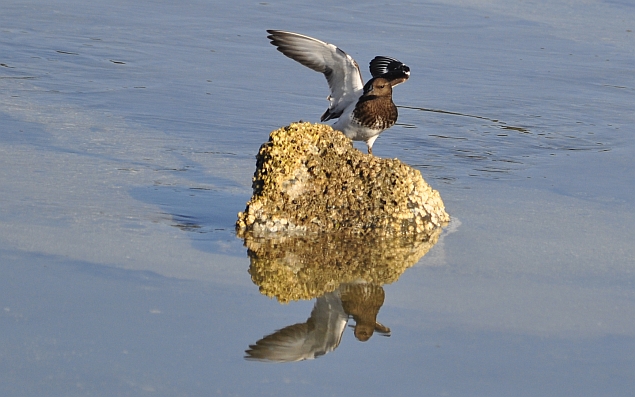
Here is a Black Turnstone that happened to land in front of me. They are common along the west coast, but this would be a definite MEGA in any of the other states...just a matter of time, I reckon. Photographed at Pillar Point Harbor, CA.


Behold its breathtaking wingspan.


Majestic, as always.


The Mighty Dunlin: Often seen, but rarely photographed....by me anyways. Coyote Point County Park, San Mateo, CA.


It's still gull season here on the California coast. Despite my efforts I have seen absolutely nothing interesting beyond a handful of freaks and unusual hybrids since locking on to my state nemesis Slaty-backed Gull (above, middlish) in Sausalito several weeks ago, where this was photographed. Other birds in this photo are Glaucous-winged X Western Gulls (aka "Olympic" Gulls), and a pure Western Gull (bottom left). Oh, if you disagree with any of my gull ID's, please provide cruel negative feedback.

The oiled bird is an adult Herring Gull; the bird in front is a pale-eyed Thayer's Gull. Herring and pale-eyed Thayer's can certainly be confused for one another...I think this photo shows the contrast in bill and head shape between the two pretty well. Pilarcitos Creek, Half Moon Bay, CA.


A pretty typical first cycle Glaucous-winged Gull with a bit more pink in the bill than normal, but that is not unusual in late winter. Sausalito, CA.


I don't think Eurasian Wigeon has graced BB&B many times, although I am lucky enough to see them pretty regularly. The drakes (left) are really snazzy looking ducks, and the hens (not pictured) provide a good ID challenge. Pier 94, San Francisco, CA.


Here is a grotesque Greater Scaup. I don't know how a duck goes about having a huge chunk of it's bill removed...that's gotta hurt. Lake Merritt, Oakland, CA.


Here is a non-grotesque Greater Scaup for comparison. Lake Merritt.


Harlequin Duck is in that small realm of birds that defy explanation, both in plumage and lifestyle. Someday I hope to have some photographs that do them justice, but at the moment all I have is stuff like this. This crippler is hanging out at Pier 94 with a female Surf Scoter.

Sunday, January 29, 2012

Winter Tour Part III: The Olympics!


Gray Jay. THE CUTENESS IS TOO MUCH. Olympic National Park, WA.


After leaving Ocean Shores behind, Stilt and I traipsed (yup, traipsed) up the east side of the Olympic Peninsula to doomy Port Angles, Washington. I ended up staying for about a week, practicing with the drinking team and getting in a few hours of birding every day. We stayed with our friends Cass and Liz, both of whom have been featured in BB&B's terrible interview series, and have somehow created a child together in an attempt to create the ultimate uberbirder. Although the verdict is still out on the young one, I did manage to get my lifer Pine Grosbeaks in her presence, not to mention a vagrant Mountain Bluebird.


Harlequin Ducks were not hard to come by. Ediz Hook, Port Angeles, WA.


Rural Western Washington seems to be a truly strange place...it is not for the faint of heart. Trying to cope with the face-wrecking scenery, crippling birds, horrible weather and the varied and bizarre locals (people, not birds) can be too much to handle all at once. I don't know what would have happened, had I needed to trek all the way out to the Okanagan Valley to find that Ross' Gull....it had disappeared by the time I arrived in Washington, which was sad.....but it also prevented me from reliving the Ivory Gull Incident once again, so it wasn't all bad.

In other news, I updated the Human Birdwatcher Project page, which is handily located above where you are reading this. Go there and catch up on all the edgy and groundbreaking research BB&B has been doing on birders all these years...you might learn something about yourself.

Right....things are happening this week....including a job interview (weird), and some inevitable birdwatching (embarrassing). But don't worry...as long as I am Funemployed, you will get the BB&B fix that you know, love and need. Mahalo.


Harlequin Duck. Have you seen one? If not, you bring great shame and dishonor to your family. Ediz Hook.


Trumpeter Swans take on a frightening and grimly realistic rendition of a fox. Sequim, WA.


A mated pair of birders with altricial young. It should be noted that this is a good place to stand to see Pine Grosbeaks. Olympic National Park, WA.


Common Raven. The snow beneath the bird really helped light it up. Olympic National Park, WA.


Barrow's Goldeneyes. The seaducks in Washington were great...a weird mix of White-winged, Black and Surf Scoters, Long-tailed and Harlequin Ducks, both goldeneyes, Buffleheads and Red-breasted Mergansers. Go there and stare at them intently. Ediz Hook, WA.


Seagull Steve flogs a beach for megas. Sequim WA.


A different look at the same beach. That's Mount Baker looming on the horizon. Sorry for all these non-bird pictures, you don't have to get your feathers all ruffled. Sequim, WA.


Gray Jay is in the running for being BB&B's official bird. Why? In some circles, people still refer to them as WHISKEY JACK. Olympic National Park, WA.


In Washington, even Sanderlings will come to bird feeders. Consequently, minds are boggled. Ediz Hook.


Cline spit in the foreground, Dungeness Spit in the distance. Sequim, WA.

Sunday, October 17, 2010

Rock Well To Tell The Spell


Red-faced Cormorants rule the cliffs from their corma-eyries. Truly a gem amongst the non-waterproofed ones.

When dispensing indispensable pieces of wisdom and advice, as I'm prone to do, I frequently finish my advice with the flourish of, "I am a scientist, after all", to add that extra sense of professional credibility.

Which is true.  I am a (currently unemployed) scientist.  It's what I do.  In fact, I science really hard.  Yeah.  I just used it as a verb, and I'm not sorry about it.


Harlequin Ducks and Common Eiders lurk in nearshore waters throughout the Aleutian Islands.  

Most people can respect that.  But, as so many people at each end of the sociopolitical spectrum have pointed out, scientists are TERRIBLE at communicating their knowledge and discoveries to the general public.  Evangelical Christians will tell you this.  Heretic scientists will tell you this.  And, more importantly, I will tell you this.

Ostensibly, one might say that there are many reasons for this distant gap in dialogue.  You could claim that there is no real mechanism in place to give people up-to-date information about some of the big picture things.  You could claim that scientists don't put enough effort into making their research not only available to the public, but easily comprehensible.  You could claim the Right-Wing media purposefully vilifies science, or at the very least filters it to their liking.  And you would be right on all accounts.


Love the kittiwakes.

But there is one true reason at the root of this thing, which is.......scientists are nerds.  

Which should not be news to anyone.  Imagine, for a moment, that we scientists did not get into our respective fields partially (or in some cases, entirely) as a result of our pathetically underdeveloped social skills.  That we could get along with people just as well as animals, microbes, photons, or what have you.  Imagine that we were actually known to be The Great Communicators of our time.....I think the ideological and political landscape would be a bit different (feel free to interpret that to mean "better"). 

Are there exceptions to the rule?  Of course.  But who cares???  The main thrust of this thing is that the next time you meet some self-sequestered, xenophobic, coffee-avoiding, granola-snorting, croc-wearing obnoxious quasihippiebiologist who is incapable of carrying on a conversation with someone outside his/her field......well.......you can do what you think is best.


Aleutian Cackling Geese are one of the few species that have made a strong recovery thanks to the Endangered Species Act.  Common on Buldir, they are also very annoying.

Tuesday, September 7, 2010

Something So Offending As You


The (charming) old pet cemetary on Adak Island.

It makes sense, in the long run, to get some basic facts down on the table here…so here we go…

The Aleutians are a long chain of volcanic islands, stitched along the Pacific Rim’s famed Ring Of Fire.  They stretch from all the way from just off the tip of the Alaska Peninsula all the way out to Attu Island, a distance of about a thousand miles.  In previous ice ages, when the seas were lower, the Aleutians acted as a land bridge connecting Russia and Alaska.  It’s thought that the New World came to be inhabited by people through this link.


A male White-winged Crossbill in Homer.  He made my eyes bleed.

They islands lie considerably south of the Arctic Circle, so it can get damn windy and cold, but the weather was definitely bearable (this does not apply in winter though).  At least, it was not much worse than the weather on top of Mt. Wrightson or Carr Peak in southeast Arizona.  There are no bears or moose on any of them (or Aurora Borealis, for that matter).  Caribou have been introduced to a couple, as have foxes and rats.  Foxes and rats can take huge tolls on nesting birds, so the Alaska Maritime National Wildlife Refuge (my employer who I do not represent here in any way shape or form) have been actively attempting to remove them for a number of years now.  But the whole reason I’m up here at all are the millions of birds that use this area.  A vast array of seabirds nest here…..cormorants, gulls, kittiwakes, jaegers, auklets, murres, murrelets, puffins, storm-petrels…the list goes on and on.  The albatross and shearwaters that forage between the islands breed further south (Hawaii, New Zealand, etc.), and the many sandpipers and waterfowl that pass through during migration are on their way to/from Russia and Alaska.  Relatively few songbird species breed, but those that do (“Pacific” Wren, Song Sparrow, Lapland Longspur, Gray-crowned Rosy-finch, Snow Bunting) seem to do well, as their only native predators in much of the chain are Peregrine Falcons and Common Ravens, who usually seem to be preoccupied with larger things.

Of course, one of the huge draws of the western Aleutians to birders is its proximity to RussiaOld World birds that are almost impossible to find in the rest of the United States can show up out here with regularity during migration.  So to a birder coming from the Lower 48, getting paid to live in the Western Aleutians is a dream come true  (scratch that….a birder’s wet dream come true…yeah, I went there) especially when you take into account that most of the birders who find their way to Attu pay an exorborant sum to do so.  Oh, and NO you cant see Russia from anywhere, goddamn it.

Ok.  Now you are all experts on the region.  


 Adak Island's Clam Lagoon.  Back in May, it was chock full of Kittlitz's Murrelets.

So all the way back in May, I got to spend a few days in Homer, which is advertised by a lot of people as being one of the best towns in Alaska (I can neither confirm or deny that). The refuge has its headquarters here though.  Some casual birding around town was productive.  Hello Trumpeter Swan.  It is nice to meet you.  Oh, hello there White-winged Crossbill.  It is nice to meet you too.  And hello to all you fabulous Northwestern Crows.

After leaving Homer in May, I flew out to Adak Island, in the central Aleutians.  This is where my Odyssey of nerd-dom really began.  Adak is an old Navy base which was abandoned by the military some time ago, after the Cold War had a chance to thaw out.  Bad puns aside, its now a bit of ghost town, although about 100 people live there and it gets a lot of visitors in the form of caribou hunters, birders and fisher-people.  


Harlequin Ducks are common in much of the Aleutians, although they do not breed here.  

When I first stepped foot out there, I walked around in a kind of giddy haze.  I didn’t really know what to expect.  As I stepped out of the airport terminal, a Rock Ptarmigan flew overhead.  Sick.  Gray-crowned Rosy-Finches and Lapland Longspurs sang from…everywhere.  So sick.  It was really hard to get any work done with all of these birds around.  A Hawfinch in town was my first Siberian vagrant of the trip, and also the only one I got to see.  I don’t quite know why it was bothering to eat birdseed….it’s bill looked fit to crush human skulls.


Rock Sandpiper territorial displays are hilarious.  They kinda just wave one wing around at other sandpipers around.  Its pretty great.

The birding was really good.  Other highlights included dozens of Marbled and Kittlitz’s Murrelets (which we could see from the road), Arctic Loons, Tufted Duck, Red-faced Cormorant, Bar-tailed Godwits, Arctic Terns, Common Redpoll, etc. etc.  All these birds were crippling me, and at times I was at an absolute and profound loss at taking in everything.  I just never really ever thought I’d have any business being in the Aleutians.  I’ve heard about Attu Island and its jaw-dropping roster of vagrants for as long as Ive been birding, so it was a pretty uncanny place to find myself.  After a few days the Buldir crew, the Kiska crew and the Agattu crew jumped onto the Tiglax with a bunch of fox trappers to be shipped out for the most bizarre summer I’ve ever had.


Look at this shit!  The Aleutians are incredible.