Showing posts with label Ferruginous Hawk. Show all posts

Sunday, February 14, 2016

Owls of The Ground, Owls of The Pine, and Stroking of The Robin


A Belted Kingfisher hunts at Middle Harbor Shoreline Park, Oakland, CA. This is a great birding place where I see the same common species over and over again, which is in high demand these days.

BB&B has been very focused on exotic birds so far this year. I know it. And I know what you really want to be seeing are incredibly common, run-of-the-mill birds that anyone can see without even trying! Am I right? Or amirite? That's what the birding (or perhaps the bird photographing public) seems to crave these days I think, so if that's what the public wants, that is indeed what they shall get! Also, my GLOBAL BIRDER RANKING SYSTEM rank in Mexico isn't anything worth bragging about (Felonious Jive, The Great Ornithologist, has a much better standing than I do), so while posting about Mexico has been fun, it's not a good platform for touting where the GBRS puts me. However, as you may recall, I can totally brag about my GBRS score for U.S. ranked birders.  That would be #7, in case you have forgotten...but how could you? Anyways, lets take a look at some abundant, widespread birds.


Here is a Snowy Egret! Oh, joyous day! How pretty!


My goodness! A fish is pursued!


Ok, I'm not knocking Snowy Egrets and Belted Kingfishers or beginning birders (well...I am a little bit), I just thought I would change things up. I've got a big backlog of pre-Mexico photos to deal with, you know? I wasn't seeing many rarities in late fall/early winter so this is what we are stuck with. And if you are not happy about that, how do you think I feel? For good or ill, any kind of wader is fun to photograph when it gets giddy about catching fish. I'm still waiting for my epic, point-blank Reddish Egret photo session, so until I get spoiled with that we will have Snowy Egrets...


...and Forster's Terns! This is the one and only tern we have an abundance in the bay area in winter. It's a sad state of affairs. We don't even have many tern species in the summer. I miss living in places where seeing Black Terns is a normal thing. Ballena Bay, Alameda, CA.


At high tide, this bird was roosting on a little floating piece of driftwood, and drift it did until it was crushed into oblivion.


Ok, I reckon you have had enough of all the robin-stroking. Here is a Ferruginous Hawk, a bird superior to most birds. Salt Springs Valley, CA.


Judging by the extensive amount of white on the underwing and underparts (including the shaggy legs), this is a young bird. According to Dipper Dan, famed Calaveras County birder, Salt Springs Valley is the best winter birding the county has to offer. I reckon he is probably correct on that account. While we dipped on Rough-legged Hawks (this hasn't been a good winter for them), there was an abundance of Ferruginous Hawks and Lewis's Woodpeckers, and Tricolored Blackbirds and Bald Eagles were refreshing birds as well.
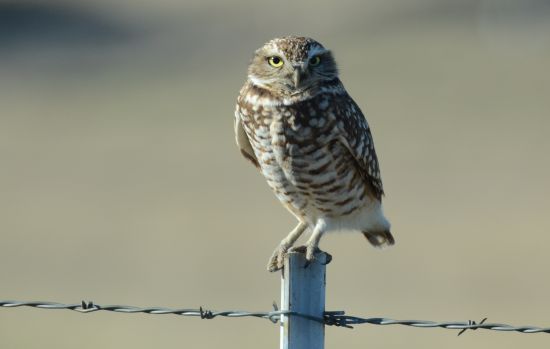

Refreshing birds are nice and all, but certain species reside on a higher plain of perception and enjoyment. I have a special place in my cold, nerdy little heart for Burrowing Owls.


This is the other half of the pair, presumably the male based on the paler coloration (or colouration, if you are so inclined). Shortly after this, while I was attempting the most epic photo anyone has ever taken of a Lewis's Woodpecker, my SD card took a shit and it was hell trying to get the photos off of it...not that you care, but it was a relief to rescue some decent owl shots.


Sometimes I post things photos of things like Black Phoebes, which is not a momentous achievement but it seems to drive the easterners crazy. In that vein, I offer you this California Towhee. Back in December, I went on a ragey camping trip that happened to take place where a few birds live. This brown beauty belongs to a breathtakingly common species, and it also happens to be disgraced former Bird Policeman Adam Searcy's favorite bird...and lets face it, he needs some cheering up. Only a month ago, The Bird Police relegated the besmirched Mr. Searcy to a boring subcommittee and stripped him of his former power. Will he ever rise again, like the phoenix, to become a voting member? We may not know for years. In an apparent snub to Mr. Searcy, Officer John Garrett celebrated Mr. Searcy's demotion by finding a briefly-chaseable Kelp Gull. It rained on Officer Garrett that night...droplets of Glory soaked him for hours. Pinnacles National Park, CA.


While northern California has a deficit of winter terns, we at least have a couple species of quail. California Quail is a fine state bird I reckon, delicious both to the eyes and mouth. Such plumpness and fine patterning is a thing best beheld in person, and behold I did.


Fantastic patterning on these birds, though their roundness may be even more remarkable. And no, we did not see any California Condors.


After Pinnacles, it was out to Mercey Hot Springs in Fresno County. Everyone in the group was excited about soaking in the hot springs...which was fun and led to exacerbated inebriation, but I was looking forward to Long-eared Owls a lot more. I had heard this place was the best place in the state to see LEOWs, and I had also heard that birders can't just show up there anymore without paying (which I cannot confirm or deny to be true at the moment), but I didn't care since we were paying to camp. The owls were easy, really easy to see, thankfully, and my nonbirder roommate Arrison found them before I even arrived.


While I was there, all the day-roosting birds I saw were all in a single pine tree. They were used to people, so it was no problem walking under them and getting a good look. Now this is a bird I will never get tired of seeing.


Incredibly, there were TEN Long-eared Owls roosting in this tree! Here are five of them, looking like oversized pine cones. I never thought I would see a flock of them, but you know what? I have seen a flock of Long-eared Owls. Imagine that. Shortly after this photo was taken, I became completely incapacitated with a hangover. As Flycatcher Jen says, good times!

p.s. #7

Sunday, October 25, 2015

Destiny Is A Little Green Goober


Nerds.

Back in the day, I used to blog hella, with multiple posts a week. I'm not doing that these days, and for that I am truly sorry. It's not you, it's me. Being a bird wizard, I know in my heart of hearts that I have a sacred duty to get the good word out there...and of this I feel like I am failing you.

But fear not...BB&B will not be abandoned by any means, and between Felonious Jive (the Great Ornithologist), myself, and our squadron of suffering and unpaid interns, we will continue to strive to take the Birdosphere by storm. We will do whatever it takes...except for post as much as we used to, apparently.

One of the reasons I haven't been posting as much is a very good reason...I've been birding hella, and we have a lot of catching up to do.

Fall Vague Runt season seemed to have a bit of a late start here in California. For a while I was afraid that we would have another fall of 2013, which sucked, generally speaking. But at the end of September things really turned around, and the massive staff of eager and oft-abused interns here at the BB&B campus were suddenly working overtime, keeping track of incoming rarities and trolling birders on the internet...which they do all year, frankly, but that is not the point.


I've only been out to Point Reyes once this fall...I'm not exactly sure why that is the case, and I'm kind of embarrassed about it...may have to rectify that soon. On this day at the end of September, this Tropical Kingbird at the Fish Docks was a pleasing Vague Runt and county bird. Tropical Kingbirds are a low-level rarity on the California coast, we get quite a few of them every fall, but it's one of only a handful of Central American species that come up this way with much abundance, if you can call it that. It would be fascinating to know where they are all coming from...Mexico, or points further south?


Speaking of county birds, this roadside Burrowing Owl was also a pleasant thing to gaze upon. There were two of them at this spot; this bird was acting very much like a migrant, using a culvert for cover and being extremely wary of all the raptors in the area (a wise thing to do if you are a Burrowing Owl in transit). The other owl seemed much more settled in, with just the top of its head sticking up from a nice burrow.


Burrowing Owls are all but extirpated as a breeder on the California coast away from south San Francisco Bay, but can still be found in low numbers as migrants and wintering birds.


The Burrowing Owl was not stoked when this Ferruginous Hawk flew directly overhead. I was quite chuffed, however.


There are many reasons to be content as a birder living in California; Ferruginous Hawks help provide this contentment for about 5-6 months every year. They are grand birds.


Spaletta Plateau is one of the legendary hotspots out on the outer point, though I've never seen a whole lot out there until this day. A short walk out from the road produced a big roosting flock of Black-bellied Plovers, with a number of Pacific Golden-Plovers sprinkled in. This is what looking at golden-plovers looks like.


I've said this before here many times, but the outer point is a magnet for Tricolored Blackbirds. Here is a female displaying all the typical field marks; long bill, dull "cold" coloration, mottled underparts.


No one should go to the outer point in fall and miss seeing Tricolored Blackbirds. They are everywhere out there, it's a unique and special situation.


Upon returning home from birding Marin County that day, where I actually dipped/missed a number of tasty birds, I found out that a Painted Bunting had been found in San Francisco. This is a bird I have longed to see in California...one of those birds where if you tell someone else you haven't seen one in the state, they raise their eyebrows and say "really?".  Much like Scarlet Tanager, it has been a source of great shame and frustration for my family. So with low expectations and high hopes, I ventured forth to Golden Gate Park the next day to see if I would meet my destiny.

Behold my destiny.


This little green goober brought me much joy. Back in the day (in this case, the 90's), California's Bird Police were very skeptical of Painted Buntings, suspecting that many were just escaped cage birds. Adult males were beyond suspect, more like just plain guilty. A distinct pattern of occurrence has emerged since then, and the Bird Police don't even review them anymore, so birders can enjoy them here without suspicions or hangups.


Not great photos, but who cares? This is the first one I've seen west of the Rio Grande in Texas, and only my third state bird of 2015. It's so easy to fall in love with fall migration out here...anything can happen!

Friday, March 2, 2012

Brilliance Borders On Nonsense

This past week BB&B has pulled stakes from the bay area and has been encamped in my old haunts of Arcata, California. Unfortunately, the weather has been miserable all week so I don't have much to show for it, at least in terms of photography. As a result, you will be getting an eyeful of other winter birds that I've gotten to lay optic nerves on over the past couple months.

I'm not sure if you've noticed or not, but my short attention span requires me to generally not post more than one photo of a species at a time. In an exercise of tranquility and mellowness, you are going to get DOUBLE the number today.


Our first bird is no other than one of the Wood Ducks that wintered at Golden Gate Park, in San Francisco. They mostly sat around in the shade under some trees and didn't come out much, so most people had their eyes glued to the Hooded Mergansers that lived in the same pond. Obviously, a Wood Duck is a completely facemelting bird. They're brilliance borders on nonsense. I can't imagine life without seeing these birds once in a while.


That's right....right when you thought the Birdosphere was done with Snowy Owls, I'm bringing one back! This is the infamous Barfing Owl from Damon Point, Washington. I have a vast quantity of pictures of it relentlessly gagging. I've never seen a creature so devoted to trying to vomit.


Look at that face. Know it. Then love it. How could you not? Do you not? WHAT IS WRONG WITH YOU???


Here is a Ferruginous Hawk surveying its grassy domain. It may be thinking about squirrels and kangaroo rats and how it's going to break their little necks and eat them. Or maybe its admiring the view. Or maybe it just realized it needs to poop. Who knows?


Here is a different bird. Can you imagine seeing one of these, back in the day, flying around with frakking buffalo bones to include in their nest? Maybe one day they will again, provided there are enough buffalo. These Ferrugs were photographed on California's Carrizo Plain.


Black Oystercatcher is a west coast specialty. I pity all regions of the country that are not blessed with an oystercatcher of some sort. Of course, you probably pity me because I don't have things like Prairie-Chickens or Golden-cheeked Warblers or Spectacled Eiders or Mangrove Cuckoos...touche, reader, touche.


Although they can be migratory, Black Oystercatchers have very strong site fidelity at nesting sites and do not share their stretch of coast with other individuals. The same pair of birds can occupy the same territory for many years.


Unlike oystercatchers, most of us readily have access to Black-crowned Night-Herons, an extremely appropriately named bird. Not to mention good-looking.


Immature Black-crowned Night-Herons, on the other hand, do not live up to their name very well. They are also not very good looking. Awkward. These birds were photographed at Lake Merrit.


Common Goldeneyes all around the country are going full swing into courtship displays, whistling, farting, splashing, and yes....BELLOWING. These birds were getting kinky on Lake Merritt, in Oakland, CA.


This bird was a bit more subdued, feeding by himself. Either he has a lot of confidence or is not very attractive by female Common Goldeneye standards.

Enjoy your Friday, for freedom will soon be upon you. Rage.

Thursday, February 2, 2012

The Carrizo Plain


Dark-morph Ferruginous Hawk, or as one "ZAWA" calls it, the Buffalo Eagle. Behold its greatness and shrink from its majesty. We saw 15 or so Ferruginous Hawks on our last Carrizo visit. 


My last birding trip of 2011 that took me out of my normal routine was a trip to the Carrizo Plain, a massive grassland, dotted with sage flats, punctuated by a large alkali lake, located in east San Luis Obispo County. While Carrizo is probably not the best place to go hunting for vagrants, it does offer some of the best inland birding in California. Winter is probably best...the raptors include Ferruginous and Rough-legged Hawks, Golden Eagles, Short-eared, Long-eared and Burrowing Owls, Prairie Falcons and Merlins. The humongous flocks of Horned Larks may reveal some longspurs to the dedicated birder. Mountain Plovers lurk in the background, and Sage and LeConte's Thrashers and Sage Sparrows hide in the brush. Mountain Bluebirds add welcome color to the landscape, since pretty much every bird I've mentioned so far is brown.


This Vesper Sparrow chose the best rock on the plain to sit on for a photo op. My, what lichen you have...thank you Vesper Sparrow. Vespers are uncommon to fairly common (as opposed to "fairly uncommon") on the Carrizo. 


When the winter rain comes, a large Sandhill Crane flock roosts on Soda Lake each night...this is one of the relatively few flocks in southern California, and (in my opinion) are more fun to hang out with than the Salton Sea and Colorado River flocks. How the fuck they know to show up after the proper amount of local rainfall? I really don't know.

Some cool nonbirds that live on the plain include Tule Elk, Pronghorn, badgers, San Joaquin Kit Foxes, San Joaquin Antelope Ground Squirrel, Giant Kangaroo Rats, Blunt-nosed Leopard Lizard...the list goes on. I once found a Giant Kangaroo Rat there in broad daylight, only have it to keel over and die right in front of me minutes later. What does it mean?

And so much for that. If you haven't been, you must go. Winter is best for birding, but spring has raging wildflowers and doesn't have the desolate feel of the colder months. You can find out more about the place over at Los Padres Forestwatch.

By the way, check out Handsome Dan's murderous Short-tailed Albatross over here. Truly chilling stuff.


Red-tailed Hawks are (predictably) everywhere in the area, but that doesn't mean you shouldn't look at them.


Numbers of Mountain Bluebirds vary from year to year, but you can typically expect to find a lot of them. Looking at them makes life more bearable.


Prairie Falcons can be dependably found in the area. On my last trip, we saw at least 8 individuals. The scientific word for that level of local abundance is "hella".


What are you laughing about Coyote? Shut up!


Loggerhead Shrikes are abundant on the plain. For that reason, you may probably get the opportunity to obtain a less boring picture of one there. This photograph is lacking something...maybe a small rodent carcass impaled on a spike?


Mountain Plover is one of the specialities of the plain. While they are completely missable, you are also just as likely to blunder into a flock. If you have yet to do this, blundering into a flock of Mountain Plovers is like a massive hit of morphine blundering into your arteries.


Long-billed Curlews are the other common grasspiper in winter. Real shorebirds will use Soda Lake when it's holding water, but it was bone dry on this visit.


Here are some more stripes of the brownish rainbow that make up Ferruginous Hawk color morphs.


This was my last and 550th bird species in 2011, a LeConte's Thrasher. Since I have only been lucky enough to see them three (3) times, I have no shame for publicly displaying this atrocious photograph. LeConte's Thrashers are not rare on the Carrizo Plain, and this is one of the better places to look for them in California.