Showing posts with label laughing gull. Show all posts

Tuesday, July 11, 2017

Great Glorious Gulling in San Mateo County


You knew it was coming...it was unavoidable. I don't think I've done a gull post since 2016. Is a full-blown Larid post in July appropriate? Not in the slightest, but here it is and here you are reading it. Don't worry, this should be better than a photo study of Ring-billed Gulls or some similar garbage.

The winter of 2016-2017 was quite good for California gullers. While the Ross's Gull was undoubtedly the undisputed highlight, a close second was the Black-tailed Gull that was seen in Monterey County (where Billy and I dipped the day the Ross's died) and then again in San Mateo County. That is what brought me to the mouth of Gazos Creek, where I found Terrills, Michael Park and other unidentified birders, but no Black-tailed. At least there were kittiwakes though.


Last winter was tremendous for Black-legged Kittiwakes in this part of the state, being seen from shore with regularity in many places. This was another bird I had missed entirely in 2016, but they were easy to find early this year. Seeing pelagic birds on shore really feels like cheating.

This was the second time I had dragged Billy and Annabelle (the first time in fetal form) out to dip on this Black-tailed Gull. Hopefully this event won't repeat itself again.


Luckily, kittiwakes were not the lone highlight of the day. This Lesser Black-backed Gull in Princeton Harbor (Denniston Creek Mouth) was a very nice consolation rarity. Despite their abundance in some parts of the continent, this is still a very rare bird in most of California. To give you an idea of how good the gulling was around this time, there were a minimum of 3 individual LBBGs in San Mateo County; in eBird, there is only one record in all prior years.


On another day, I lurked across the bay down to get my usual punishment at Pilarcitos Creek Mouth...this is a legendary gull spot where I have failed to see anything interesting year after year after year. This newly-arrived Allen's Humingbird was next to my car when I got out; a good omen?


I bumped into Ken Schneider, who let me know about a Glaucous Gull at the creek mouth. I arrived just as the bird peaced out to the northeast, possibly to visit one of the inland reservoirs.


I stuck around for a while, hoping something else of interest would stop in; this roost site is well-known for its high turnover of gulls. I felt the old familiar presence of rarities...but where were they? This attractive Glaucous hybrid (presumably Glaucous x Herring) dropped in to the flock, but that was not what I had on my mind.


Finally, a Vague Runt worth writing home about materialized...Laughing Gull! Like Lesser Black-backed, this is a Salton Sea specialty in California. Show me a Laughing Gull anywhere else in the state, and I will show you a damn rare bird.


Ok gull nerds...what do you think the bird in the center is? This is not a quiz, I honestly don't know. Note the bright red orbital ring, red gape, eye color, bill shape and pattern (see below as well). It superficially resembles a Herring Gull, but there are things "wrong" with it. Those are Mew Gulls in front and to the right, and a Western Gull on the left for comparison. The primaries are the typical four-year gull black with white apical spots. I did not see leg color, the bird disappeared almost immediately after I found it, flushed by wankers.


Lots of conflicting weirdness here.


You may have noticed a theme in this blog post so far...no, not the gulls, I'm talking about the shitty photos. Here is a decent kittiwake to help redeem myself. Speaking of shitty photos and redemption, let me betray a photographer's secret to all you noobs (n00bs)...if you want to convince everybody that you were born with a camera in your hand and that you are god's gift to nature photography, don't post shitty photos. Only post good ones. It's that simple. Fortunately for you and me both, I don't pretend to be a photographer, I just take photos. Some are good, most are not, but I will show it all...gross.


This kittiwake was bellowed at by an asshole Western Gull. Luckily, no harm was done.


This kittiwake demonstrated the classic pleasantness and unobtrusive nature characteristic of the species. The kittiwakes that morning were the most confiding I've seen south of Alaska.

It is also worth mentioning that at this site alone, over a couple different visits, I witnessed birders string Laughing Gull, Slaty-backed Gull, Lesser Black-backed Gull and Glaucous Gull. I appreciate that trying to identify rare gulls is an exercise in self-harm for many, but let's be careful out there friends.


After the unambiguous victory at Pilarcitos Creek (a first for me), I returned to Princeton Harbor to scour the Denniston Creek flock. Unambiguous success quickly turned into ambiguous success though when John Sterling and I got on this nice "Kumlien's" Iceland Gull. Note the lack of a tail band, which the bird was happy to display repeatedly.


The identification of this bird was actually not the ambiguous thing for once - it even has the dark "arrowheads" on the primaries, which don't tend to persist with a lot of wear. It was the classification that was problematic. At the time, rumor had it that Iceland Gull and Thayer's Gull were to be lumped in some fashion, a rumor which proved to be true...the AOS not only lumped them, it smashed the Kumlien's subspecies into oblivion. So, instead of this being a kumlieni Iceland Gull (a Bird Police species in California), officially this bird is now considered an intergrade between the thayeri and glaucoides subspecieseseseseseseses of Iceland Gull.


That's it on the left, showing the tail and wing pattern one would expect on a kumlieni thayeri x glaucoides intergrade. So for now I have put this bird on the shelf, no point in sending it to the Bird Police.


Here is a somewhat bleached Iceland Gull (formerly known as Thayer's...crap, this is going to take some getting used to) with a very white base color, but still showing the contrasting dark secondaries and darker primaries typical of thayeri.

Oh, and in case you are wondering, I spent a great deal of time looking for Slaty-backed Gulls in February and early March without success, but at least I had some other good birds to show for it. The San Mateo County coast offers some of the best gulling in the Lower 48, hopefully next winter can come close to matching the glory of the last. 

Thursday, June 30, 2016

Business, Spring Gulling, and Dreams Really Do Come True


We are in the depths of summer now...there is no doubt about it. You know how I can tell? If I wake up late on a Saturday morning I don't have immediate FOMO, thinking there is some rare bird nearby that I should be looking at. It's a disappointment, and also a relief, but reminds me that I should just be out birding anyways.

I do have some more spring birding to catch up on, so let's get to it. After the Siberians packed up and left, it was out to the Hayward Regional Shoreline marshes to look for some migrant Black Terns and a vague runt Laughing Gull. The crippling Black Terns had packed up and left the night before, but the modest young Laughing Gull was easy enough to find, picking up and periodically flying above a Least Tern breeding colony. This is only the third I've seen in the state away from the Salton Sea, and is an exceedingly good bird in this half of California.


By this time, local breeders were already conducting their reproductive business, while other lingering migrants in the area still had thousands of miles to go before they were in the right business-conducting habitat. Black-necked Stilts had already made their cute fuzzy precious babies.


Black Oystercatchers poke around the rocks at Middle Harbor Shoreline Park, in Oakland. They are my favorite resident shorebird. They put a lot more effort into chick-rearing than the other local shorebirds, actually delivering food to their chicks (plover and sandpiper chicks do their own foraging) and continuing to do so for months. Chicks that survive to fledging are thought to migrate with their parents.


That said, I have no idea if the birds present in the bay area through summer are year-round residents or disperse in fall, or both. Our winter climate is pretty tame compared to some of the places they winter, so it seems like there would be a lot of permanent territories here.


This is the view looking west at downtown San Francisco from Middle Harbor...it's not very far away. There are some Red Knots in that shorebird flock between the Canada Geese, which was a nice addition to my patch list.


In late May I went with Billy and several nerds to Point Reyes, with high hopes of eastern vagrants and low expectations to match. Low expectations won out, but it was still a nice day on the point. A couple Rhinoceros Auklets close to shore were a surprise, and hundreds of Pacific Loons migrating past Chimney Rock made for a mellow consolation. The resident Great Horned Owl pair at Mendoza Ranch successfully stopped traffic.

The Common Murre colony below the lighthouse was getting crowded. There is much business to do.


The secret-not-so-secret Western Screech-Owl in Lafayette was still holding it down in May. It's possible this bird did no business at all this year. Here it is dreaming about sitting in a tree cavity all day....luckily for the owl, its dream happens to be its reality.


Earlier in the spring, Billy and I checked out Briones Regional Park after a rain. Other than a Golden Eagle, the birding was pretty weak, so I had to find pleasure in the nonavian. California newts were on the move and provided the pleasure that I was seeking.


One patch along the trail was particularly rife with fungus. I don't know much about fungus, but my friend Christian does...check out his blog! Christian is not just another breed of nerd with a blog though, he just coauthored a pioneering mushroom identification guide that any west coast mycofiend would do well to own. Read all about that here.


I just don't know what to caption a fungal photo with. I know nothing about fungus. This kind likes logs and is pretty.


We better get another bird in here...I don't want ya'll to get intimidated by expertise in mycology. Aside from dipping repeatedly on the gannet at Half Moon Bay this year, I managed to gather up the Kelp Gull to join in my Half Moon Bay Dip Party. The only interesting bird I saw at the mouth of Pilarcitos Creek was this bird on the right. The contrast between the mantle of this bird and the surrounding California Gulls was even starker IRL than it is here. It was so freaking pale...but it was just a California Gull! Gulls continue to amaze and enrage me.

Thursday, September 18, 2014

September Birding: My Grunts and Vague Runts


A Vague Runt Chestnut-sided Warbler abides and confides. Ferry Park/Sue Bierman Park, San Francisco, CA.

The first half of September has come and gone. I've done pretty well for myself...no MEGAS or state birds, but enough to keep me happy. Fall migration seems to be going a lot better than last year in northern California. Humboldt County had a Ruby-throated Hummingbird, which is a big deal here. Point Reyes and Bodega Bay have been good, and the Farallones have hosted a number of decent passerines, along with the goddamn gannet. I dipped on a one-day-one-observer-wonder Sulphur-bellied Flycatcher, which sucked but at least I didn't have to cope with getting gripped off by dozens of other birders.

Not bad at all so far, although of course many of us are waiting with baited breath for something Siberian to show up. How I long to meet a wheatear, how I would coddle a dotterel, how I would warble to a Dusky Warbler...but the season is young! Of course, there are still a number of pelagic trips I plan on leading (starting with Bodega Bay tomorrow), so there will be lots of upcoming opportunities to meet Vague Runts with or without tubes attached to their faces.


This was a nice county bird, which allowed some brutal crushings. Ferry Park is an awful, disgusting place to bird but it gets Vague Runts and is hella close to BART. I'm sure I'll be back again this fall.


Here is a more typical photo of a Vague Runt. I was shocked to find this Laughing Gull loafing with Elegant Terns and California Gulls at Point Reyes earlier this month. Before this bird, I've previously only seen one in northern California. I don't think it was ever refound. Drake's Beach, Point Reyes, CA.


Back to crushier fare. Hutton's Vireos are the bravest of all vireos....there, I said it. I've been holding in this news for years, but it feels good to finally get it out. Like their lookalike relatives the Ruby-crowned Kinglets (and unlike most of humanity), Hutton's Vireos are not afraid to snuggle up with a birder. Golden Gate Park, San Francisco, CA.


Depending on their posture and plumage, Hutton's can passingly resemble Hammond's Flycatcher, Cassin's Vireo and Ruby-crowned Kinglet (this one is in kinglet mode). I have distant memories of actually struggling to tell apart Ruby-crowned Kinglets and Hutton's Vireos. Now, I can look back and laugh.


If anyone is aware of a more interesting Hutton's Vireo photo, please notify the authorities. The Global Birder Ranking System has heaped praise upon me for capturing this image. The bellow was aimed directly at me, and I was immediately knocked to the ground by the force of it. I think I am still bleeding internally.


A pair of Peregrine Falcons overlook their migrant-ridden domain. Point Reyes, CA.


I wonder how many bird species this one has consumed. Maybe she keeps a list.


Pomarine Jaegers will frequently come check out the chum line off the stern during pelagic trips. Photographed off Half Moon By, CA.

As you may have read about on other blogs, some nerds from the Birdosphere recently convened on the bay area for a pelagic trip. Flycatcher Jen came from Portland, This Machine Nate from Austin, and Laurence from Phoenix (we need a nickname for you Laurence). We got excellent weather but inexplicably few birds, unfortunately...oh well, pelagic trips are always a gamble, and unlike last year it seems there are very few Buller's Shearwaters offshore this fall. At least Nate didn't miss Black-footed Albatross for the second year in a row, and they all got lifers.


We had only one Sabine's Gull that day, but it came straight in to the stern for great looks.


Few other birds have been so wildly successful in turning the Economy of Style into something truly special.


Common Murres bellow loudly in northern California waters this time of year. 


Who know how many Pygmy Nuthatches I have crossed paths with. 3,256? That is my guess. Anyways, I finally got a decent photo of one. El Polin Spring, San Francisco, CA.


If you happen to live in a region lacking in small, hyperactive nuthatches, I would also suspect that you are living in a region of despair.


I know you easterners scoff when I talk about eastern birds here, so I'll end this post on a very Californian note. Here is a shitty Tricolored Blackbird picture. It's pure rubbish, I know...the light is rubbish, the color is rubbish, and even the bird is rubbish because it's freshly molted so it doesn't have that sharp look birders typically expect. But it's a pretty good bird, and also one that is declining rapidly. Photographed at Point Reyes, which is an excellent place to see them.

Friday, February 14, 2014

Flying Nightmares, Beloved Belding's Yellowthroats, and The Hummingbird of Anxiety


Old Man Pelican. All photos today from the Todos Santos area, Baja California Sur.


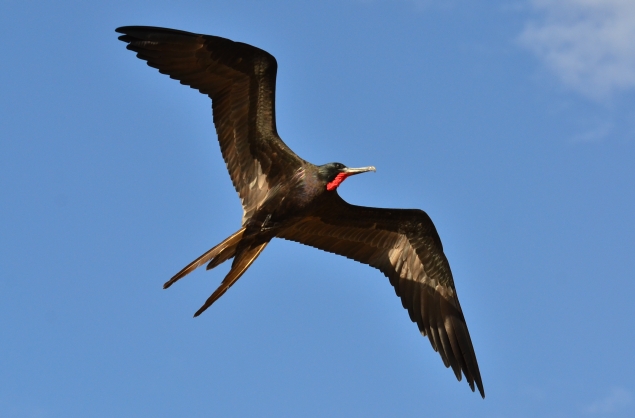
Frigatebirds are the best. They usually look like this; majestic, awe-inspring, and confident. However, it does not take much for them to turn into living nightmares.


If I showed this photograph to a nonbirder and told them these birds have been known to snatch babies from their cribs, they would probably believe me.


Ah yes, the last thing countless toddlers will ever see.

I struggle to come up with an apt description of this...perhaps an example of post-nuclear-fallout-avifauna.


Motmots aren't the only birds who can tick-tock their tails...which perhaps is a scary notion to some.

Laughing Gull, Mexicrushed.


We saw a handful of Herring Gulls at Punta Lobos, just south of Todos Santos, which seemed to have the best gull concentrations in the area. Larids gather there in the afternoon to eat discarded fish scraps from the panga fisherman; unfortunately I failed to pull out anything very remarkable; the best was the Laughing Gull (above) and a disturbing number of yellow/orange-legged Western Gulls. If you go there expecting Yellow-footed Gulls, I can only offer the old adage "caution is warranted".


If you are a white person and move to Baja, you end up looking something like this after a few years.


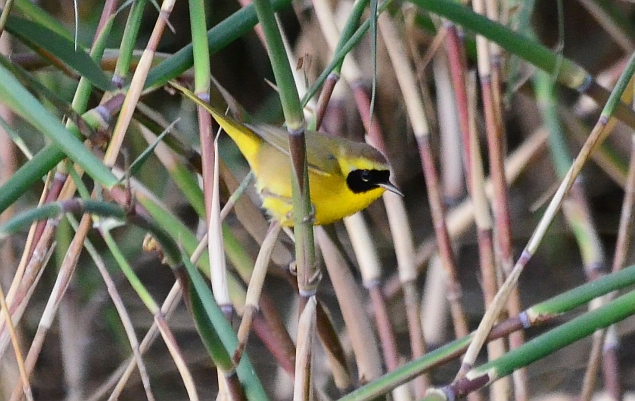
There are hordes of Belding's Yellowthroats at La Poza, the big pond on the beach in Todos Santos. It was nice to see so many, considering the tiny distribution this subspecies (beldingi) has.


Hella yellow underparts.


Here's a considerably duller-looking individual, but still with significant yellow coming up the side of the mask and onto the forehead. A younger male?


Females were surprisingly pretty easy to tell from Common Yellowthroat...surprising because I wasn't using a field guide and just thought I'd wing it. As with males, there is much yellow on the head, which frames a grayish auricular patch.


Scott's Orioles were greatly outnumbered by Hooded, but they were still easy to find. Every morning I could hear their soothing meadowlarky songs sung from our house.


There are birders out there who think it is completely unethical to photograph a bird on its nest...ever. Why? Because birds can't handle the stress and will abandon their nest, which is often true...but always is a considerable stretch of the imagination. Well, have a look at this disturbed, stress-ridden bird. It is the Hummingbird of Anxiety. What do you say to do this crush? The bird is pretty much life-sized in this picture. Is your blood boiling?


Look at her sleep. What a sleepy hummingbird. This Xantus's Hummingbird was nesting inside a restaurant in Pescadero where we had lunch one day, so I wasn't exactly worried about disturbing her. Maybe she likes the big fiestas and live music they have every weekend...the waitress said she nested there last year too.


Male Xantus's Hummingbirds are too cool to not stand next to and blow hundreds of photos on.


Young male Costa's Hummingbirds have some fresh facemelt growing into their faces, but only when the sun hits them right.


I could not identify this bird.