Showing posts with label western wood-pewee. Show all posts

Monday, November 11, 2019

It's Getting Late Early: November in The 5MR


This Common Merganser bellows a simple song: FIVE MILE RADIUS! FIVE MILE RADIUS! Photographed at Almaden Lake in San Jose.

And then it was November. Suddenly the heinous notion of the year 2020 is not such a far-fetched idea after all...it is a terrible reality, just waiting for us right around the corner, lurking in the shadows cast by the specter of what Hunter S. Thompson would surely call "this foul year of lord, 2019." By the time we realize it is here, it will be too late.

But Hunter has been dead since 2005, and from his point of view...maybe that was for the best. Here we are in golden weeks of 2019, an age when Hope is Dead and Idiocracy is Real. But one phenomenon swept over birders in 2019 that has changed many hearts and minds forever, and the world is not a worse place for it. No, it's not ID by democracy or identifying everything as a hybrid, it is the FIVE MILE RADIUS. It's high time BB&B checks in with my 5MR, which is running smoothly after a grinding start to the fall.


You may recall that I connected with an Eastern Kingbird in my YARD of all places back in June. July delivered a radial gift on a similar scale - a self-found Red-eyed Vireo, which I found by walking out my back gate out to the ponds behind my house. Red-eyed Vireo is a MEGA vague for Santa Clara County and the first I'd seen in California in many years, though they are more expected in coastal counties. Like the kingbird, it was a one day wonder and easily one of my top 5MR birds ever, let alone this year. Photographed at the Los Capitancillos Ponds.


But after a surprisingly productive summer, things really slowed when fall migration was supposed to get under way, at least on the year bird front. August had but a single new addition to the 5MR year list (Scaly-breasted Munia, ew), and September had only two, a Willow Flycatcher (clutch - they are very uncommon and come through for a brief window) and American Wigeon (a "gimme" I knew I would run into eventually). By the end of September, I was wondering if my radius would actually be fading in fall instead of lighting up. September was good for Vaux's Swifts at least, like this one at Los Gatos Creek County Park.


Incredibly (to me), on this day many swifts were foraging *on* several conifer trees - they would make contact or "land" briefly among the needles as they presumably gleaned insects. I have never seen a Vaux's Swift previously make contact with anything denser than air. Here you can see a swift entangled in the foliage, and yes, this is a Vaux's Swift-Anna's Hummingbird combo.


More gleaning swifts. There is also an eastern gray squirrel partially hidden in there, which I didn't see at the time. I love me some novel swift combos.


The fall rarity drought vanished as soon as the calendar changed to October. I successfully chased this spiffy Clay-colored Sparrow, which was also a county bird. Not only was it a county bird, it is the species that sparked the entire Lori Meyers fiasco from last year! Not the vaguest vanguard but a very nice rarity for the county. I would also go on to find two more Clay-colored Sparrows of my own last month, all in my 5MR! In the fall of 2018, Clay-coloreds went unrecorded in the county entirely. Photographed at Vasona Lake County Park.


This was the last Western Wood-Pewee I saw this year. Sadly, I likely will not be adding additional flycatchers in 2019, although I hold out hope for a vague runt Eastern Phoebe or something of that sort. I will most likely finish the year with a middling 9 flycatcher species, with Eastern Kingbird headlining that group and Western Kingbird and Olive-sided Flycatcher being new for the 5MR. I missed a locally rare Cassin's Kingbird last winter, and its likely Hammond's Flycatcher passed through undetected. Photographed at Vasona Lake.


One day, while sitting on the couch vacantly staring into my backyard, I saw a yellow-green bird appear next to the Rancho de Bastardos bird bath. I almost didn't look at it with binoculars, utterly convinced it would be yet another Lesser Goldfinch, but I am the Global Birder Ranking System's #7 U.S. birder, and one of the reasons you all look up to me is because I practice and preach DUE DILIGENCE. So I went ahead and hopelessly glassed the bird as it plopped down into the bath, and almost fell off the couch when I saw it was in fact a TENNESSEE WARBLER...which was not just a yard bird, not just a 5MR bird, but a county bird! And the only one seen in Santa Clara County in 2019. It was also the first warbler of any species to use the bird bath since April! I was, and still am, astounded. Don't you just love geri birding?


Minutes later, a Western Tanager dropped in. I had seen and heard them from the yard a number of times, but this was the first one *in* the yard. Quite the day of geri.


The yard has continued to produce good birds ever since baptized by the Tennessee Warbler. This Northern Pintail (left, Gadwall on the right) was not only a yard bird, it was a new radius bird! Cackling Goose, Greater White-fronted Goose, and Pine Siskin from the yard all were new recent 5MR year birds.


Ok, this is the last yard bird, I swear. Though I've seen one from the yard once before, a California Thrasher has been a totally unexpected addition to the yard flock, and it has been here daily for the last couple weeks. It's a nice bird to have in the 5MR, where they are fairly common at a few places, but it's a weird yard bird considering the less-than-marginal habitat in the area.


Seeing this normally retiring scythe billed friend casually hanging out with the sparrows, towhees and doves all the time has taken some getting used to. It seems to relish our wood chip situation, as it really flings those things with reckless abandon. It's not particularly wary. When in Rome, right?


I'm lucky to have a little bit of grassland at the edge of my radius. I recently hiked up here in a desperate bid to get a new radius bird (I had a few targets in mind) and was rewarded with a Prairie Falcon, my latest and greatest new 5MR bird. I got it only because I was doing a stationary count in a spot where a White-tailed Kite was sitting nearby - the falcon appeared out of nowhere and started tangling with the kite. This was part of the November 5MR Challenge, but of course you knew that. It was a steep hike so I didn't bring a camera (and I knew I would see something good if I left it at home) so here is a picture of the area from earlier this year when things were green - this is a good microcosm of my radius, awesome open space on one side colliding abruptly with urban sprawl.


Not new, not rare, and not photographed in my yard - I just like Red-breasted Sapsuckers and so do you. Glad they will be around again for the winter. Photographed at Vasona Lake.

I'll finish with 10 target birds I've got for the rest of the year, we'll see how it goes. Some are more likely than others, but all of these could be present...simultaneously...in my 5MR as you read this. A disturbing thought indeed.

American Bittern
Snow Goose
Ross's Goose
Greater Scaup
Western Gull
Mew Gull
Golden-crowned Kinglet
Varied Thrush
Swamp Sparrow
Evening Grosbeak

We'll see if I get many (any?) of these in about 7 weeks! My self-imposed 5MR bourbon challenge is still in play and I may find myself forced into buying whiskey any day now...my goal for the year in my 5MR is 185 and I'm so close I can taste it. Good luck to all you radius birders out there for the rest of 2019...you're gonna need it.

Monday, May 20, 2013

Back In The (Silver) Saddle


This is my FOY WEWP! Western Wood-Pewee is not often thought of as a beautiful bird...but now that you have seen my crush, I believe you think otherwise.

Ah, the desert. The desert means different things to different people. To average people, "the desert" screams boredom and dusty wastes. To climbers and hikers, the desert means adventure...dusty adrenaline mixed a unique flavor of peace and quiet. To birders, there are those who think of the desert birds...the thrashers, the sparrows, Verdins, Cactus Wrens and the like...and then there are those who think of migrants. California's deserts, from Death Valley to the Colorado River, offer excellent birding during migration, if you know where to look. Thousands of migrant songbirds pass through these areas and spring and fall, and where there is greenery, there will be birds. You show me a lawn and trees, and I will show you some goddamn vagrants....eventually. That's how this works.

Way back before I was the Number 7 birder in the nation, I used to go out to the Kern desert and scour the place for vagrants...I have many fond memories of Butterbredt Springs (Bay-breasted Warbler, Prairie Warbler, Hooded Warbler, etc.), California City (Golden-winged Warbler, Black-throated Blue Warblers, Gray Catbirds, Dickcissel, etc.) and Galileo Hill (Virginia's Warbler, Lark Bunting, Least Bittern, etc.). I lost track years ago of the number of lifers I stacked up out there as a young birder...but sadly, I have not been able to return to these sacred migrant traps since the good old days.


What's that? You want me to crush this helpless pewee even harder??? Cool, here you go.


Seriously guys, I think I'm almost beyond crushing here. I don't know if this bird can take being documented so well. And what's with the contrasting brown auricular patch? I don't understand it, but I like it.

When I accepted this job on Santa Cruz Island, one of the instant perks that I thought of was being within striking distance of the Kern County hotspots during spring migration. Aside from being rarity-magnets, these sites pull in so many birds that you actually get a sense that a major movement of songbirds is happening...nothing unusual for those on the eastern half of the continent, but for west coast birders this is a really big deal. And when you are deprived of such migratory goodness for much of the year...you crave it.

And so I waited until early May, when I made my triumphant return to Galileo Hill and Kern County. I swear, when getting out of the car at Galileo Hill, I felt like MacArthur coming back to the Phillippines. Although Galileo failed to provide any birds with eastern flavors, the numbers of migrants were unlike anything I'd seen in California in years. Today's succulent content covers a few of the birds and unnervingly realistic dinosaurs of Galileo Hill.


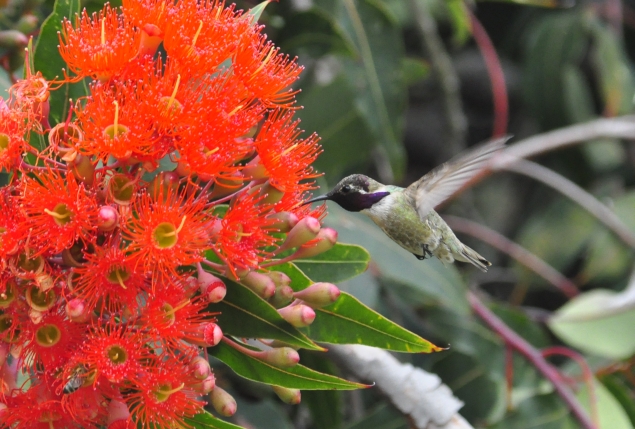
Male Costa's Hummingbird is one of the coolest SoCal birds, I reckon. The head of a male morphs into a blob of indescribable brilliance in just the right light, and they have a long, weird and whimsical song that makes them easy to identify by ear.


Female Costa's Hummingbird, on the other hand, is a pretty tough ID, especially for those of you who don't get to see this bird very often. Without a good look, they can easily be mistaken for a female Black-chinned. But surely you own a field guide, and the likes of Jon Dunn and David Sibley can break down the ID process better than I.


This is Midnight the cat, who apparently lives there. Midnight took an instant liking to us when we arrived...Bird Police Officer Searcy and I were, of course, super stoked when it started following us around while we birded, meowing loudly. Nothing attracts rare birds like a large, black, noisy cat. So we had to call in the local cat control.


Help came in the form of a random Jack Russell terrier, who didn't seem attached to any human. He is stationed there to keep Midnight away from birders, according to Officer Searcy. After watching the dog and the cat try to kill each other for several minutes, we took advantage of the distraction to sneak off and go birding without small predators in tow.


Catharus thrushes were plentiful this day. Many of the Hermit Thrushes we came across had very gray upperparts, very different than the individuals that winter across the state.


Perhaps this is auduboni, or a very similar subspecies. Nice to this flavor of Hermit Thrush again, at any rate.


Swainson's Thrushes typically outnumber Hermits considerably during the spring months at many migrant traps in eastern California. Although Hermit Thrushes can vary in the amount of contrast they show between the tail and the rest of their upperparts, Swainson's always sport the same colors from the top of their heads to the tips of their tails.

Galileo Hill, where all of these photos were taken, also goes by Silver Saddle Ranch. It is private property, and you must sign in at the office if you wish to bird there. If you do anything stupid to threaten the access birders get to this unique site, the entire California birding community will hunt you down and make your life a living hell. The Bird Police will sit idly by and watch as you are bludgeoned with binoculars, tripods, and unimaginably large lenses...they are a corrupt and vengeful bunch.


It's probably best that I don't explain this...be sure to show it to your kids before they go to bed though.

Sunday, September 23, 2012

The Death Of The Mystery Bird

In the age of the internets, birders can communicate and share photographs like never before, which along with digital photography has lead to a dramatic jump in the prevalence of "mystery birds" over the past several years. To label a bird as a mystery bird, of course, is simply just a way of saying you are unable to identify a particular bird. Nowadays, listservs, forums and facebook groups are awash in these things. I do like weighing in on these anonymous birds from time to time, despite the plethora of horrible photographs to wade through. The most infamous realm of the Mystery Bird is the ID-FRONTIERS listserv, which consists of birders willing to slit throats over such fascinating issues as the amount of expected wear on the lesser coverts of a molt-retarded 3rd-cycle Herring X Glaucous-winged Gull hybrid in July (that occurred out of normal range, but not in a completely questionable location)...which is all well and good of course, but I don't always have the stomach for such in-depth and brain-numbing semantics. That's more of The Great Ornithologist Felonious Jive's thing.

Since I am, as you know, our great nation's Number 7 birder, it's not difficult to weigh in on the mystery birds that surface here and there throughout the internets. It's fun to debate birds, and gives everyone a chance to learn something. BB&B is very pro-birducation of course, so I do my best to keep it real. I do admit to being wrong one (1) time of late, when an outranking birder whose name rhymes with "Benn Baufman" correctly nailed down a sparrow that I could not. All hail!

Over the past few years of checking out these Birds of Mystery, certain patterns begin to emerge that I think are representative of the challenges that birders throughout the U.S. and Canada often face. So, now, I give to you, The Final Guide to Identifying Mystery Birds. Chances are, if you've only been addicted to birds for a few years or less, the fuzzy, blurry, anonymous bird you have a picture of will be pictured or mentioned somewhere in this post. You are welcome.

The bird groups that people seem to struggle with the most are flycatchers, sparrows, buntings, warblers and shorebirds. Surely seabirds and gulls have surely crippled many a birder as well (I'm still working on my degree in International Storm-petrel Studies), but I can't argue with Pure Statistics.

And now...your mystery birds are revealed.


Is your mystery bird yellow? Is it a warbler? Good chance it's a Yellow Warbler. They don't look like this in fall, so don't expect them to. Des Lacs National Wildlife Refuge, ND.


See a weird sparrow? Well...is it a Song Sparrow? Song Sparrows are one of the champion sparrows for confusing people. Like Yellow Warblers, they are more variable than people think, with a staggering 24 subspecies in the U.S. That is more than any other North American bird! Amazingly, 11 of these breed in California, with 4 other subspecies occurring in winter. Point Reyes, CA.


Western Wood-Pewee. People are terrible at identifying flycatchers (I don't blame them), in particular both species of wood-pewee. Lack of eyering and long primaries make it easy though, and the dull wingbars help as well. Advanced birders struggle with vagrant pewees (a Western in Eastern Wood-Pewee range, and vice versa); for silent birds, I see no end in sight to this problem. Fort Rosecrans National Cemetery, San Diego, CA.


Willow Flycatchers are equally notorious for confusing birders, since they resemble both wood-pewees and Alder Flycatchers, and can also be confused for other Empidonax. Some birders are under the false impression that Willows never have eyerings (which they can, particularly in the east), which makes it even messier. But lets face it, this genus stems from its own special circle of Birder Hell. Port Hueneme, CA.


Common Terns seem to be the Most Mysterious Tern. Probably because they can turn up anywhere on the continent, and that they are frustratingly similar to Forster's, Arctic and Roseate Terns. Ormond Beach, Port Hueneme, CA.


Looking at people's "mystery shorebirds", Least Sandpiper wins the award for our Most Mysterious Sandpiper, despite the fact it is our only peep with yellow legs. Being tiny, their name is a good clue as well. Just the other day a local birder reported 4 Sharp-tailed Sandpipers at a marsh...can you guess what they were? San Diego River, San Diego, CA.


Tennessee Warbler. In spring they look like vireos, in fall they can still look like vireos, as well as a number of other warbler species. An understandably confusing bird for fledgling birders. Lostwood National Wildlife Refuge, ND.


Ruby-throated Hummingbird. Despite being practically the only "eastern" hummingbird, they somehow continue to confuse birders within their normal range. A great example is one in Maryland that was recently reported as a Magnificent Hummingbird. We know this to be the case because the photos show a Ruby-throated Hummingbird. Sadly, a number of birders attempted to chase this staggering rarity in vain. Chavarrillo, Veracruz, Mexico.


Savannah Sparrow ("Belding's" subspecies pictured). Savannah Sparrows are hard for people to come to terms with, but with a massive range and a number of different and probably incorrectly described subspecies, this is understandable. Streaky sparrow give you brain freeze? Think about these duders, whether in a coastal marsh or open grasslands...yellow lores are a giveaway. Imperial Beach, CA.


Chipping Sparrows. People recognize them in their summer duds, but not as a grotesque juvenile or basic-plumaged bird. Juvenile Spizella can be nightmarish to identify for many a birder, but Chipping is (arguably) the easiest to identify in this streaky state. Point Reyes, CA.


Common Yellowthroat, by my calculations, is the Most Common Mystery Bird Of All Time. Female, juvenile, and hatch year birds of both sexes get misidentified for all sorts of other warblers. And yes, despite the tens of thousands I have seen by now, I still don't have a good photo of one...how embarrassing! Tijuana River Valley, CA.

Are none of these species your mystery bird? Are you sure? Well, it seems that Magnolia Warbler, Indigo Bunting, Swainson's Thrush, Western and Baird's Sandpipers, juvenile Verdin and Brown-headed Cowbird all turn up frequently as mystery birds. You should consider them in your quest for The Final ID.

I should remind birders to use their field guides to their fullest...i.e. don't just look at the pictures, read the text and range maps. It's good stuff, I swear. That makes all of this a lot easier.

There you go. Case closed. No more mystery birds, ever again. Rejoice, and bask in wisdom and knowledge!

Tuesday, June 12, 2012

Blinded By Dacnis* And Deafened By Bellbirds


Black Phoebe, Guardian Flycatcher of Rory Jo.

Good news today birders...I have managed to cobble together a plan to compete with Bostick in our 2012 big year competition.. He is almost 40 species ahead of me at the moment, and having fallen behind so much I had only one choice to make...I bought a plane ticket to Costa Rica. Then, and only then, can I cram in enough species to attain ultimate glory. Our respective year lists are not bound by the arcane/prehistoric/arbitrary boundaries of the ABA Area, so anything is fair game. I won't be going until the day after Christmas, and the birding will be thick...considering I haven't birded south of Mexico's Veracruz State, this 3 week stint in Costa Rica will likely leave me without any semblance of a face, for it all will have melted off within 24 hours of touching down. The combinations of yellows, reds, greens and blues of the tropical birds I lay eyes will leave me featureless. Friends will no longer recognize me and, after learning the horrible truth, will compare me to that poor lady who had her face ripped off by a disgruntled chimpanzee. This is the price we pay for birding....or the one I will pay, at least.


I've had pretty poor luck with getting Cooper's Hawk pictures...this adult, for reasons we may never understand, couldn't care less that a couple birders were milling around under it.

Because I have been lucky enough to see a few tropical birds already, there is a slim chance that I will be able to withstand seeing the shimmering tanagers and glimmering hummingbirds (those are descriptions by the way, not actual bird species) without falling into cardiac arrest. However, I have great fear that if I get to see something like a Turquoise Cotinga, Snowcap, Agami Heron or (god forbid) a Resplendant Quetzal, my very existence will probably slip into another dimension entirely, much like what happened to Obi Wan Kenobi after his battle with Darth Vader.

Even if I do survive...I will return spiritually rich, but physically crippled. The Great Ornithologist Felonious Jive may have choice but to put me out of my misery...blinded by dacnis* and deafened by bellbirds, there will be no point in carrying on.

Of course, there is the horrible possibility that Bostick will learn of my plans and simply go everywhere I go. Could he be that sinister? I can imagine laying eyes on a small, wrenthrushian bird for the first time, and I hear "Zeledonia!!!!" in my head....except its NOT in my head, it is Bostick, and he is standing right behind me. That devious bastard! How could he?


Near the bizarrely unconcerned Cooper's Hawk was this bizarrely unconcerned Western Bluebird.


Maybe living in a cemetery makes you considerably less fearful of death and doom.

Aside from Bostick, TPAD Dan and the one who goes by "Stilt" are also planning on meeting me in Costa Rica....I look forward to slaying many a lifer (with my eyes) in their good company.

It is, I think, important to travel...we often cannot put value on things we have not experienced firsthand. Sure your personal carbon footprint gets a lot bigger when you fly, but ecotourism can save habitat, and if enough of us do it that can have all sorts of positive effects on human and avian communities alike. No, you are not saving the world when you go birdwatching...but sometimes it can help.

Until then, I will most likely be spending my time in California, for good or ill. All of today's birds are from Fort Rosecrans National Cemetery, an exceptional birding spot during migration, but just a creepy place to be loitering the rest of the year.

* = How do birders pluralize "Dacnis"? I really don't want to catch myself saying "3 Dacnii just flew into that strangler fig!".


Gravestones make excellent places to mark your territory.


Or to kind of weirdly float around.


Hermit Warbler. Yet another rad bird that I am stuck with mediocre photos of.


Calliope Hummingbird. When birders see one of these, their hearts beat fast enough to pace a hummingbird's. Consequently, most birders have severe heart problems afterward.


Western Wood-Pewee. Dapper.


Chipping Sparrow...this pose makes me think of Charley Harper for some reason. Sorry my captions today are lacking in wit and rambly screeds, but I got stung in the face by a bee and I'm too swollen to be creative. Sorry!

Wednesday, May 30, 2012

Diaspora Done


Costa's Hummingbirds make everything better. Fort Rosecrans National Cemetary, San Diego, CA.

As you know, migration is winding down, and its no longer easy to head out and get a bunch of year birds whenever you go birding. Here in SoCal its a great time of year for vagrants, but that too will soon pass. The Birder's Summer is about to set in.

As I do most springs, I've been working feverishly and have been unable to get to many destinations that get a lot of colorful migrants...once again, places like High Island, the Dry Tortugas and Magee Marsh will have to wait, and my life list remains without a Cerulean Warbler. There's always next year I guess.

Some California birders loathe March, June and July in general, although July can be decent for shorebirds and seabirds. I'm not sure how I'll cope this year. I suspect beer will help.


Western Wood-Pewees are still moving through California in late May, but it's more of a dribble than a stream. Fort Rosecrans.


Bostick has had a successful trip to Maine, and has a significant lead on me in our half-assed big year competition. That bastard. You know it's really hard to win a big year competition when part of your big year strategy is deliberately avoiding going way out of your way just for year birds. Sigh.

Right. Well here's some birds to look at, a mix of local summer residents and some of the more fleeting spring migrants. Time to buckle down for summer.


Hooded Oriole. Common in San Diego. Still great to look at. Fort Rosecrans.


This is an extremely familiar bird to a lot of you reading this, but it is not a bird to scoff at in California. This teenaged male Baltimore Oriole was one of the rarer birds I saw this month. Fort Rosecrans National Cemetary.


Behold the massive intellect of the Baltimore at work. It's prying open that Eucalyptus with its bill. Why?


To obtain a giant, extremely flat bug of course. When in doubt, pry.


Beginning birdwatchers who bitch about their impotence at sparrow identification have never laid eyes on a Black-chinned Sparrow, who are attired somewhere in between the exotic realms of Facemelt and the simple but chic Economy of Style. Kitchen Creek Road.


The first time I ever heard a Field Sparrow I was floored...they sound exactly like these guys.


Another black-faced bird with a chestnut back...but with the gray swapped for something more extravagant. Blue Grosbeak. Tijuana River Valley, CA.


Olive-sided Flycatcher. It was foraging for three beers. Stonewall Mine, Cuyamaca Rancho State Park.


I never realized how wide their bills are...surely an adaptation for efficiently consuming three beers. Stonewall Mine.


Looking at this makes me sleepy. White-winged Dove. Agua Caliente County Park, CA.


Calliope Hummingbirds were easy to see this year at Point Loma...maybe there is a god. Fort Rosecrans.


Another rare bird, but not something that fits in very well on a checklist. This is an Audubon's X Myrtle Yellow-rumped Warbler, full of hybrid vigor. Old Mission Dam, San Diego, CA.