Showing posts with label olympic gull. Show all posts

Tuesday, July 22, 2014

On Warranting Caution: Angles and Lighting


Birders have a lot of cliches. One you hear over and over again, in heated, sweaty-palmed and pained discussions on advanced bird ID (and occasionally, with regards to provenance) is "caution is warranted". What birder popularized this phrase? We may never know. One thing that is not uncertain is that it is good advice, albeit phrased in such a melodramatic and painfully nerdy manner that I wince when I try to say it.

An occasion in which a birder should not throw caution to the wind is when we don't get to see all we want of a bird, even when we think we do. Take the Black Tern above, for example. This is a pretty good look, right? It's almost a crush. But something is off...why does it have dark gray wing linings? It's not a shadow. What is wrong with it?! Call the bird police!


Oh, wait. That looks better. What happened?

What happened is angle. What happened is lighting. The effects even minute changes in angle and lighting can have on a bird's appearance is monumental. The above photo was taken less than a second after the top photo, and the tern looks like it changed wings in between frames. Sure it's hard to see birds when its dark, and obviously looking at backlit birds sucks, but I don't think birders fully appreciate how subtle changes in lighting and angle can fully transform a bird.

Cool. A quick glance at this photo may make a birder guess Caspian Tern. It's a good guess. That's a dark bill.


And here it is a second earlier. Obviously a Royal Tern. That bill is no-doubt-orange, not the slightest bit red.


Philadelphia Vireos are notorious. Notorious for being yellow. Not yellow like a Yellow-green Vireo, or a Yellow-throated Vireo...or a Thick-billed Vireo...but you know what I'm talking about. If you don't, you are probably unskilled at Philadelphia Vireo identification. Not that there is anything wrong with that...or so I'm told.

But I digress. Here is a vireo. Obviously a Philadelphia or Warbling. Yeah, the lores dark, but this thing is bland. Could it just be a funky Warbling? The head looks numbingly gray, the throat an unfathomable shade of drabness. Where is the yellow? Show me the yellow!


Oh. There it is. It obviously is saturated with yellow. That's funny. Do you see where I'm going with this? Not only am I trying to address problems of birding in the field, I'm talking about how misleading photos can be.


Of course, I can't talk about issues with lighting and bird ID without talking about gulls. Here is an ostensible Western Gull taking flight. Quite the dark mantle, eh? Looks pretty normal.


Oh. That looks pretty pale now....disturbingly so. Clearly not a pure Western Gull.


Oh wait. It's super dark. It looks like a Western Gull. What is going on? What is the real shade of its mantle? This is all the same bird, and the photos were all taken within ten seconds of each other. Questionable gulls (and even some unquestionable gulls) require a lot of study, and a large dose of caution. When you are trying to ID a gull based on someone else's photos of one (an increasingly common practice), I suggest even more caution. Huge amounts of it. You should be getting drunk on caution, because you didn't get to see all the angles and lighting on the bird in the field. This is one of the many reasons gulls suck and I hate looking at photos of "mystery gulls", addicting as they may be. And yes my nerds, the mild mottling on the nape is indicative of some Glaucous-wing ancestry.


Let us look at the gull in front (although you have the freedom to ponder the other one). It looks almost textbook for a Thayer's Gull. But why is the mantle so dark? Surely this is a dark-mantled species of some sort, or at least a hybrid of one, because look how pale the other bird's back is in comparison.


Here is the same bird. Why, it doesn't have a dark back at all. Suddenly, it becomes a pristine Thayer's Gull. The only difference is that the bird is turned a few degrees to the right, compared to the previous photo.


Despite the misleading bird-to-bird comparison I offered two photos above (that was more of a don't-ID-gulls-by-just-one-photo-sometimes kind of warning), comparing birds directly is the way to go. It can be gulls, it can be vireos, it can be various strolling Siberian ground-dwellers.


California birders still remember what happened last year...Savannah Sparrows were being misidentified time and time again as Red-throated Pipits. It was an outrage, a debacle of the highest order. GBRS ranks were in freefall all over the state. There was even a backlash counter-outrage to combat it, defending the rights of stringers everywhere. It was a sad state of affairs, and we may only be a few months away from history repeating itself. At any rate, when the two species are side by side, is it really that confusing? You can't even claim that they are both brown. The bird on the right almost looks like a fucking Prairie Warbler. This is a story of what happens when overenthusiastic birders don't bother comparing their bird of interest with what else is around...and when one Savannah Sparrow is around, there are more (that is a rule). Caution is hella warranted.

Remember my friends...angle and lighting make identification frightening. Take this to heart, and you will go far.

Thursday, February 28, 2013

Gull Worshippers: The Cult of Larophilia


Thayer's Gull, generally a west coast specialty, is a species many birders struggle with. Lake Merritt, Oakland, CA.

It all starts simply and innocently enough. When you are a nonbirder, they are all seagulls. Case closed. But as you fall deeper and deeper in love with birding, you realize there are many gull species. They are similar, but should be easy enough to tell apart, right? But after that overly optimistic assessment, other, more experienced birders inevitably correct the IDs you are attempting. Gulls are not what they seem. You eavesdrop on gull conversations that include unfamiliar words like webs, mirrors, gonydeal angles, bleaching, backcrosses. You look at photos of strange birds online that appear telling to some, but mean absolutely nothing to you. You might as well be trying to read Egyptian hieroglyphs. Suddenly, you have the horrible realization that gull identification is extremely messy and complex. You become daunted, weak in the knees...how will you ever master this perplexing group of birds?

From here, birders go one one of two ways. Either they become extremely intimidated by gulls and refuse to master identifying them, or they obsessively begin gobbling information about them and spend long, cold hours in the field staring at gull flocks intently (although rarely contentedly). The majority of birders go the former route, at least temporarily. There are a lot of other birds out there that need to be seen that are more interesting, more unique, more attractive, don't hybridize and at the very least can be identified by the sounds they make. The fact that many great gull-watching sites happen to be dumps and landfills is nott very appealing either.


In California's bay area, gull-watchers often convene at the sites where herring spawn, in mid to late winter. Spectacular concentrations of gulls that gather to feed on herring roe hold a few rarities more often than not. Photographed near Fort Baker, CA.


Even the smaller, "hooded" gulls regularly cause complications for people. Franklin's Gull (above) vs. Laughing Gull is a regular struggle for many birders. Photographed at Des Lacs National Wildlife Refuge, CA.

In fact, some birders find "gulling" to be such a difficult and unappealing activity that they fail to see the attraction of it at all. This post is for them. There are, in fact, a number of reasons to get into gull mode, for good or ill.

1) Rarities. There are a large number of gull species out there, they readily form mixed flocks, and they often migrate long distances. This means that they frequently turn up outside of their normal range and are highly prone to wandering...this includes everything from the diminutive Ross's Gull to the hulking Great Black-backed Gull. Birders love a rarity, and in the sometimes dull winter months (depending on where you live), if you want to find a rare bird, looking at gull flocks is a good idea. In fact, aside from a few species that occur across the continent (i.e. "American" Herring Gull, Ring-billed Gull, Bonaparte's Gull), the majority of gull species common in one part of the country are likely to occur as a vagrant somewhere else. Add species from other continents in to the mix (i.e. Kelp Gull, Black-tailed Gull, Yellow-legged Gull, Slaty-backed Gull), and the possibilities of what you can find are almost endless...provided you know an uncommon bird when you see one.


If you are one of the people who want to begin (correctly) putting names to the gulls they see, this is a good "starter gull" for you west coasters. Adult Mew Gull is a very easy bird to ID and doesn't readily hybridize...they are also cute. Golden Gate Park, San Francisco, CA.


Two "Olympic" Gulls (Glausous-winged X Western hybrids) and a Western Gull loiter next to a dump in San Leandro, CA. Olympic Gull is not only a common hybrid, its a common bird in general on the coast from central California north into British Columbia. A good "starter hybrid", I guess.

2) For birders who have been around for a long time, gulls often remain the most challenging group of birds to master. The amount to learn about their appearance, molt cycles, habits, variation and hybrids is practically limitless. If you love learning about bird identification, then dipping into gulls will keep you on your toes for the rest of your life.

3) The fact that large gulls are so prone to hybridizing raises a number of issues regarding taxonomy and species limits, which some find fascinating. Case in point is the Kumlien's Gull...the (almost) definitive gull book by Howell and Dunn treat it as its own species, but most high-ranking birders either consider it a subspecies of Iceland Gull or part of a massive hybrid swarm between Iceland Gull (glaucoides) and Thayer's Gull. The word on the street is that significant doubt has been cast on the study that proclaims Kumlien's to be a definitive species, but there has apparently been absolutely no followup on the genetic relationships of the Thayer's/Kumlien's/Iceland complex. Crazy shit, I'll leave it at that.


Speaking of funky taxonomy, this bird used to be lumped with Western Gull. Now you may think that all gulls are prone to vagrancy and grinding cloacas with different species...well, not this one! Yellow-footed Gulls are endemic to Mexico's Sea of Cortez, but wander in sizable numbers to California's Salton Sea. In the U.S., they have been recorded remarkably few times away from this lake, so if you want to see one in the ABA Area, there is only one place to go...more on the Salton Sea's special gulls in this post. Oh, they have never been documented hybridizing either.


Here in coastal California, young gulls can become exceptionally whitish by late winter. By summer, some young Herring Gulls that stay in the state essentially turn white, where they are inevitably misidentified as Glaucous Gulls. This eyecatching second-cycle Herring Gull is a very pale bird, no doubt colored in part by the California sun. Miller-Knox Regional Shoreline, Richmond, CA.

4) Prestige and Elitism. No explanation needed. If you know your gulls well, you will be worshipped as a birding Jedi. Become a gull warrior and you will start getting messages from gull wizards that youve never spoken to before, looking for your highly-valued gull opinions. Other birders will seek your consul and bombard you with gull pictures for you to identify. You will experience Raw Power like you have never felt before.

5) Variability. As mentioned above, there are so many factors that could cause a gull's appearance to be "abnormal" that it is really hard to get bored with gulls if you are trying to correctly age them and identify them to a species or particular hybrid combination. Put 100 gulls of the same age and species next to each other and you will be amazed at the differences between them...field guides don't get this point across, just time in the field.


This is what I call a first-cycle-late-winter-really-worn-and-or-bleached-bird-that-I-am-pretty-certain-is-a-Thayer's Gull-but-in-the-east-I-bet-they-would-call-it a Kumlien's Iceland Gull. I've seen a few of these birds in the bay area the last two winters. Photographed at Lake Merced, San Francisco, CA.


What the hell is this thing? I don't know. I can tell you some things it is definitely not, I can tell you some things it is probably not, and that is about it. I believe that's a Herring Gull (somewhere between 2nd and 3rd cycle) sitting behind it. San Leandro, CA.

6) Community. Top gullers are well known to other folks who are into gulling, and there are multiple gull-based listservs (and a pretty active Facebook group) out there so people can reach out for help and bounce prospective ID's off each other. Its nice because everyone is pretty open to learning and somewhat at the same level of ID skill. Having this network available is a great tool...and who doesn't like being part of a community? Aren't we all birders because normal communities shunned us anyway?

And that's it, straight from the source, one Seagull Steve. Hopefully you now have an understanding, and can sympathize with, the sickness they call Larophilia.


My favorite Larid! Red-legged Kittiwakes are one of the most lovable birds I've gotten to work with...if you have gotten to see this declining and charismatic seabird, consider yourself lucky. Buldir Island, Alaska.

Thursday, February 14, 2013

Some Recent Birds: Majestic, Mighty, Nemesis, Oiled, Typical, Snazzy, Grotesque, Crippling.


Not much new to report here at BB&B. Post-Costa Rica birding has been good, but has gotten a bit slow lately...even year birds are getting difficult. I do have my first job interview of the year next week, and so The Perpetual Weekend is now in jeopardy.

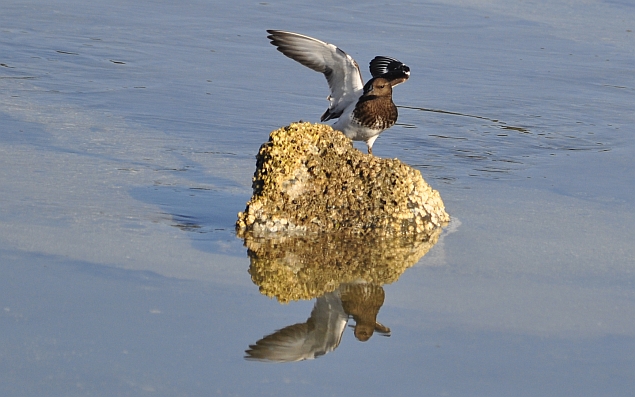
Here is a Black Turnstone that happened to land in front of me. They are common along the west coast, but this would be a definite MEGA in any of the other states...just a matter of time, I reckon. Photographed at Pillar Point Harbor, CA.


Behold its breathtaking wingspan.


Majestic, as always.


The Mighty Dunlin: Often seen, but rarely photographed....by me anyways. Coyote Point County Park, San Mateo, CA.


It's still gull season here on the California coast. Despite my efforts I have seen absolutely nothing interesting beyond a handful of freaks and unusual hybrids since locking on to my state nemesis Slaty-backed Gull (above, middlish) in Sausalito several weeks ago, where this was photographed. Other birds in this photo are Glaucous-winged X Western Gulls (aka "Olympic" Gulls), and a pure Western Gull (bottom left). Oh, if you disagree with any of my gull ID's, please provide cruel negative feedback.

The oiled bird is an adult Herring Gull; the bird in front is a pale-eyed Thayer's Gull. Herring and pale-eyed Thayer's can certainly be confused for one another...I think this photo shows the contrast in bill and head shape between the two pretty well. Pilarcitos Creek, Half Moon Bay, CA.


A pretty typical first cycle Glaucous-winged Gull with a bit more pink in the bill than normal, but that is not unusual in late winter. Sausalito, CA.


I don't think Eurasian Wigeon has graced BB&B many times, although I am lucky enough to see them pretty regularly. The drakes (left) are really snazzy looking ducks, and the hens (not pictured) provide a good ID challenge. Pier 94, San Francisco, CA.


Here is a grotesque Greater Scaup. I don't know how a duck goes about having a huge chunk of it's bill removed...that's gotta hurt. Lake Merritt, Oakland, CA.


Here is a non-grotesque Greater Scaup for comparison. Lake Merritt.


Harlequin Duck is in that small realm of birds that defy explanation, both in plumage and lifestyle. Someday I hope to have some photographs that do them justice, but at the moment all I have is stuff like this. This crippler is hanging out at Pier 94 with a female Surf Scoter.

Wednesday, October 26, 2011

A Revisit To The Economy Of Style

Black-footed Albatross. You can tell this haggard-looking adult has been spending a lot of time in Hawaii this year. San Francisco County, CA.

"I think that birders should not take themselves as seriously as they do." - Matt Brady

You hear that birders of the world? This statement has always played an important roll in BB&B's official policy, and we are glad that some people out there agree.

Some recent happenings:

- The Great Ornithologist Felonious Jive posted his monthly blog entry over at 10,000 Birds. Please go check out Selling Birds Short: A Heretical View Of Avian Intelligence.

- BB&B's first book review will be up soon.

- The next interview in our world famous/highly questionable Human Birdwatcher Project Series has been completed and will be up in the near future.


Long-billed Dowitchers, Marbled Godwits and Greater Yellowlegs. Arcata Marsh, CA.

Today's photos are all a tribute to The Economy of Style that many of California's birds employ. This phrase, brought into the BB&B lexicon by one "Cassin", is a commentary on the color schemes of many ocean-going birds, and some of their land-based bretheren as well. Check out An Economy of Style for some vintage BB&B goodness....that was way back before I had an SLR!

Lastly, I saw The Big Year yesterday. My review is this: if you are a birder, you have to go see it. It (unintentionally) has some pretty funny parts, and they don't slaughter what birding is all about. The bird blogger and Angelica Huston are hilarious, particularly if you've been on one of Debi Shearwater's trips. If you are not a birder, and are one of my friends who has asked me at one point, "Why birds? I don't get it.", then hopefully it will shed some light on what exactly is going on here.

Not a great movie, but it could have been a lot worse....


Parasitic Jaeger. San Francisco County, CA.


Olympic Gull attempting to choke down a starfish. King Salmon, CA.


I don't think I've ever posted a House Finch on BB&B before...cant forget those ubercommon birds. Near Novato, CA.


Great Egret, filtered through some manmade weirdness. Petaluma, CA.


Common Murres. San Mateo County, CA.