Showing posts with label Wilson's Plover. Show all posts

Thursday, July 5, 2018

Bolivar Flats and Anahuac: Friends, Fevers and Feelings


Back to Texas! Let's start with the legendary Bolivar Flats. Our wonderful group went on a couple different days; it was quite good one day and more on the meh side on another day, but it was easy to see why it's such a heavily-birded spot. The first time out we had good looks at this Glaucous Gull, which was lingering late into the spring. This is the southernmost Glaucous that I have ever seen, which also gave better looks than what I'm used to.


I expected a lot of great birds on this trip, but hulking arctic gulls were not among them. You just never know what will turn up when MAX REBO BIRDING TOURS is in the field! Speaking of unexpected hulking arctic birds, we just missed a Pomarine Jaeger by a few days that had been hanging out at Rollover Pass. I've never even seen a Pomarine Jaeger sitting on solid ground before, and I've seen a lot of them. The Vague Runt potential of the Bolivar Peninsula is not to be taken lightly.


Glaucous Gull bills look almost tubular to me sometimes, due to the depth and relative lack of a gonydeal angle on many individuals like this one. We also had Great and Lesser Black-backed Gulls here on this day...three quality gulls, especially for late spring, all of which were Sierra Bravos for me. Over 300 in Texas now, mmmm.


This Machine Nate and Officer Shaw courageously plow through distant flocks.


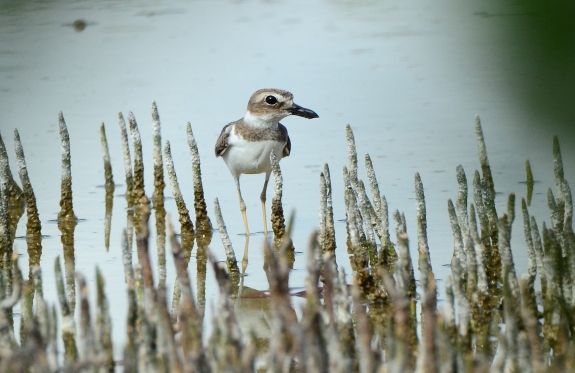
California has a lot of great birds, but Wilson's Plover is not among them. Birders who dwell within the range of Wilson's Plovers should consider themselves lucky. Be sure to stop and smell the Wilson's Plovers next time you are around them, I bet they smell good.


It's hard not to think of Wilson's as a heavily enhanced Snowy Plover. What invertebrate could withstand the bludgeoning bill and furious charge of a Wilson's Plover? Snowies, while similar, appear to woo their prey into submission by being cute.

We never could find any actual Snowies. Our trip list suffered for it, but we soldiered on.


Black-bellied Plovers were in abundance, as expected, and were looking mighty fine and crispy. At another site, we saw some get strung as American Golden-Plovers...which isn't a digression of the Summer Tanager-Blackburnian Warbler class, but very typical all the same. One past trip report I read from the area (probably at the same site where this misidentification went down) showed photos of an obvious American Golden-Plover, with the author discussing how it was an Upland Sandpiper and how he convinced his whole dubious group of the identification.

Geri, how do you do it? The blunders never cease.


Continuing with the plover theme, Piping Plovers are very lovable and easy to find at Bolivar. I wish I could have spent some more time with them, as they are worth all the time in the world. Speaking of time being a Piping Plover (as opposed to a flat circle), this species has grown into a major blocker in California...I think we are due for another.


One of the great perks of birding the UTC (and the thing that mostly makes the birding so great in the first place) is seeing migrants drop straight in from who-knows-where, like these Wilson's Phalaropes did. Yankee bravos! Oh by the way, you can potentially get ticketed for parking here without a beach pass, which you can apparently get from many local businesses. We just missed getting busted by a couple minutes one day.


Dan found a sand friend (sand-friend), and leaned in to hear what he had to say. His sandy compatriot whispered, "Your work here is finished, my friend. Go out to the command ship and await my orders."


Not as famous as Bolivar Flats but birded just as hard (since it is conveniently halfway between High Island and Bolivar) is Rollover Pass. We didn't see anything too juicy here but there was an enormous tern flock (mostly Commons) here one day.


Back to Anahuac! Yes, I will stoop to taking Cattle Egret photos. Disgusting, I know. What won't I do? Well, you don't get to be #7 by being classy. I will say that I won't chase unambiguous escaped birds though...some things are just wrong. Mandarin Ducks come to mind...seems like quite a few have turned into chase targets in recent years, which defies logic. The only Mandarin Duck I've seen was by accident, and I feel shame in even mentioning it.


Least Bittern in a classic pose. This is much better than a Mandarin Duck. I'm amazed this photo came out, I was pretty much shooting into the sun. Bless you Least Bittern, mysterious wraith of the reeds. Bless you Nikon, god of cameras.


Piles of Purple Gallinules await you on the Shoveler Pond Loop, where they are acclimated to cars and aren't shy. Check out the length of that gallinule talon!


Common Nighthawks were indeed common on multiple days. We didn't have the luck to blunder in to any Eastern Whip-poor-wills anywhere, but incredibly had a day-flying Chuck-will's-widow cruise high over Officer Shaw's Sugar Land yard right before yours truly had to drag himself to the airport. Classic April Magic in Texas.


Dipper Dan and I specifically went down into the bowels of the refuge in search of Seaside Sparrow, which I've only seen a few of and Dan had not seen at all. Finding them was an easy task...there were dozens of them out in Yellow Rail Prairie, singing and displaying everywhere. Seaside Sparrows galore! We were chuffed. Despite our Great Success with seeing copious amounts of Seaside Sparrows, we never did connect with any Nelson's here or anywhere else.


On the way back in from Trinity Bay and the Seaside Sparrows, we stopped at the one and only little woodlot next to the road before the Shoveler Pond turnoff. It was hella birdy! And there was a drip! In eBird this is called the Jackson Prairie Woodlot - I had never heard of it before but it was quite birdy, and I recommend it highly. We saw very few Blackpoll Warblers that week, this is the only one I got deec photos of.


While we had to put some work in daily to find Blackpolls, the other monochrome warbler migrating through the area was abundant day in and day out. Yes, you are in for a treat...I am talking about the Black-and-white Warbler.


On one emotional, tear-filled night, a choked up Dipper Dan confessed to me how much Black-and-white Warblers mean to him. Luckily for Dan, we saw them pretty much constantly. He had Black-and-white Fever, flogging the migrant patches for maximum Black-and-white yield.

Who am I to argue with these warblers, these feelings, these interesting approaches? Not even #7 has jurisdiction over such things.


Speaking of fevers and waking dreams...at one point my head became light...my tongue swelled up, and a salty liquid discharged from my eyes. What had gone wrong? Was this the end of Seagull Steve? It almost was. You see, Bay-breasted Warblers also occupied the woodlot, and this bird was suddenly gleaning about unnervingly close to me, closer than I've ever been before. The crippling effects of this species are not well-publicized compared to other warbler species, but I assure you they are very real and very serious. I thought this was a close call, but it was nothing compared to what I was about to experience at Sabine Woods...more on Sabine in the next installment.


Yet another Philadelphia Vireo that loves to forage in close proximity to people. This is the people's vireo, the vireo of the commons. Philadelphia Vireos are for all to enjoy. For a bird that is misidentified so much, they sure are considerate about trying to make sure everyone gets to see them well.

Wednesday, December 28, 2016

Puerto Rico Winter Tour Y2K16: Comerio to Guanica


Our time in Ceiba was done, so the nerds got up early for making the Kessel Run trip to get the final east side target bird, none other than the rare, legendary and highly-localized endemic subspecies of Plain Pigeon. This is not a bird you will blunder into while birding in Puerto Rico; you definitely need to make a targeted effort to see them. Google Maps was highly ineffective in getting us to the right spot (again, beware the app's suggestions for shortcuts in Puerto Rico), but eventually we made it. It was a weird place...basically, you look for the birds from a baseball field. Lifer situation.

Adam and I immediately had a Plain Pigeon fly directly overhead when we arrived, basically looking down the first base line, though better views were definitely desired. Looking at the trees beyond the outfield was unproductive after the initial flyover, so I turned the scope around and started scanning the hillside beyond home plate....BINGO. We had distant but prolonged looks at two Plain Pigeons feeding in the blooming African tulip trees (local photogs call them tulipans)...fuck yes. A scope was essential here, so if you plan on seeing Plain Pigeon in any satisfactory way, do bring a scope or you run the risk of stringing a Scaly-naped Pigeon. We ran into some local bird photogs who were about to head up a road to the general area where we had seen the birds, so if you want to try and get closer to the birds you can walk up the small road at 18.222429°, -66.201390°.


Ground Zero in the valley of the Plain Pigeon.


Gray Kingbirds seem to run things in any remotely open habitat on the island.


The most conspicuous reptiles of Puerto Rico are the introduced green igaunas. They are everywhere. Any loud, crazy thrashing sounds you hear coming from shrubbery, plopping into ponds or falling out of trees are iguanas.

After the pigeon victory we headed down to the south coast, hoping to check out some random spots between Jobos and Guanica, where we sould be spending the night. This stretch of the island is seemingly unbirded by anyone who doesn't live in Puerto Rico, as this large area is completely absent from any trip reports I've found. Dipper Dan worked on trying to find some places to bird switching between eBird and Google Maps with mixed success...we managed to get to 2/4 spots we attempted to bird. Again, Google Maps on the island is not your best friend, but it's not worthless either.

Playita-Vertedero Salinas was a totally random spot Dan found on eBird that was not hard to access (17.955920, -66.286848). Just drive down the dirt road and park in the obvious dirt parking area next to the lagoon; scope the lagoon and bird further on down the road. The lagoon and salt flats were not overly birdy but did net us a number of trip birds (most notably the one and only Gull-billed Tern of the trip), and the mangroves along the road held Black-faced Grassquits (common and widespread on the island) and a smattering of warblers.


By far the best bird here (for me anyways) was this cooperative Green-throated Carib, which we got much better looks at than back at Humacao. Caribs appear to have their eyes set further back in their heads than other hummingbirds, which gives them a unique facial expression.


The deep blue belly contrasting with the emerald throat is a nice touch. This would be the last carib we would see on our trip, and we never saw Antillean Crested away from Humacao and the Fajardo Inn.


Palm Warbler was a new trip bird; we finally got our first Yellow Warblers of the trip here as well. The local Yellow Warbler subspecies turned out to be much more uncommon than we thought they would be.

Dipper Dan worked furiously on eBird, trying to figure out how to access other hotspots...attempts to access a couple bird areas east of here were met with abject failure (thanks Google Maps), but we did successfully reach Laguna Salinas (yes, another Salinas) after an awesome lunch at the Oasis Cafe and Bakery in Santa Isabel. Their coffee was unlike anything I've ever had...hot damn!

Accessing this site is interesting...you have to get on an eastbound onramp to Hwy 2 and then make a sharp right turn onto a dirt road directly off the highway. The dropoff between the highway and the road is pretty big, so I'm not sure how well this would work with a sedan (we had a jeep, so it was mellow). At any rate, the turnoff to the laguna is at 17.974407, -66.673697. The birding here was decent (in other words, more trip birds), with close looks at a Clapper Rail being one of the highlights. Lifer subspecies!


I hadn't seen Wilson's Plover since I was working in Texas a couple years ago...this bird was standing in the middle of the road, a niche typically occupied by Killdeer. Lifer situation. I had forgotten what a massive bill is attached to that cute little plover face.

At the end of the day we finally pulled in to our Airbnb, a few minutes southeast of Guanica. As we had hoped, the area had some decent birding to offer...a big semi-birdy (genuinely birdy places are apparently rare in Puerto Rico) lagoon was right next to our place. Venezuelan Troupial was a facemelting but reluctant lifer (they are an introduced species), and were very common here. This would be home base for the next four nights. One of the beds smelled like piss and the tap water was burly (not the owner's fault obvi, but tap water in other parts of the island was excellent), but otherwise it worked out really well. Lots of great birding within an hour's drive!


The view from the balcony, a mellow mangrove-lined lagoon with the famous Guanica Dry Forest cloaking the hills in the background. Tranquilo, though the mosquitoes got annoying. This was one of the best views of any Airbnb I've ever stayed at, though I still think "The Edge" in Lubec, Maine, still has...an edge.


These amazing/terrifying lobster-tailed things were crawling all over the place. You never know what is waiting in the bushes of love.


The lagoon was filled with Lesser Yellowlegs and Stilt Sandpipers; more than 400 Stilt Sandpipers could be seen roosting from our balcony every day, which is hella to a California birder. The only place we can see that (well, maybe not anymore 😓) is down at the Salton Sea.


White-cheeked Pintails were the commonest ducks here, which were always visible in some numbers. Fantastic. I no longer need to feel the pain of a stinging gripoff whenever one is seen in Florida.

The next day we would bird a lifer habitat in the Guanica Dry Forest, which was very kind to us. Spoiler alert: lifers.

Monday, August 4, 2014

More From The Valley: Aquatic Texans


No megas to report on today, although I did miss being on a Hawaiian Petrel boat on Saturday. It hurts, I won't lie. The only Pterodroma I've seen in California was a Murphy's Petrel, and it was so bloody far by the time I got glass on it that I couldn't make out any field marks to speak of (thus I do not count it, for I am an honorable birder). But before BB&B goes into full fall seabird mode, here is some more terrestrial spring coverage from Texas instead. After all, Texas is notorious for it's awful pelagic trips...not that anyone can blame the birders who organize and lead those trips, but let's face it; the Gulf is a desolate place compared to waters off California or North Carolina.

Right. Sorry Texans. Despite being impressively unadorned, semi-aquatic Northern Waterthrushes are quite variable in appearance. This is a "yellower" bird with legs on the pink end of the spectrum. South Padre Island, TX.


And here is a "white" individual, with duller legs. This isn't an uncommon variation, despite what some field guides and a lot of birders will tell you. It even appears to have some color on the flanks, LOWA style. Note how heavy the streaking on the breast is compared to LOWA. South Padre Island, TX.


It took me a long time to see a White-rumped Sanpiper...I had seen a grand total of 3 before this year. Thankfully they are a plentiful spring migrant in south Texas, and I even got side-by-side comparisons with Baird's Sandpiper. Pretty sick. Near Boca Chica Beach, TX.


This bird isn't quite as far into it's alternate plumage. Seeing a fish-eating Calidrid is not an everyday occurrence.


Long wings. White rump. Classic.


Hey, it's a Wilson's Plover. Did you know there is a Collared Plover in south Texas right now? It's the second U.S. record. Dan Jones found it, who you may know from the Global Birder Ranking System's Lower Rio Grande Valley Honor Roll. I called up the GBRS statisticians to do some math for me, and it turns out that on average 0.91 Collared Plovers actually occur in Texas every year. Why are they not found? Two reasons...the large amount of shorebird habitat available, and the impressive number of low-ranking birders in the area (mostly visiting birders) who misidentify COPL for other species. A lethal combination, if ever there was one. Near Boca Chica Beach, TX.


Fulvous Whistling-Ducks...birds I have not seen since the 90's. We had quite the reunion. Bummer that these birds are essentially gone from California now. Lake Harlingen, TX.


Fulvous are dwarfed by their more abundant black-bellied counterpart. On one of my last days on my Texas work site, there were hundreds of Fulvous Whistling-Ducks flying around (Willacy County). It was a vexing experience, to be sure. Other spots I turned up FUWD were at Estero Llano Grande and South Padre Island.


Least Bittern. I've had better looks at these skulky bastards, but never with sherbert lores! What a delicious flavor of facemelt. Estero Llano Grande WBC, TX.


The bittern unleashes a deafening bellow in the direction of some prey. Within seconds, a 7-foot alligator went belly up in the pond. Adult alligators are the preferred prey for Least Bitterns...it is known.


Lesser Yellowlegs are quite stylish a few months of the year. South Padre Island, TX.


Graduating the yellowlegs course is an important first step for beginning birders. Overcome this hurtle (Greater vs. Lesser vs. Solitary Sandpiper), and you will find yourself skyrocketing up the GBRS ladder...until you have to take the dowitcher test, that is.


Not only is the south blessed with winning wading bird diversity, the birds themselves are far more tolerant of humans. Here is a fearless Green Heron. South Padre Island, TX.


Maybe the next sushi craze will be consuming fish in this manner (swallowed whole, head first, in the ancient tradition of the Ardeidae).


I'm still looking for a Reddish Egret crush. I should have just crawled out there on my belly like the nerds below, but I was too busy birding and not wanting to wallow in mud. South Padre Island, TX.


Stately, but frantic when it comes to feeding. I wonder what a Reddish Egret would do if prescribed Ritalin. My hypothesis? Starve to death.


The challenges of dowitcher identification seem never-ending. This Short-billed Dowitcher, which actually has a short bill, is probably a male. A few things to note on this bird are the spotting on the sides, steep forehead and gentle (yet noticeable) decurve of the mandible. South Padre Island, TX.


Another Short-billed. Take a look at this comprehensive article on dowitcher ID, you might learn a thing or two.


Like Fulvous Whistling-Duck, Least Grebe is one of the birds that brings in birders from all corners of the country. They're not much to look at compared to some of the valley specialties, but if that doesn't put you off you can get a hell of a look at Sabal Palm Sanctuary (where this bird was photographed).


Hard to get better looks than this.


I failed to photograph Speckled Racer on this day, so this Rio Grande Leopard Frog (I think) will have to do. Sabal Palm Sanctuary, TX.


Look at these nerds crawling around in the mud. I feel bad for the girl they dragged along, through the mud, who has to carry their shit. Crazy photogs.